Masses of scalloped hammerheads have returned to one of Australia’s busiest beaches. But we don’t need to panic
- Written by: Olaf Meynecke, Research Fellow in Marine Science and Manager Whales & Climate Program, Griffith University
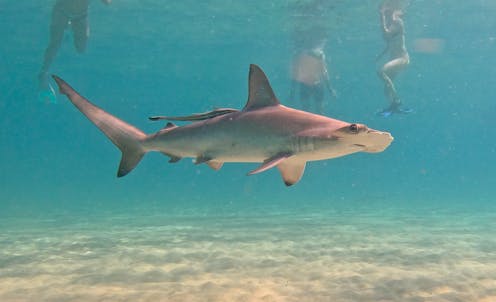
For the second year in a row, over 100 hammerheads have gathered at one of Australia’s busiest beaches, Burleigh Beach in the Gold Coast.
Why aren’t we alarmed? Because these are small scalloped hammerheads, not the larger great hammerhead. Even this species is feared far more than it deserves[1]. Plus, these scalloped hammerheads are juveniles between 40 cm and 1 metre.
Scalloped hammerheads prefer tropical and temperate oceans. But as the oceans heat up, they’re moving further south – just as we’re seeing in Western Australia, where these timid sharks are now gathering[2] off Perth.
These remarkable sharks are one of the few social sharks, gathering in large numbers as juveniles and adults. But this behaviour makes them easy to catch and kill for their fins or meat. Their numbers have fallen by over 80% over the last five decades. It’s urgent we find ways to protect them wherever they school.
Up to 100 scalloped hammerheads have gathered off the popular Gold Coast swimming and surfing beach, Burleigh Beach, in April 2024. Credit Roving MediaWhy are they here?
Schooling behaviour is about safety in numbers. This behaviour – known in sharks as “shivering” – can also help them hunt prey. Sharks of similar age tend to migrate and form a shiver together.
For young sharks, the open ocean has many dangers with very few places to hide from larger sharks. Young scalloped hammerheads seek sheltered, warm waters with abundant small prey, where they can grow fast.
Last year, young scalloped hammerheads spent several weeks at the end of the summer at Burleigh Beach on the southern Gold Coast.
Why this location? This year’s gathering of even more sharks at the same location and time as last year coincides with warm water temperatures of 26°C. This, combined with the sheltered waters behind the sand bar and an abundance of small prey, means Burleigh might hit the sweet spot.
High rainfall in recent months has brought more nutrient-laden runoff into the ocean, boosting prey species such as small fish, squid and crustaceans.
Where the young sharks migrate after this is still being studied. But during the cooler months we do see young scalloped hammerheads skimming the sea surface further offshore. As adults, they can swim vast distances, reaching as far as Papua New Guinea or Pacific island nations.
We have seen a similar shiver of scalloped hammerheads in the Shoalwater Island Marine Park off the coast from Perth’s southernmost suburbs. Here, young hammerheads have gathered[3] since 2011.
These sharks are bigger in size than those on the Gold Coast, though still considered immature. The Perth aggregation happens during summer and takes place a few hundred kilometres further south than the Gold Coast. In fact, it’s the most southerly known[4] aggregation in Australia.
On the east coast of Australia, this species has been sighted as far south as Sydney with a remarkable sighting[5] of about 15 sharks last year in January. We don’t yet know if they are reliably gathering here.
Read more: Critically endangered scalloped hammerheads gather in seas off Perth. They need protection[6]
Fear and wonder
We’re primed to associate the word “shark” with danger. But of the world’s 500 plus shark species, there are only a handful which pose any kind of threat.
Still, when sharks appear close to shore near popular beaches, safety concerns spike.
It’s important to stress that this gathering of young sharks poses no threat to people. In fact, it’s the opposite. Hundreds of people have swum out to see them where they gather, drawn by social media posts and news coverage. Unfortunately, sharks have been chased and are unable to keep swimming close together for their safety.
While it’s encouraging to see so many people interested, it also points to the need to show our interest respectfully. We don’t want to exhaust or scare off these young sharks.

Hunted for flesh and fin
The world’s authority on threatened species lists the scalloped hammerhead as critically endangered[7]. This means in the last 70 years, scalloped hammerhead numbers have fallen globally by at least 50% of its pre-1950 abundance globally. It’s sought for its high-value fins and meat.
Despite this, scalloped hammerheads can still be legally caught in Australia by both commercial and recreational fishers. They often also suffocate in shark nets such as those at Burleigh Beach.
Shark nets are at least partly responsible for the decline[8] in scalloped hammerhead and other shark populations. Queensland, New South Wales and Western Australia have maintained their shark nets despite the lack of evidence[9] that they make swimmers safer.
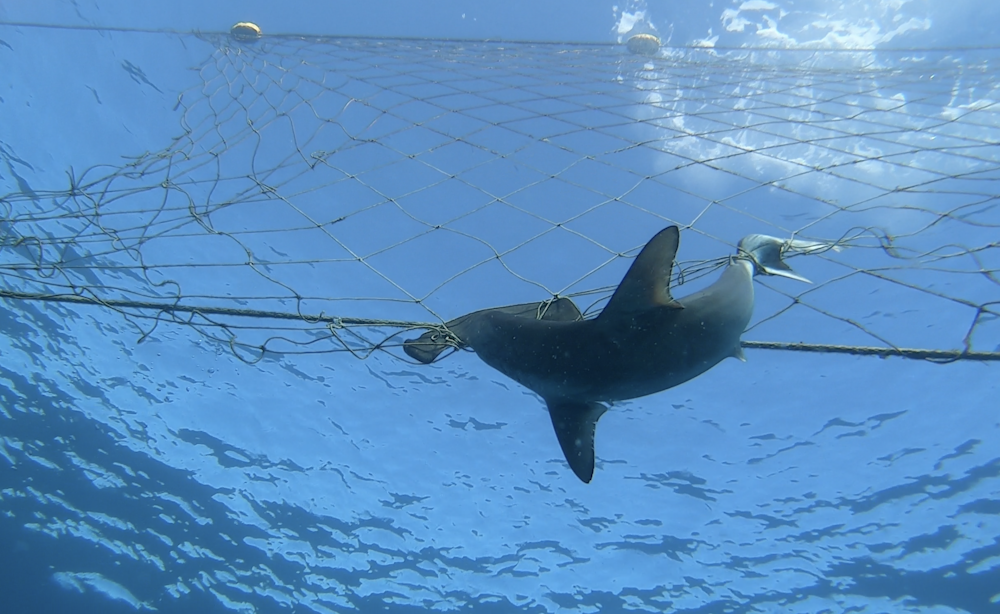 Shark nets regularly kill hammerheads. This image shows a dead hammerhead in a net off the Gold Coast.
Olaf Meynecke, CC BY-NC-ND[10]
Shark nets regularly kill hammerheads. This image shows a dead hammerhead in a net off the Gold Coast.
Olaf Meynecke, CC BY-NC-ND[10]
There are signs of positive change. From January 1 this year, taking and possessing of any hammerhead sharks became illegal for commercial and recreational fishers in Queensland.
But Northern Territory fishing boats can take up to 50 tonnes of each hammerhead species[11] every year, while Western Australia has no limits at all.
What’s next for the scalloped hammerhead?
In February, Australia’s threatened species committee advised[12] environment minister Tanya Plibersek to leave the species’ conservation status as “conservation dependent” rather than “endangered”.
As a result, the species can still be fished without recovery plans in place.
This is disappointing, as the committee’s advice overlooks the lack of conservation management since the species was last assessed in 2018 and ignores the lack of evidence of any recovery.
The fact this shark is now appearing in more southern waters suggests a climate link as well. Other shark species have headed southward[13] as the oceans heat up. Young scalloped hammerheads may well be doing the same.
Given their plight, we should look to safeguarding aggregation areas wherever possible.
Read more: Marine species are being pushed towards the poles. From dugong to octopuses, here are 8 marine species you might spot in new places[14]
References
- ^ than it deserves (www.newsweek.com)
- ^ now gathering (theconversation.com)
- ^ have gathered (theconversation.com)
- ^ most southerly known (onlinelibrary.wiley.com)
- ^ remarkable sighting (www.9news.com.au)
- ^ Critically endangered scalloped hammerheads gather in seas off Perth. They need protection (theconversation.com)
- ^ critically endangered (www.iucnredlist.org)
- ^ responsible for the decline (theconversation.com)
- ^ lack of evidence (theconversation.com)
- ^ CC BY-NC-ND (creativecommons.org)
- ^ each hammerhead species (www.environment.gov.au)
- ^ advised (www.environment.gov.au)
- ^ headed southward (www.forbes.com)
- ^ Marine species are being pushed towards the poles. From dugong to octopuses, here are 8 marine species you might spot in new places (theconversation.com)