Will you be this year’s ‘April fish’? Businesses have a long history of using April Fools’ Day to try and prank us all
- Written by: Gary Mortimer, Professor of Marketing and Consumer Behaviour, Queensland University of Technology
This morning, breakfast television shows will be reporting obscure, although mildly believable, announcements from organisations and brands about new products, services or discoveries. Social media platforms will also be awash with similar claims.
Then customarily, at the strike of midday, these organisations “come clean”, explaining the alleged new product, service or discovery was nothing more than a simple April Fools joke.
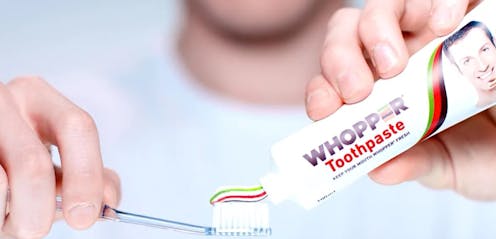
Perhaps you recall Burger King’s “Chocolate Whopper”, McDonalds “Sweet ‘N Sour sundae[1]” or the end of Oporto’s famous Bondi Burger[2]. In 2022, Subway’s April Fools “subdog[3]” even became a reality, when the prank ignited genuine demand.
So why do brands love jumping on the April Fools bandwagon?
A long history
While the origins of April Fools’ Day remain a mystery[4], there are some theories.
Some suggest April Fools’ Day can be traced back to classical Roman times[5], quite possibly an equinox celebration, recognising the end of the European winter and the coming of spring. Similarly to the Roman festival of Hilaria[6], celebrated in late March and marked with fun, gaiety and the wearing of disguises.
An alternative theory offers April Fools’ Day originated in 16th century France, at a time when the beginning of the New Year was observed on April 1, before the introduction of the Gregorian Calendar[7].
In France, the first reference to “poisson d’avril[8]” (“April fish” – the name for a person tricked on April Fools’ Day) appeared in poem by Eloy D’Amerval in 1508.
In 1686, English antiquarian John Aubrey first mentioned “Fooles Holy Day[9]”, observed on April 1.
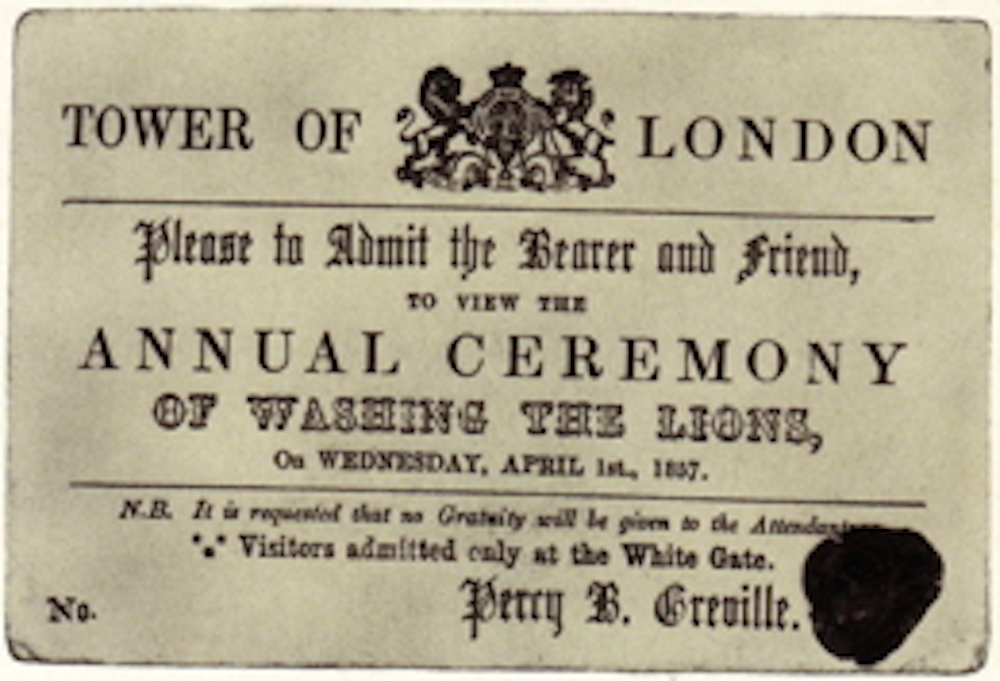
Possibly the earliest April Fools advert appeared in Britain on April 1 1698, inviting gullible people to bring a friend to the Tower of London to “see the washing of the Lions[10]”.
Organisations began to truly leverage the day from the 1950s.
In 1955, Popular Electronics[12] magazine ran an article about “contra-polar energy[13]”. The hoax article claimed the government had lifted restrictions on secret second world war electronics developments, which enabled the magazine to finally report on a new “negative energy” innovation that would cause electrical devices to produce the opposite effect of what they normally would do. For instance, a table lamp that generates “darkness” rather than “light”, or an electric hotplate that freezes water, rather than boils it.
Most famously, the BBC current affairs programme Panorama reported on a “spaghetti tree[14]” on April Fools’ Day 1957. The man largely responsible for the hoax was Austrian-born Panorama cameraman Charles de Jaeger[15], who liked to play practical jokes.
The segment showed farmers apparently picking spaghetti from trees[16] and laying the strands out to dry. BBC reporter Richard Dimbleby was in on the joke and his authority lent credence to the ruse – reportedly[17], hundreds called the BBC asking where they could buy their own spaghetti trees.
Since then, a myriad of April Fools’ Day Pranks have been played by global corporations and brands around the world, using the start of April to embrace “prankvertising”.
Read more: Principle behind Google's April Fools' pigeon prank proves more than a joke[18]
The power of prankvertising
In contemporary marketing, prankvertising[19] – a mash-up of the words “prank” and “advertising” – is used for online branding purposes.
These “professionally developed” pranks are created by advertising agencies, often planned well ahead of execution and with anticipated results. In digital media, prankvertising has become a tactic for individuals’ attention in a highly crowded market.
Research[20] has found a carefully crafted “prankvertisement” can increase an individual’s perception of brand “friendliness” and “love”, generate greater engagement and memorability, leading to a stronger willingness to buy – even when the product or announcement they are advertising is fake.
Why humour works to humanise brands
Humour, jokes and pranks are more greatly associated with humans, rather than organisations or brands. We all have a member of the family or a friend who we consider a lot of fun or a bit of a prankster.
Individuals generally desire[21] partners who have a “good sense of humour”. In a workplaces, humour between colleagues can build relationships[22].
Organisations and brands want to attain these same outcomes.
Advertising or promoting firm-initiated amusing media are more likely[23] than non-humourous posts to encourage positive comments, likes and re-posts.
Incongruity theory[24] says humour arises when two contrasting ideas are mingled. For instance, the CSIRO, police forces and emergency services[25] are important, credible and “serious” organisations we normally don’t associate with pranks.
When they participate in April Fools’ Day events they generate greater levels of engagement, humour and fun, because we don’t associate these organisations with pranks.
By engaging in April Fools’ Day pranks, organisations and brands can build relationships and connect in the same way humans do, by creating positive emotions though entertaining (hopefully viral) campaigns.
So today, when you see stories about “iced coffee-inspired deodorant[26]” or “Nutella-flavoured Tic Tacs[27]”, take a moment to think if you’ve just been sucked into prankvertising.
Read more: Why are some people more gullible than others?[28]
References
- ^ Sweet ‘N Sour sundae (www.facebook.com)
- ^ Bondi Burger (www.instagram.com)
- ^ subdog (www.marketingmag.com.au)
- ^ remain a mystery (www.historic-uk.com)
- ^ classical Roman times (blogs.loc.gov)
- ^ Hilaria (penelope.uchicago.edu)
- ^ Gregorian Calendar (theconversation.com)
- ^ poisson d’avril (blogs.loc.gov)
- ^ Fooles Holy Day (www.chr.org.uk)
- ^ see the washing of the Lions (blogs.princeton.edu)
- ^ Cotsen Children’s Library, Princeton University (blogs.princeton.edu)
- ^ Popular Electronics (archive.org)
- ^ contra-polar energy (hoaxes.org)
- ^ spaghetti tree (news.bbc.co.uk)
- ^ Charles de Jaeger (arstechnica.com)
- ^ picking spaghetti from trees (www.bbc.com)
- ^ reportedly (www.telegraph.co.uk)
- ^ Principle behind Google's April Fools' pigeon prank proves more than a joke (theconversation.com)
- ^ prankvertising (dspace.uni.lodz.pl)
- ^ Research (lup.lub.lu.se)
- ^ generally desire (journals.sagepub.com)
- ^ build relationships (www.tandfonline.com)
- ^ more likely (www.tandfonline.com)
- ^ Incongruity theory (www.degruyter.com)
- ^ police forces and emergency services (www.skynews.com.au)
- ^ iced coffee-inspired deodorant (www.facebook.com)
- ^ Nutella-flavoured Tic Tacs (twitter.com)
- ^ Why are some people more gullible than others? (theconversation.com)