The Times Australia
Google AI
The Times World News

.

Aged care workers have won a huge pay rise. What about the cleaners, cooks and admin staff who support them?

  • Written by Matthew Xerri, Senior Lecturer in Human Resources, Griffith University
Aged care workers have won a huge pay rise. What about the cleaners, cooks and admin staff who support them?

This month, the Fair Work Commission handed Australia’s aged care workforce an historic pay rise[1], with some groups’ wages set to increase by more than 28%.

The news was a welcome relief for much of the female-dominated workforce, who have faced chronic staffing shortages and poor rates of pay[2] in recent years.

But not everyone working in the aged care industry was counted equally.

A whole host of workers essential to running aged-care facilities – such as cooks, cleaning staff and administrative assistants – are included in what’s called the indirect care workforce[3]. Many of them will get a raise of just 3%.

Australia now risks continuing to leave behind this hardworking and often overlooked group.

Who gets more

Most direct care workers on the Aged Care Award – such as nurses and care staff – will see a big pay increase from July this year, inclusive of an interim 15% raise [4] awarded in 2023.

For example, workers on Level 3 of the award will see an overall wage increase of approximately 23% year over year, while workers on Level 5 (holding Certificate 4 in Aged Care and Disability) will see their pay go up by 28.5%.

Experienced nursing assistants on the new Aged Care Award will also receive a pay increase of 23%.

Who gets left behind

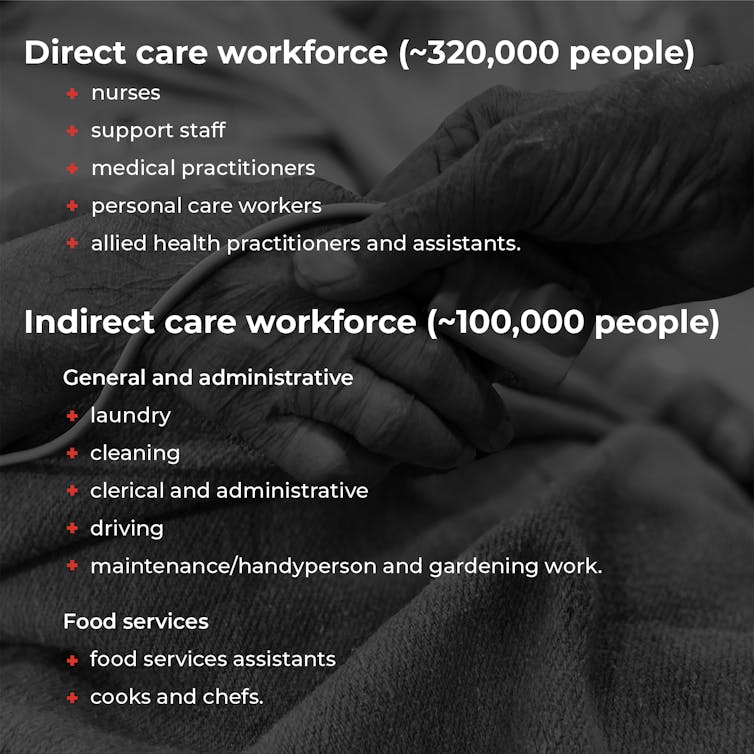
Running an aged care facility is a multifaceted operation. Approximately 100,000 residential aged care workers[5] are in “indirect care” roles, working across administrative and clerical services, food services, and laundry.

In its decision[6], the commission ruled that a “fundamental difference” between the work of direct and indirect care workers meant they did not deserve an equal pay increase.

The expert panel said[7]:

Without diminishing the importance of the work of indirect care for the proper functioning of residential aged care facilities, the above workers do not perform work equivalent in value to the direct care workers.

For many workers in the areas of infection prevention and control, as well as some indirect workers in dementia wards, it awarded a pay increase of just 3%.

Other segments of the indirect care workforce received greater recognition. Laundry hands, cleaners and food service assistants who interact directly with residents saw this extra contact acknowledged, and won a raise of about 7%.

A list of the aged care workforce, showing the direct care workforce is about 320,000 people and the indirect care workforce is about 100,000 people
The Conversation, CC BY-SA[8] A widening pay divide impacts quality of care At 3%, the lowest pay increase for this group is below the current Australian inflation rate[9] of 4.1%. For them, increases in take-home pay will fail to meet the rising cost of living. 7% is only slightly higher, and just a fraction of the raises awarded in direct care. Pay disparity in the treatment of indirect care workers could further entrench a serious equity divide, the impacts of which we may already be seeing. At large provider BaptistCare NSW and ACT, employee turnover among direct care workers fell by about 6%[10] after last year’s interim pay rise, to 29.3%. But among their indirect care colleagues who did not receive the raise, turnover remained stubbornly high, above 38%. High staff turnover poses a serious challenge to delivering quality aged care. cleaner wheels a trolley of rubbish outside an aged care facility
Indirect aged care workers may be less likely to stay in their jobs than colleagues who won a bigger raise. Dean Lewins/AAP[11]

By influencing attitudes at work, the pay divide could also be exerting a profound influence on the quality of care delivered.

BaptistCare NSW & ACT has shared anecdotal reports[12] that indirect care staff have become less willing to assist their higher paid colleagues.

Australia cannot afford further negative influences on its aged care sector.

It hasn’t been long since the Royal Commission into Aged Care found[13] the “unkind and uncaring” system had failed to meet the needs of elderly people, and could even be neglecting them.

Pay rises for direct care workers are an important step in improving the quality of our aged care offering. But we could risk it all if we continue to leave part of its workforce behind.

Read more: Who will look after us in our final years? A pay rise alone won't solve aged-care workforce shortages[14]

References

  1. ^ historic pay rise (www.abc.net.au)
  2. ^ chronic staffing shortages and poor rates of pay (theconversation.com)
  3. ^ indirect care workforce (www.agedcareguide.com.au)
  4. ^ an interim 15% raise (www.fwc.gov.au)
  5. ^ 100,000 residential aged care workers (helloleaders.com.au)
  6. ^ decision (www.fwc.gov.au)
  7. ^ said (www.fwc.gov.au)
  8. ^ CC BY-SA (creativecommons.org)
  9. ^ current Australian inflation rate (www.rba.gov.au)
  10. ^ fell by about 6% (www.theweeklysource.com.au)
  11. ^ Dean Lewins/AAP (photos.aap.com.au)
  12. ^ anecdotal reports (www.theweeklysource.com.au)
  13. ^ Royal Commission into Aged Care found (www.abc.net.au)
  14. ^ Who will look after us in our final years? A pay rise alone won't solve aged-care workforce shortages (theconversation.com)


Read more https://theconversation.com/aged-care-workers-have-won-a-huge-pay-rise-what-about-the-cleaners-cooks-and-admin-staff-who-support-them-226236

Times Magazine

Freak Weather Spikes ‘Allergic Disease’ and Eczema As Temperatures Dip

“Allergic disease” and eczema cases are spiking due to the current freak weather as the Bureau o...

IPECS Phone System in 2026: The Future of Smart Business Communication

By 2026, business communication is no longer just about making and receiving calls. It’s about speed...

With Nvidia’s second-best AI chips headed for China, the US shifts priorities from security to trade

This week, US President Donald Trump approved previously banned exports[1] of Nvidia’s powerful ...

Navman MiVue™ True 4K PRO Surround honest review

If you drive a car, you should have a dashcam. Need convincing? All I ask that you do is search fo...

Australia’s supercomputers are falling behind – and it’s hurting our ability to adapt to climate change

As Earth continues to warm, Australia faces some important decisions. For example, where shou...

Australia’s electric vehicle surge — EVs and hybrids hit record levels

Australians are increasingly embracing electric and hybrid cars, with 2025 shaping up as the str...

The Times Features

The Evolution of Retail: From Bricks and Mortar to Online — What’s Next?

Retail has always been a mirror of society. As populations grew, cities formed, technology advan...

How hot is too hot? Here’s what to consider when exercising in the heat

If you like to exercise outdoors, summer gives you more chance to catch the daylight. It’s often...

Vendor Advocacy Fees

Vendor advocacy fees can vary widely based on a number of factors, including the type of service...

MYA Cosmetics launches in Australia with bold new collection designed for creative tweens

MYA Cosmetics has officially launched in Australia, introducing its 2026 collection featuring th...

How smart home materials can shield us from extreme heat and cut energy bills all year

Australia is getting hotter. Climate change is driving more frequent and prolonged extreme heatw...

What is autistic burnout? And what can you do about it?

Many autistic people face challenges in their daily life while navigating a world made for neuro...

What is ‘oatzempic’? Does it actually work for weight loss?

If you’ve spent any time on TikTok or Instagram lately, you may have seen people blending oats...

Freak Weather Spikes ‘Allergic Disease’ and Eczema As Temperatures Dip

“Allergic disease” and eczema cases are spiking due to the current freak weather as the Bureau o...

The Man Behind Sydney’s New Year’s Eve Midnight Moment: Jono Ma

When the clock strikes midnight on New Year’s Eve, Sydney will ring in 2026 powered by a high-volt...