experiencing Marina Abramović and Laurie Anderson at the Adelaide Festival
- Written by: Catherine Speck, Emerita Professor, Art History and Curatorship, University of Adelaide
Ruth Mackenzie is the new artistic director of the Adelaide Festival of Arts, and for her first Adelaide gig she has brought in two heavyweights: performance artist Marina Abramović and avant-garde artist and musician Laurie Anderson. Both were major events, very much of the moment.
The Marina Abramović Institute’s Takeover featured nine performance artists over three days.
To begin at the beginning, audience members are instructed to arrive at 11am each day. We are ushered into a compelling virtual presentation, where Abramović inducts us into being a participative community.
She tells us performance is the most difficult of the art forms, that you need to abandon time and surrender to the moment. Then she runs the audience through a series of Tibetan breathing exercises to make us attuned to reading the mysteries and personal language of performance artists.
Durational performance
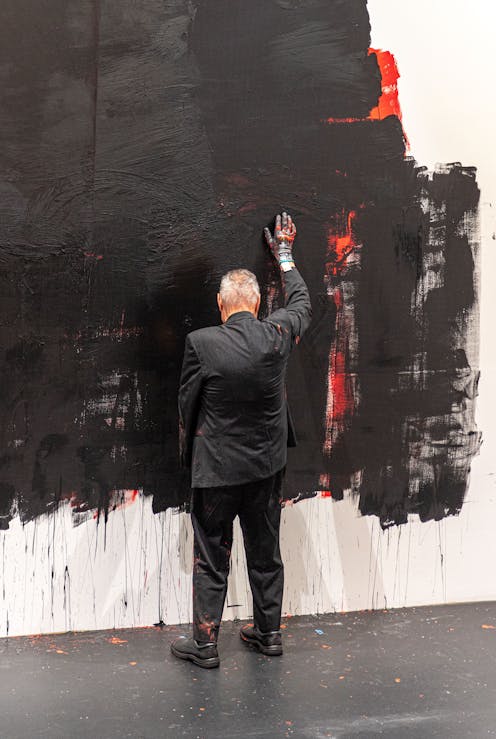
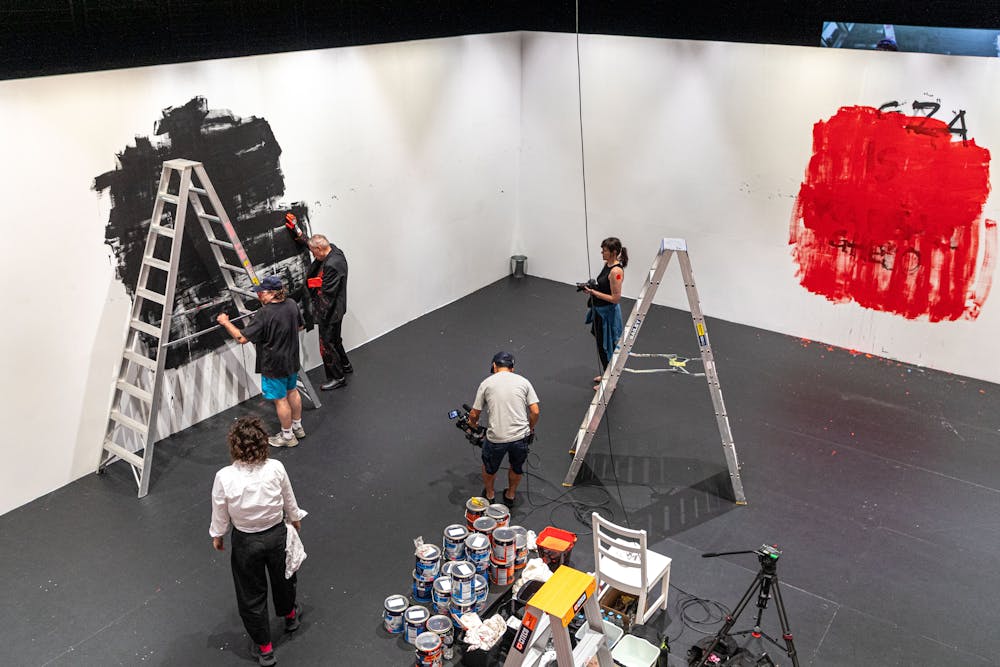
Mike Parr’s Portrait of Marina Abramović is the most extreme. A blind painting event, his eyes remain closed for the entire 12 hours. His aim was to paint four black squares, one on each side of a constructed white cube gallery space, in homage to Russian constructivist painter Kazimir Malevich’s 1915 Black Square[1].
Like Malevich, Parr says his blind painting is the creation of nothingness with a view to a rebirth. But he departs from Malevich: Parr is currently driven by the reality of the shocking events in Gaza, as set out in the painted text which starts on the walls of the show: “free Palestine” and “Gaza is a Warsaw ghetto”.
These sentiments are amplified in his “vision” statement distributed at the performance. His impassioned text says:
the Jewish diaspora rise up to join hands, to relinquish the obscene policies of its political leadership […] to demand justice, freedom, prosperity for the Palestinian people and an end to the oppression and antisemitism of the apartheid.
Over the next 12 hours, Parr paints four black squares – at times from perilously high up on a ladder – to be covered with red paint in homage to Abramović’s former Yugoslavian communist background, then covered again with black. The painted squares, complete with drips of red paint running down to the floor, remained after the performance for viewers to ponder their meaning, along with a video of the entire event.
Place and Country
Less sensational but equally demanding was the durational performance by Collective Absentia, a Bangkok-based group in a work entitled Our Glorious Past, Our Glorious Present, Our Glorious Future: Our Glorious Spring.
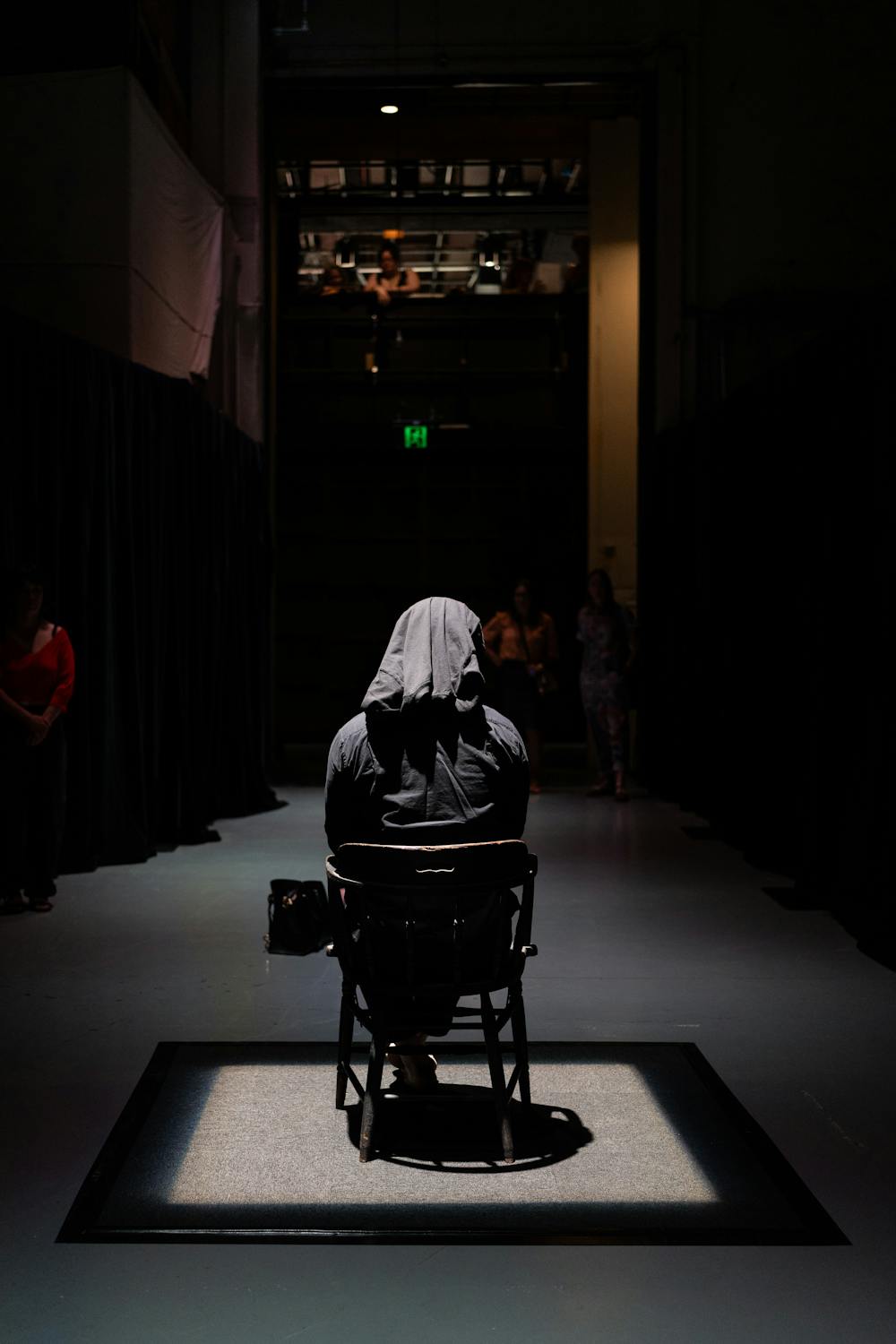 One performer meditated on non-violent forms of resistance to ongoing political events in Myanmar.
Andrew Beveridge/Adelaide Festival
One performer meditated on non-violent forms of resistance to ongoing political events in Myanmar.
Andrew Beveridge/Adelaide Festival
A member of their collective sat with his head covered and immobile in the middle of a passage-way, meditating on non-violent forms of resistance to ongoing political events in Myanmar.
All attendees at the event had to walk past and around this performance. Most stopped and connected with the sentiment of non-violent forms of resistance. One person even sat directly opposite the performer and meditated.
Christian Thomson’s postcolonial performance, Wait in Gold, involved him slowly and methodically pinning gold painted native daisies to every item of his exterior clothing so that he transforms from human into a larger flower form connected to Country. In this moving performance, he is responding to the denial of a voice as a result of the 2023 referendum outcome, and seeking refuge in the safety of Country.
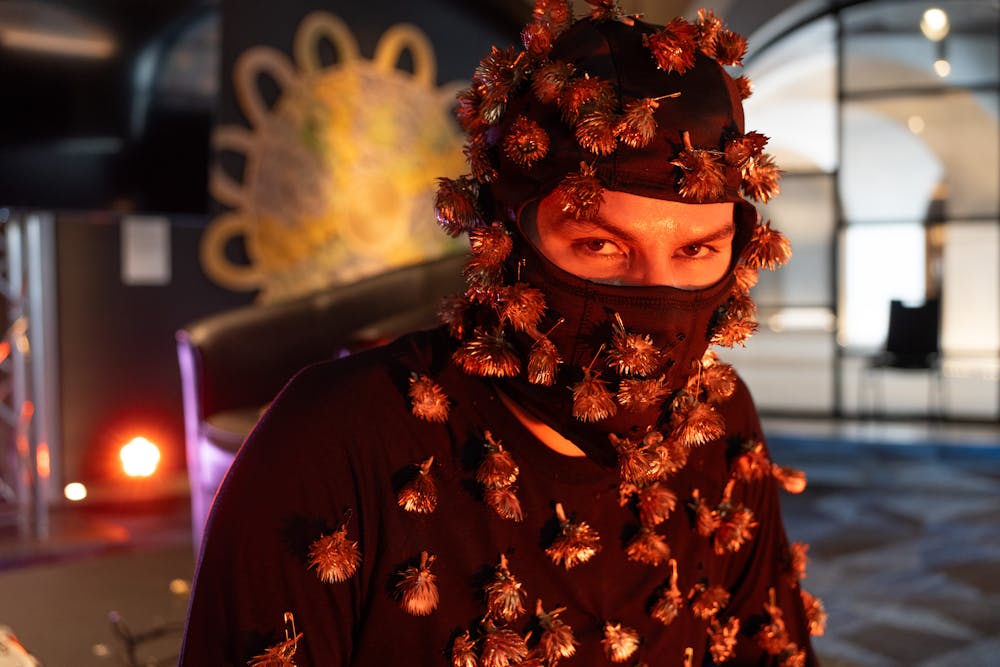 Christian Thomson seeks refuge in the safety of Country.
Andrew Beveridge/Adelaide Festival
Christian Thomson seeks refuge in the safety of Country.
Andrew Beveridge/Adelaide Festival
In Indonesian performance artist Melati Suryodarmo’s absorbing durational work, Amnesia, she slowly covers a large black board with a set of chalk markings. At each mark made, she utters “I’m sorry”.
The mark making is interspersed with her taking off her black shirt, placing it with other discarded shirts, and sewing a new one to put on. At other times she abandons mark making and moves across the floor, writhing as if in deep remorse, again uttering “I’m sorry”.
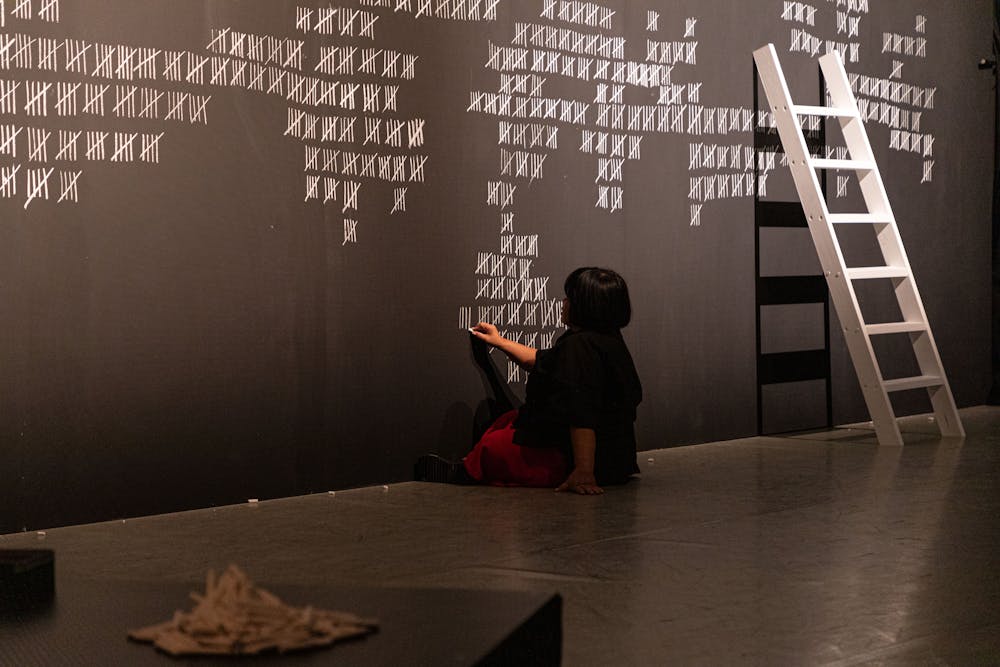 Indonesian performance artist Melati Suryodarmo’s absorbing durational work, Amnesia.
Andrew Beveridge/Adelaide Festival
Indonesian performance artist Melati Suryodarmo’s absorbing durational work, Amnesia.
Andrew Beveridge/Adelaide Festival
The promotional material accompanying her performance points to the work as an inner exploration of “untold narratives and forgotten realities of the past”. Her felt emotion in the performance is deeply persuasive, but I kept wondering about the amnesia from which Suryodarmo is recoiling: is it a deeply personal journey, or more?
Read more: Marina Abramović retrospective celebrates the grand dame of performance art – but questions the genre's future[2]
Encounters with AI
In a different vein, Laurie Anderson’s exhibition I’ll be your mirror is an encounter with AI. Taking phrases from her song O Superman and her late husband Lou Reed’s song I’ll be your mirror, Anderson has generated intriguing text which hangs in five panels in the Adelaide Circulating Library, the city’s original lending library.
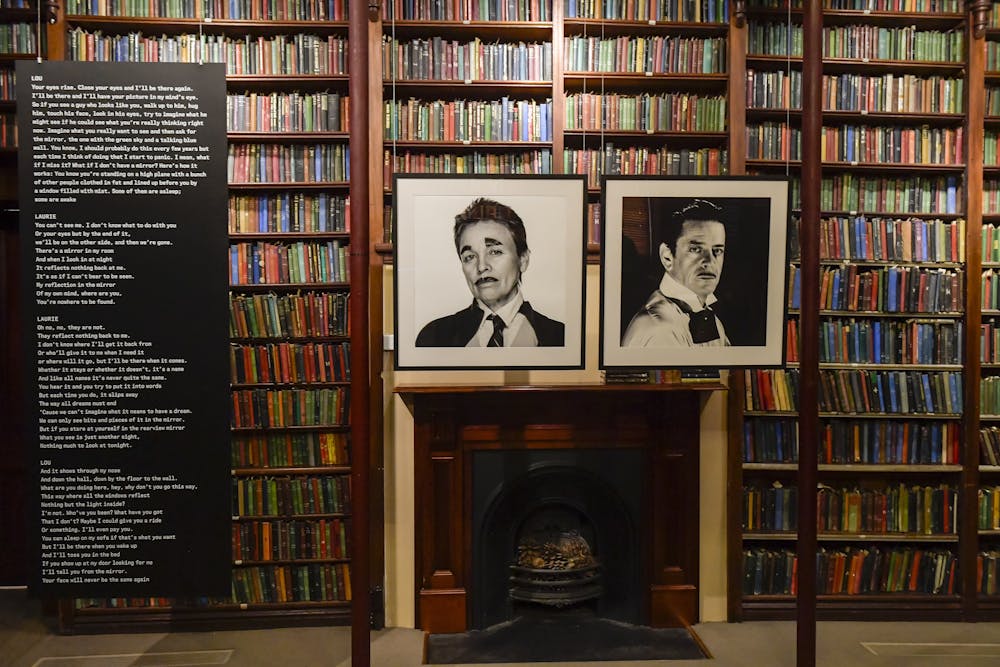 I’ll be your mirror uses AI building off songs from Laurie Anderson and Lou Reed.
Roy VanDerVegt/Adelaide Festival
I’ll be your mirror uses AI building off songs from Laurie Anderson and Lou Reed.
Roy VanDerVegt/Adelaide Festival
The AI generated conversations between Anderson and Reed, who passed away in 2013, oscillate between the surreal and the eerie with phrases such as
There’s a mirror in the room And when I look at nightIt reflects nothing back to me.
The Bible is on display and open at Psalms 84-88[3], but hanging above the Bible is AI generated text based on biblical phrases, displayed as Genesis 1: 26-31.
A section from that text reads:
Some nights now Noah dreams he sees his boat leave the dockIt’s just another day on planet Earth Only this time it’s with an animal friend.
As an adjunct to the exhibition of 21st century textual artefacts set amid 19th texts, Anderson held a virtual public conversation with the machine generating gurus she worked in Adelaide – the takeaway message being what machines generate depends on the input.
The exhibition is utterly intriguing, but novice viewers need an introduction to what they are about to encounter.
I’ll Be Your Mirror is on display until March 17.
Read more: From Duchamp to AI: the transformation of authorship in art[4]
References
- ^ Kazimir Malevich’s 1915 Black Square (www.tate.org.uk)
- ^ Marina Abramović retrospective celebrates the grand dame of performance art – but questions the genre's future (theconversation.com)
- ^ Psalms 84-88 (www.biblegateway.com)
- ^ From Duchamp to AI: the transformation of authorship in art (theconversation.com)