Run out of butter or eggs? Here’s the science behind substitute ingredients
- Written by: Paulomi (Polly) Burey, Associate Professor (Food Science), University of Southern Queensland
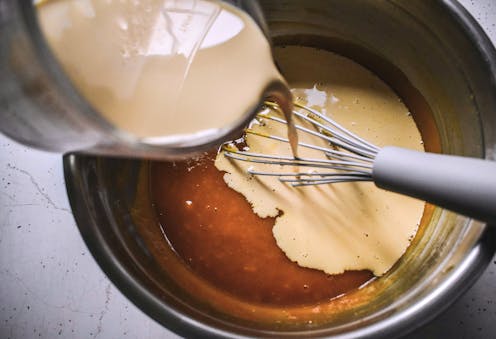
It’s an all too common situation – you’re busy cooking or baking to a recipe when you open the cupboard and suddenly realise you are missing an ingredient.
Unless you can immediately run to the shops, this can leave you scrambling for a substitute that can perform a similar function. Thankfully, such substitutes can be more successful than you’d expect.
There are a few reasons why certain ingredient substitutions work so well. This is usually to do with the chemistry and the physical features having enough similarity to the original ingredient to still do the job appropriately.
Let’s delve into some common ingredient substitutions and why they work – or need to be tweaked.
Oils versus butter
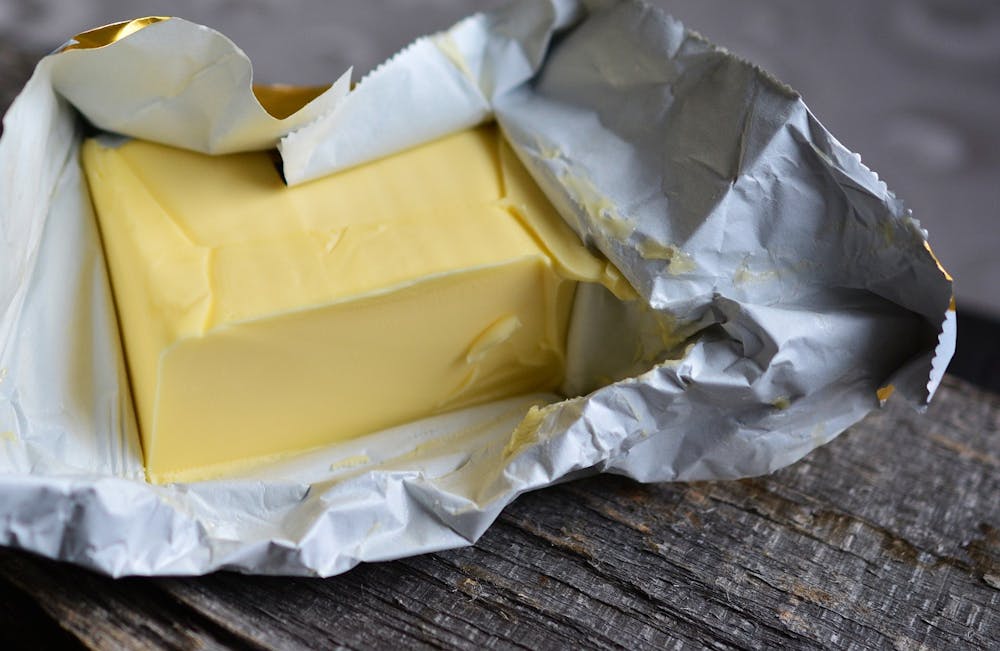
Both butter and oils belong to a chemical class called lipids[1]. It encompasses solid, semi-solid and liquid fats.
In a baked product the “job” of these ingredients is to provide flavour and influence the structure and texture of the finished item. In cake batters, lipids contribute to creating an emulsion structure – this means combining two liquids that wouldn’t usually mix. In the baking process, this helps to create a light, fluffy crumb.
One of the primary differences between butter and oil is that butter is only about 80% lipid (the rest being water), while oil is almost 100% lipid[2]. Oil creates a softer crumb but is still a great fat to bake with.
You can use a wide range of oils from different sources, such as olive oil, rice bran, avocado, peanut, coconut, macadamia and many more. Each of these may impart different flavours.
Other “butters”, such as peanut and cashew butter, aren’t strictly butters but pastes. They impart different characteristics and can’t easily replace dairy butter, unless you also add extra oil.
Aquafaba or flaxseed versus eggs
Aquafaba is the liquid you drain from a can of legumes – such as chickpeas or lentils. It contains proteins, kind of how egg white also contains proteins.
The proteins in egg white include albumins, and aquafaba also contains albumins[4]. This is why it is possible to make meringue from egg whites, or from aquafaba if you’re after a vegan version.
Read more: How to make the perfect pavlova, according to chemistry experts[5]
The proteins act as a foam stabiliser – they hold the light, airy texture in the product. The concentration of protein in egg white is a bit higher, so it doesn’t take long to create a stable foam. Aquafaba requires more whipping to create a meringue-like foam, but it will bake in a similar way.
Another albumin-containing alternative for eggs is flaxseed[6]. These seeds form a thick gel texture when mixed with a little water. The texture is similar to raw egg and can provide structure and emulsification in baked recipes that call for a small amount of egg white.
Read more: Eggs are so expensive right now. What else can I use?[7]
Lemon plus dairy versus buttermilk
Buttermilk is the liquid left over after churning butter – it can be made from sweet cream, cultured/sour cream or whey-based cream. Buttermilk mostly contains proteins and fats[8].
Cultured buttermilk has a somewhat tangy flavour. Slightly soured milk can be a good substitute as it contains similar components and isn’t too different from “real” buttermilk, chemically speaking.
One way to achieve slightly soured milk is by adding some lemon juice or cream of tartar to milk. Buttermilk is used in pancakes and baked goods to give extra height or volume. This is because the acidic (sour) components of buttermilk interact with baking soda, producing a light and airy texture.
Buttermilk can also influence flavour, imparting a slightly tangy taste to pancakes and baked goods. It can also be used in sauces and dressings if you’re looking for a lightly acidic touch.
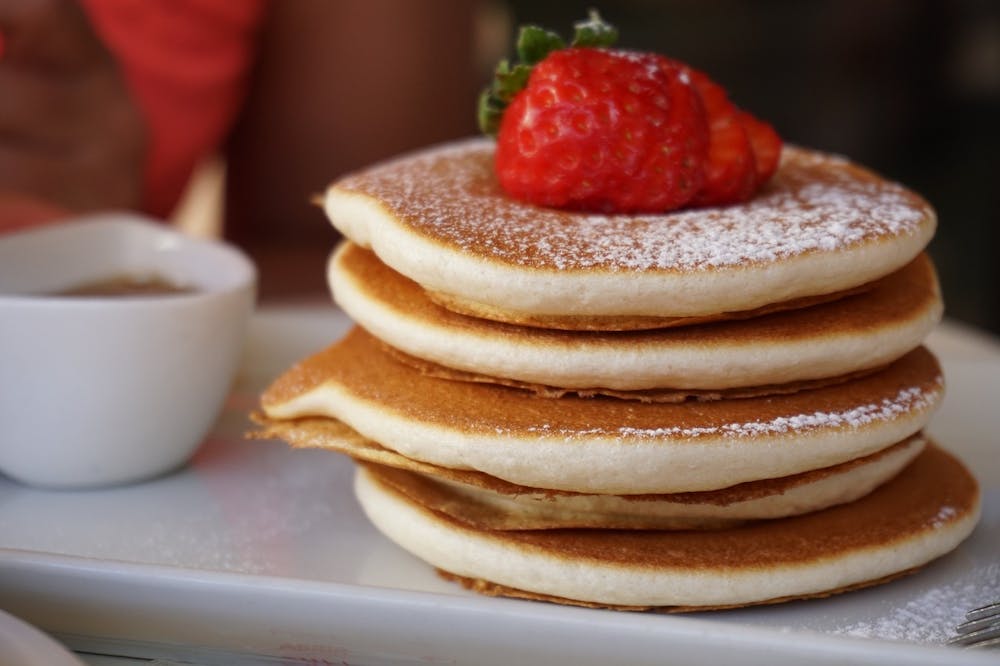 Buttermilk is a common ingredient for making fluffy pancakes.
Matthias_Groeneveld/Pixabay[9]
Buttermilk is a common ingredient for making fluffy pancakes.
Matthias_Groeneveld/Pixabay[9]
Honey versus sugar
Honey is a complex sugar-based syrup[10] that includes floral or botanical flavours and aromas. Honey can be used in cooking and baking, adding both flavour and texture (viscosity, softness) to a wide range of products.
If you add honey instead of regular sugar in baked goods, keep in mind that honey imparts a softer, moister texture. This is because it contains more moisture and is a humectant (that is, it likes to hold on to water). It is also less crystalline than sugar, unless you leave it to crystallise.
The intensity of sweetness can also be different – some people find honey is sweeter than its granular counterpart, so you will want to adjust your recipes accordingly.
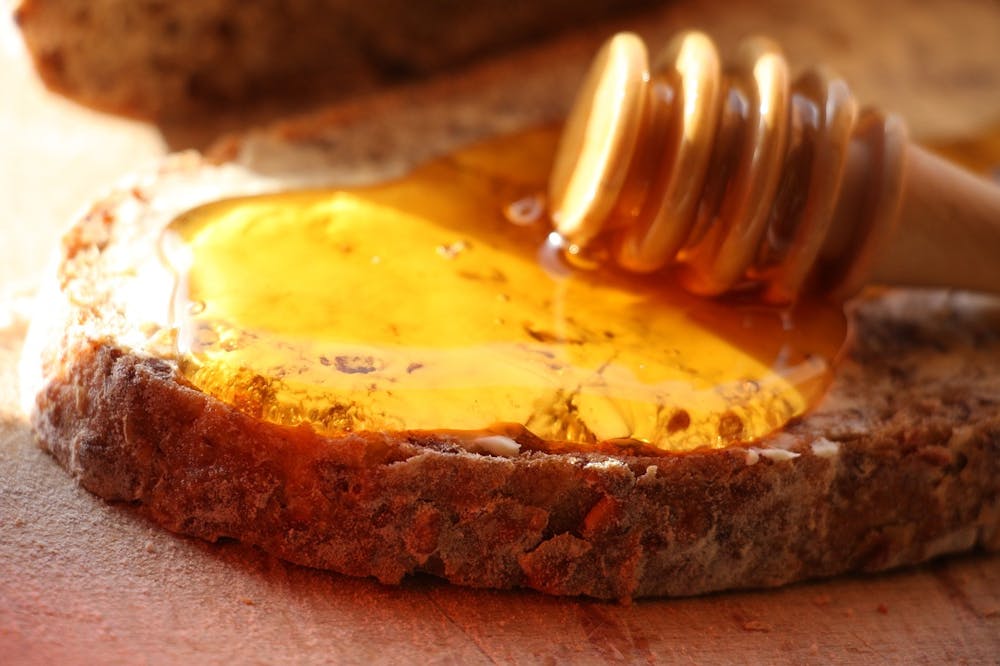 Honey has a complex flavour and can taste sweeter than regular sugar.
estelheitz/Pixabay[11]
Honey has a complex flavour and can taste sweeter than regular sugar.
estelheitz/Pixabay[11]
Gluten-free versus regular flour
Sometimes you need to make substitutions to avoid allergens, such as gluten – the protein found in cereal grains such as wheat, rye, barley and others.
Unfortunately, gluten is also the component that gives a nice, stretchy, squishy quality to bread.
To build this characteristic in a gluten-free product, it’s necessary to have a mixture of ingredients that work together to mimic this texture. Common ingredients used are corn or rice flour, xanthan gum, which acts as a binder and moisture holder, and tapioca starch, which is a good water absorbent and can aid with binding the dough.
Read more: Thank gluten's complex chemistry for your light, fluffy baked goods[12]
References
- ^ lipids (chem.libretexts.org)
- ^ oil is almost 100% lipid (www.nutritionadvance.com)
- ^ congerdesign/Pixabay (pixabay.com)
- ^ aquafaba also contains albumins (www.ncbi.nlm.nih.gov)
- ^ How to make the perfect pavlova, according to chemistry experts (theconversation.com)
- ^ flaxseed (foodstruct.com)
- ^ Eggs are so expensive right now. What else can I use? (theconversation.com)
- ^ contains proteins and fats (www.journalofdairyscience.org)
- ^ Matthias_Groeneveld/Pixabay (pixabay.com)
- ^ complex sugar-based syrup (resources.perkinelmer.com)
- ^ estelheitz/Pixabay (pixabay.com)
- ^ Thank gluten's complex chemistry for your light, fluffy baked goods (theconversation.com)