Donald Trump faces half a billion dollars of debt and several court cases. But that may not stop him from becoming president again
- Written by: Emma Shortis, Adjunct Senior Fellow, School of Global, Urban and Social Studies, RMIT University
The verdicts keep coming.
On Friday US time, the three-month hearing focused on Donald Trump’s business dealings in New York came to an end. Trump was ordered to pay back more than $US350 million (A$537 million), plus interest. He and two of his associates are banned from directing any business in New York for three years. His two sons, Donald Jr and Eric Trump, have also been handed two-year bans, and ordered to pay US$4 million (A$6.1 million) each.
In his judgement, New York Judge Arthur Engoron gave his own insight[1] into the Trump phenomenon, describing what he saw as a “complete lack of contrition and remorse” that “borders on pathological”.
While Engoron was referring specifically to business fraud in New York, the judge’s observation might also apply to Trumpism writ large.
Coverage of the case and its stunning end has consistently focused on Trump’s celebrity – after all, he built his national profile on the back of his supposed business acumen, trading on his long stint as host of the popular television show The Apprentice.
Read more: Should Donald Trump be disqualified from state ballots in presidential election? Here's how the US Supreme Court might rule[2]
The results of this civil case certainly seem to poke holes in the image of Trump as a consummate businessman. Combined with the money he owes as the result of his loss of a second civil defamation trial[3] brought by E. Jean Carroll, Trump is now in upwards of half a billion dollars of debt. It’s not clear where this money will come from[4], or what will happen to Trump’s existing New York businesses.
This has led some commentators to argue this most recent case represents a “stunning[5]”, “devastating[6]” and “shocking blow[7]” to the image of Trump as a successful real estate mogul better placed than anyone to run the world’s largest and most important economy.
The pathology of Trumpism
It is certainly possible to argue Trump’s reputation as the embodiment of rugged American entrepreneurship played an important role in his successful bid for the presidency in 2016. At least some of his support was drawn from the sense that a political outsider and ruthless businessman would shatter the stale consensus of establishment politics.
But if it were possible to make that argument eight years ago, it is less convincing now.
Read more: Does Trump actually have to pay $83.3 million to E. Jean Carroll? Not immediately, at least[8]
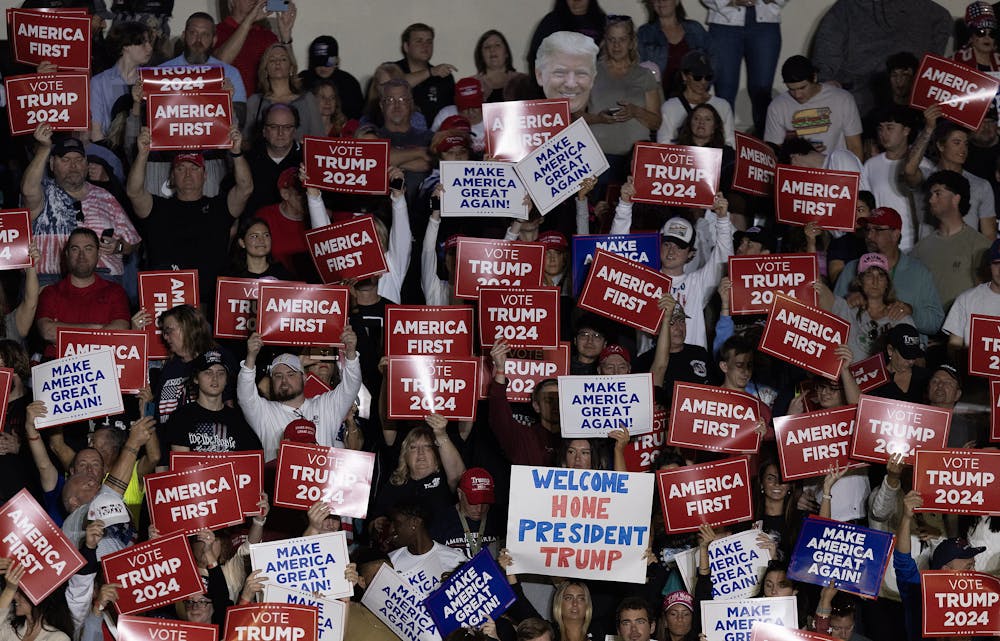
Trump’s celebrity profile was, of course, critical to his campaign. His rise to political prominence, though, came not so much as a result of his reputation as a successful businessman, but on the back of his unabashed peddling of racist conspiracy theories about the first Black president[9].
Trump’s ability to tap into a particularly American form of racial revanchism[10] – his political acumen in marrying conspiracy, racism, and political grievance in an increasingly unequal society – is what brought him to power. It is what sustains him still.
The pathology of Trumpism revolves around his politics, not his personal economics. It at least partly explains why this latest case, plus the 91 separate felony charges in four criminal cases[11], are unlikely to affect Trump’s political support, particularly with his base in the Republican Party.
That base is too far down the road Trump began mapping out when he staked his political reputation on the argument that a Black man could not possibly be qualified for the presidency of the United States. Even a half a billion-dollar hole punched through his business reputation will not change that.
Nothing, or everything, might change
That does not mean, however, that continued support for Trump is inevitable.
In another New York courtroom this week, a judge ruled that Trump’s first criminal trial will begin in just over a month. On March 25, for the first time in American history, a former president will face criminal charges in court[12].
In what will likely become the first of four possibly consecutive criminal trials, Trump will face a potential six-week hearing on his efforts to cover up politically damaging information about his relationships with two women in advance of the 2016 presidential election. Dubbed the “hush money[13]” case, this trial represents more than the sordid dealings of an alleged serial adulterer; it represents, arguably, the beginning of a pattern of deliberate election interference that began even before Trump took office.
If it goes ahead as planned, a late March trial date will likely mean these hearings will barely be over before the next set begins. The classified documents case[14], centering on Trump’s alleged illegal removal of highly classified documents from the White House, is scheduled to begin in Florida in late May. Scheduling for the other two cases, focused on on Trump’s role in the January 6 insurrection and election interference in the state of Georgia, remains unclear.
Read more: Donald Trump's stroll to victory in Iowa was a foregone conclusion. This doesn't make it any less shocking[15]
None of this has ever happened before. There is really no telling what it will mean for Trump, his campaign, or American democracy more broadly.
Polling suggests[16] that a criminal conviction may dent Trump’s national support. It is certainly possible such a conviction (or convictions), combined with eye-watering levels of debt, and the sheer logistics of conducting a national campaign amid multiple criminal trials, will have an impact.
But the pathology of Trumpism has so far proven resistant to what should be crushing blows.
The verdicts will keep coming. Trump may well, too.
References
- ^ his own insight (www.theguardian.com)
- ^ Should Donald Trump be disqualified from state ballots in presidential election? Here's how the US Supreme Court might rule (theconversation.com)
- ^ second civil defamation trial (theconversation.com)
- ^ where this money will come from (www.theguardian.com)
- ^ stunning (www.theguardian.com)
- ^ devastating (www.theguardian.com)
- ^ shocking blow (www.theguardian.com)
- ^ Does Trump actually have to pay $83.3 million to E. Jean Carroll? Not immediately, at least (theconversation.com)
- ^ the first Black president (www.theatlantic.com)
- ^ racial revanchism (theconversation.com)
- ^ four criminal cases (www.politico.com)
- ^ face criminal charges in court (www.bbc.com)
- ^ hush money (www.abc.net.au)
- ^ classified documents case (theconversation.com)
- ^ Donald Trump's stroll to victory in Iowa was a foregone conclusion. This doesn't make it any less shocking (theconversation.com)
- ^ Polling suggests (www.rollingstone.com)