This Valentine’s Day, embrace green as the new colour of love
- Written by: Elizabeth Reid Boyd, Senior Lecturer School of Arts and Humanities, Edith Cowan University
Valentine’s Day is associated with red and pink, representing passion and romance. But there’s another hue with a secret, sensual history longing for embrace: green.
The colour of nature and fertility, green is deeply connected to love in traditions throughout the world. In these times of conflict, 2024 is the year we should remember what connects rather than divides us, and embrace green as the colour of love.
Read more: From Chaucer to chocolates: how Valentine’s Day gifts have changed over the centuries[1]
Green is at the heart
In the ancient Indian chakra tradition, green is the colour of the heart. The heart organ[2] has long been associated with love. A chakra[3], conceptualised as a wheel of whirling energy, balances particular emotions and the health of the body. The heart chakra at the centre of the chest represents loving-kindness, compassion and care.
Green has a range of cross-cultural meanings to do with balance, peace and hope. Islam[6] associates heavenly paradise with the colour. It is important in the Catholic[7] faith for hope and life, as in Judaism[8], where it means renewal. In China, jade[9] is considered powerful and fortunate, as is pounamu jade[10] in Maori culture. Scottish serpentine[11] is still believed by some today to boost creativity.
In European mediaeval folklore[12], the colour was associated with both being lucky or unlucky in love. It symbolised a young woman’s sexuality, and being “greensick” was a term for a youth in unrequited love.
Mary Magdalene[13] was depicted wearing green sleeves. Robin Hood and Maid Marian wore it in the greenwoods, the home of lovers.
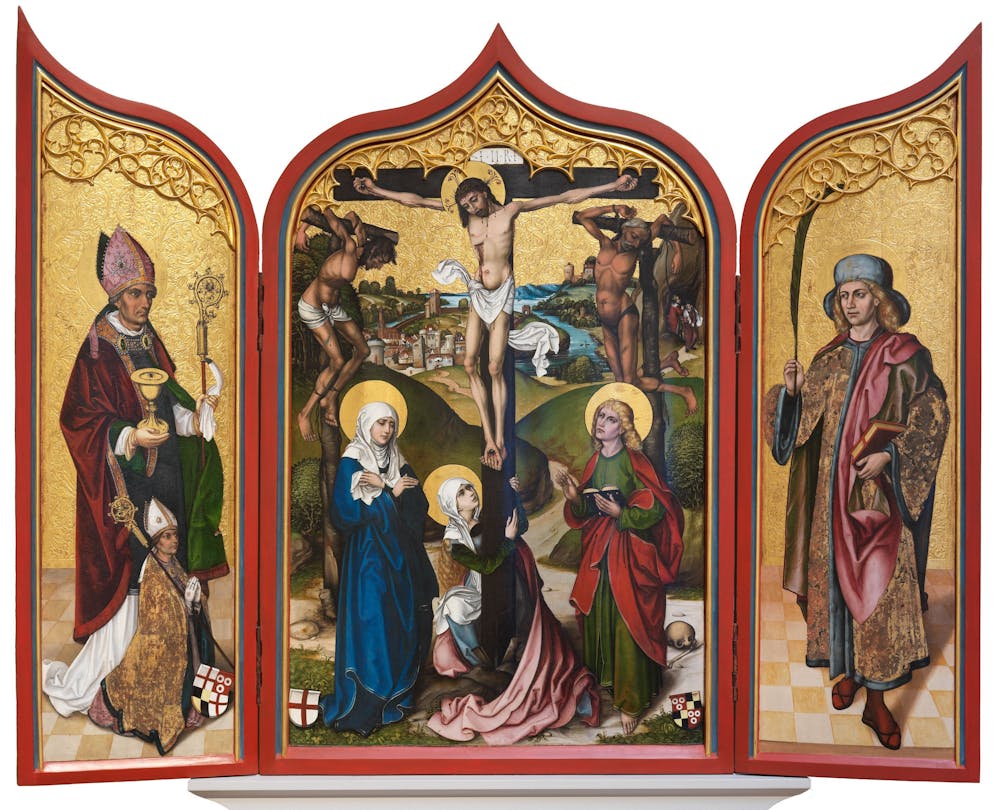 Michael Haider, Triptych with the Crucification Creator, c. 1500.
Staatliche Kunsthalle Karlsruhe, CC BY[14][15]
Michael Haider, Triptych with the Crucification Creator, c. 1500.
Staatliche Kunsthalle Karlsruhe, CC BY[14][15]
During the Renaissance, pastoral and woodland settings symbolised nature, pleasure, freedom and lack of convention, as Arden does in Shakespeare’s As You Like It and the forest in A Midsummer Night’s Dream: an alternative Green World[16], an erotic Eden[17].
Bawdy Renaissance madrigals[18] such as Now is the Month of Maying included references to a “barley break” (a roll in the hay) and lads and lasses making merry upon the “greeny grass”.
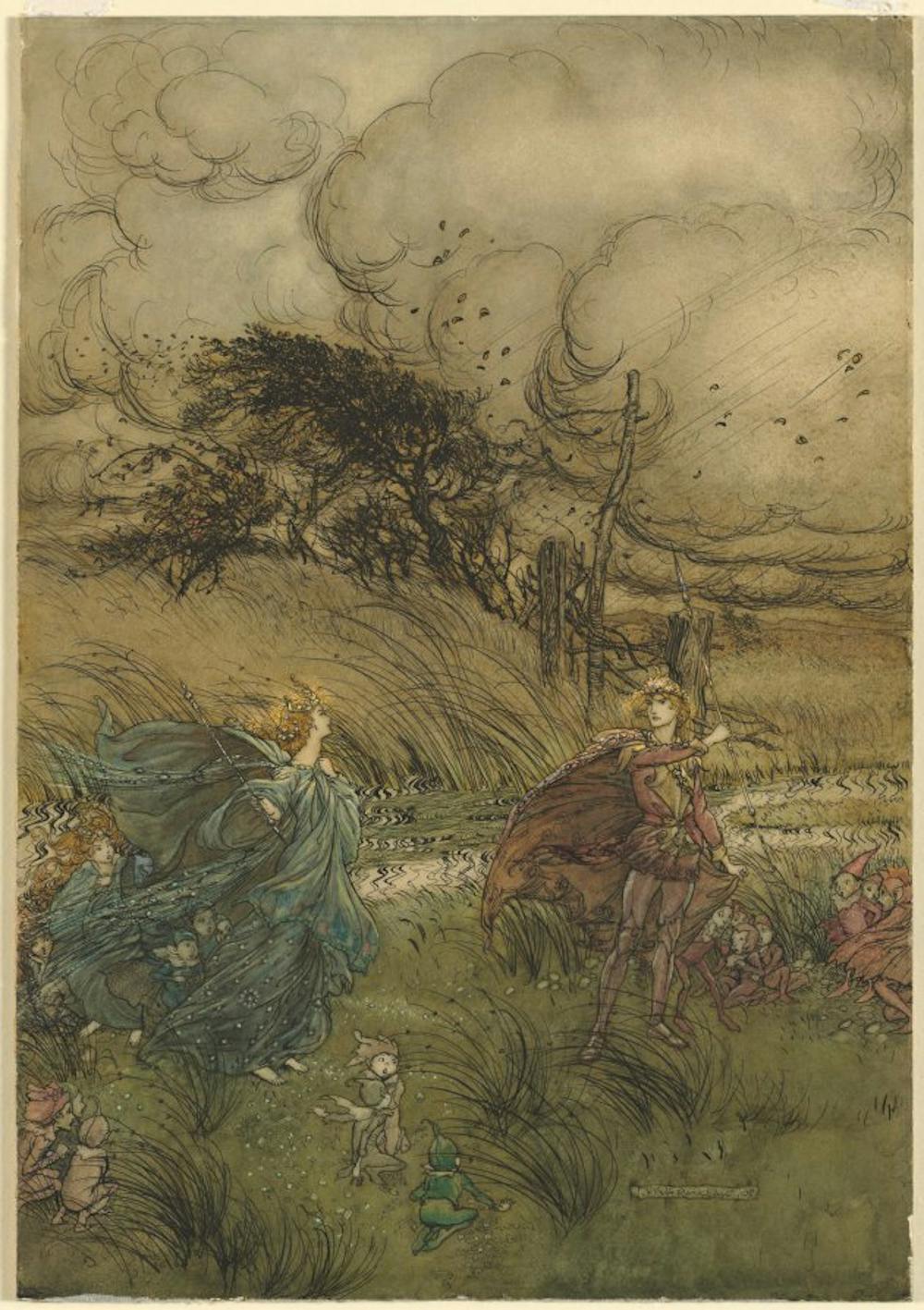 ‘And now they never meet in grove or green’ from act two, scene one of A Midsummer Night’s Dream, illustrated by Arthur Rackham, 1908.
The Cleveland Museum of Art[19]
‘And now they never meet in grove or green’ from act two, scene one of A Midsummer Night’s Dream, illustrated by Arthur Rackham, 1908.
The Cleveland Museum of Art[19]
Hidden greens
Old songs give us some clues to the secret, erotic symbolism of the colour green and its fateful relationship to women’s sexuality.
The Tudor version of Greensleeves contains suggestive lyrics regarding crimson stockings with gold above the knee and pumps as white as milk, and a grassy-green gown. According to a romantic myth[20], Henry VIII wrote Greensleeves to woo Anne Boleyn.
The lyrics go back to Celtic myths about the joining of the May Queen with the Oak King, also called the Green Man or “Jack in the Green”. Their union is consummated on May Day, also known as Beltane[21].
Rituals[22] still practised today in magic and pagan communities connect May Day festivities to the hand-fasting or marriage of the god and goddess, encouraging desire to flame and convention to be cast aside outdoors.
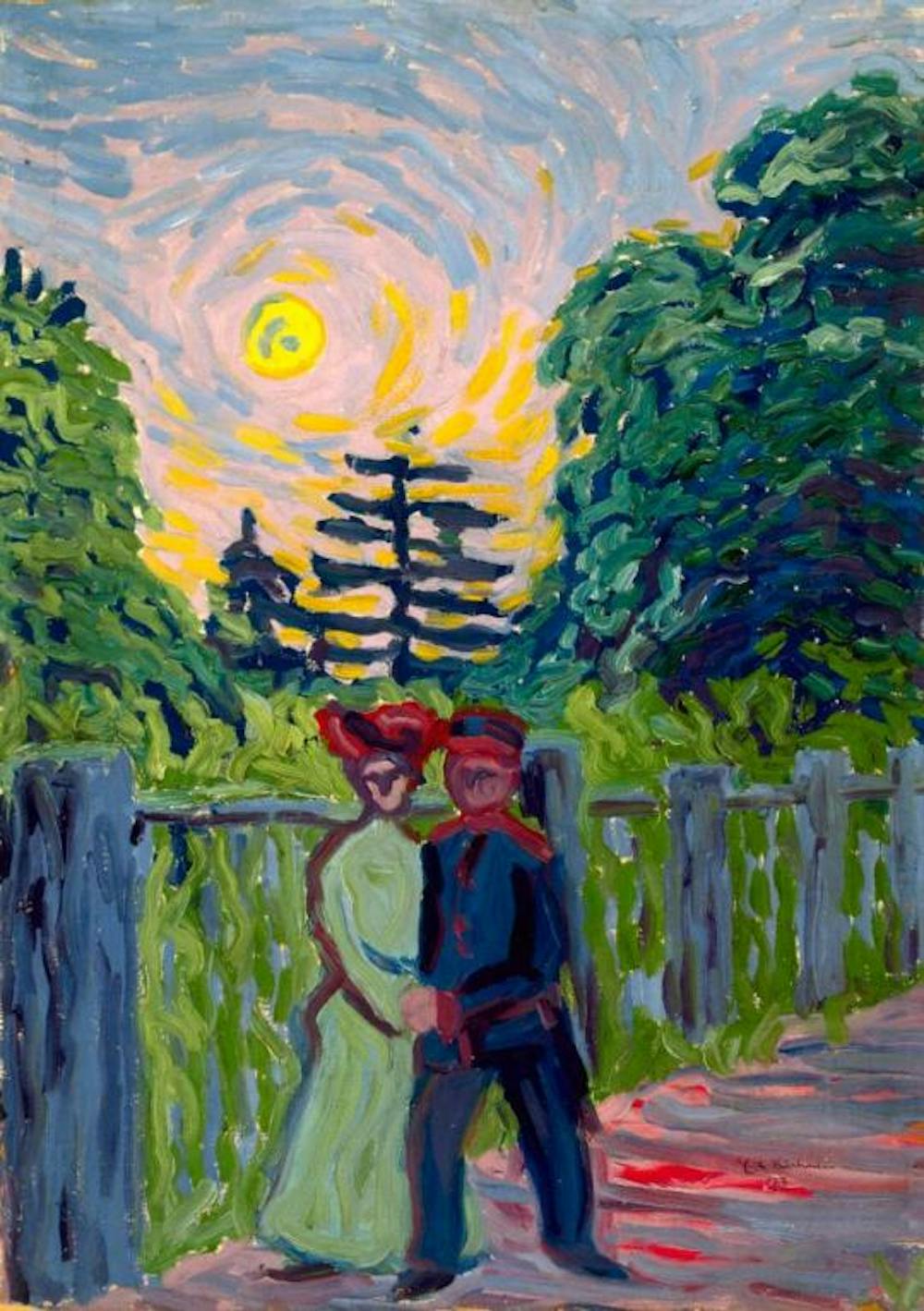 Ernst Ludwig Kirchner, Moonrise: Soldier and Maiden, 1905.
The Museum of Fine Arts, Houston[23]
Ernst Ludwig Kirchner, Moonrise: Soldier and Maiden, 1905.
The Museum of Fine Arts, Houston[23]
Green in mediaeval times was also a sign of female promiscuity[24] rather than free love. Wearing green reputedly signalled a woman’s willingness to make love, since it denoted fertility and the loss of virginity[25].
Green got a downgrade during the Middle Ages and beyond. Dubbed the fairies’ colour[26], who were associated with nature and said to be jealous of human good fortune, it became unlucky for brides[27] and even today is warned against[28] being worn at weddings.
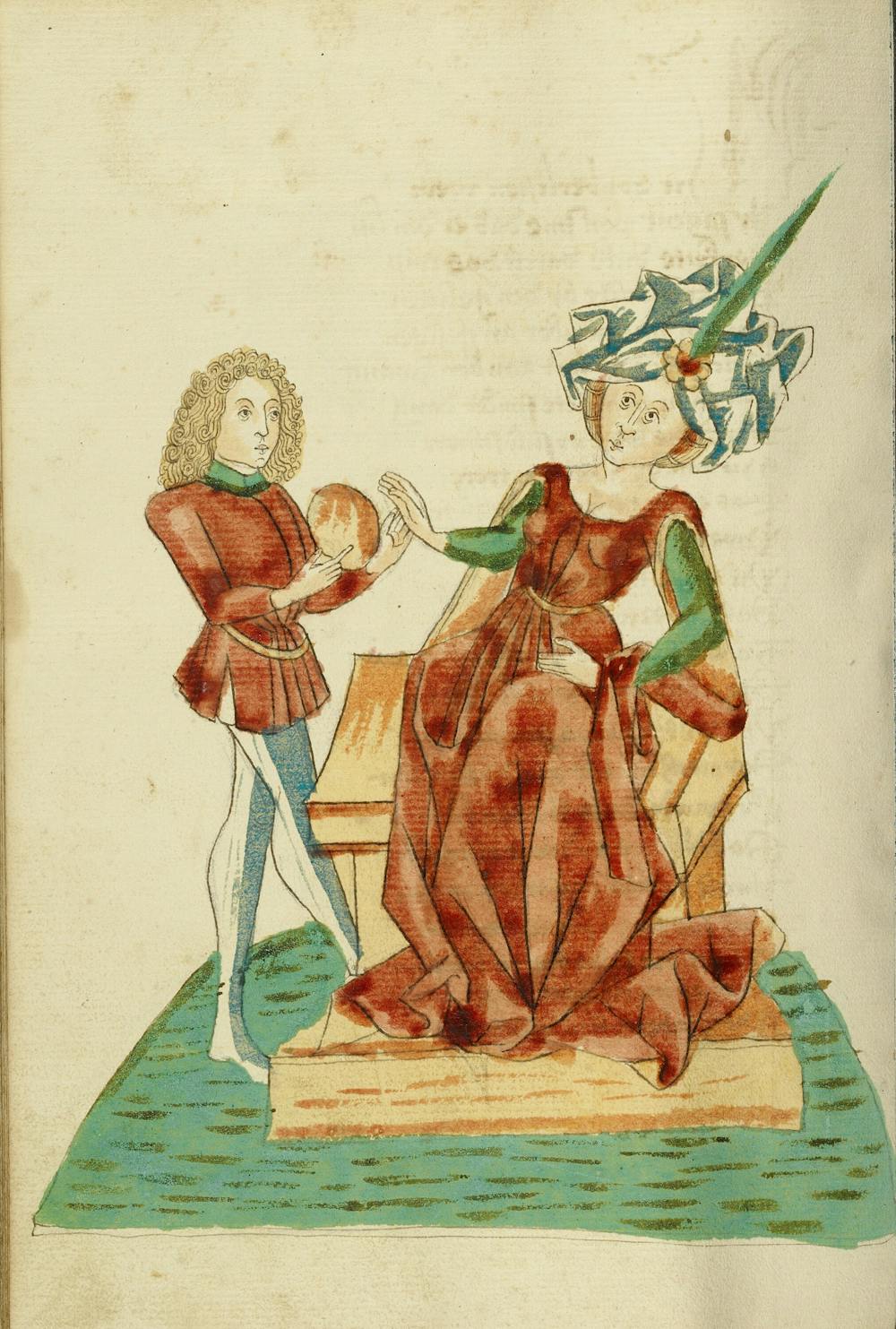 Follower of Hans Schilling, illuminator and from the Workshop of Diebold. Lauber Jupiter Gives Danae a Gift of Gold, 1469.
Getty Museum[29]
Follower of Hans Schilling, illuminator and from the Workshop of Diebold. Lauber Jupiter Gives Danae a Gift of Gold, 1469.
Getty Museum[29]
In the Middle Ages, healers and wise-women who held vital medicinal plant and herb use, as well as some who may have practised folk magic for alluring charms and love potions, were persecuted for their knowledge as witches[30]. The female witch is so associated with green that in The Wizard of Oz she was given green skin[31].
A contradictory colour
Green carries negative connotations such as poison, jealousy and envy: the green-eyed monster.
Greenwashing or green-sheening are terms for the promotion of dubious environmental products. In Green Sense[32] a treatise that explores botanical aesthetics, cultural studies academic John Ryan argues the contradiction of green comes from it being the shade of growth and decomposition: both birth and death.
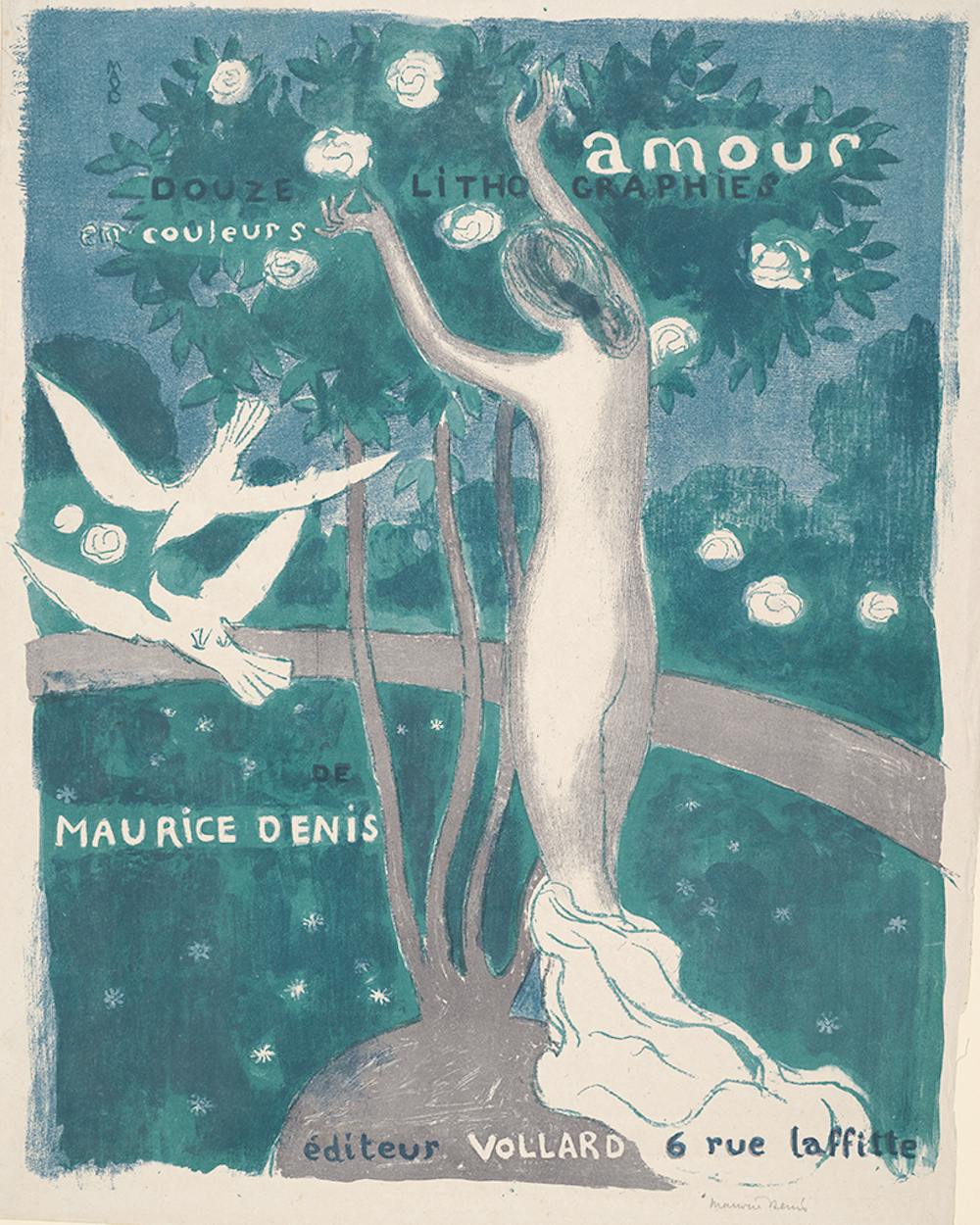 Maurice Denis, Love (Amour), 1892-1899.
Open Access Image from the Davison Art Center, Wesleyan University (photo: M. Johnston)[33]
Maurice Denis, Love (Amour), 1892-1899.
Open Access Image from the Davison Art Center, Wesleyan University (photo: M. Johnston)[33]
In The Key of Green[34] cultural historian Bruce Smith suggests green has the power to upset. It has no fixed meaning and encompasses vast mental territory. Part noun, part adjective, part adverb and part verb, we see green, and we can also shop, build, vote and think green. We can feel green: during the Renaissance, he writes, being possessed by the passions was likened to wearing green spectacles. Smith also contends that we can hear colours: to hear green would be to listen longingly, as we do to love songs.
Green flags possibility for growth and change. It revives bodies and souls. In the philosophy of mediaeval mystic Hildegard of Bingen, viriditas[35] – meaning greenness and vitality – signified the life force that makes all things fresh and new.
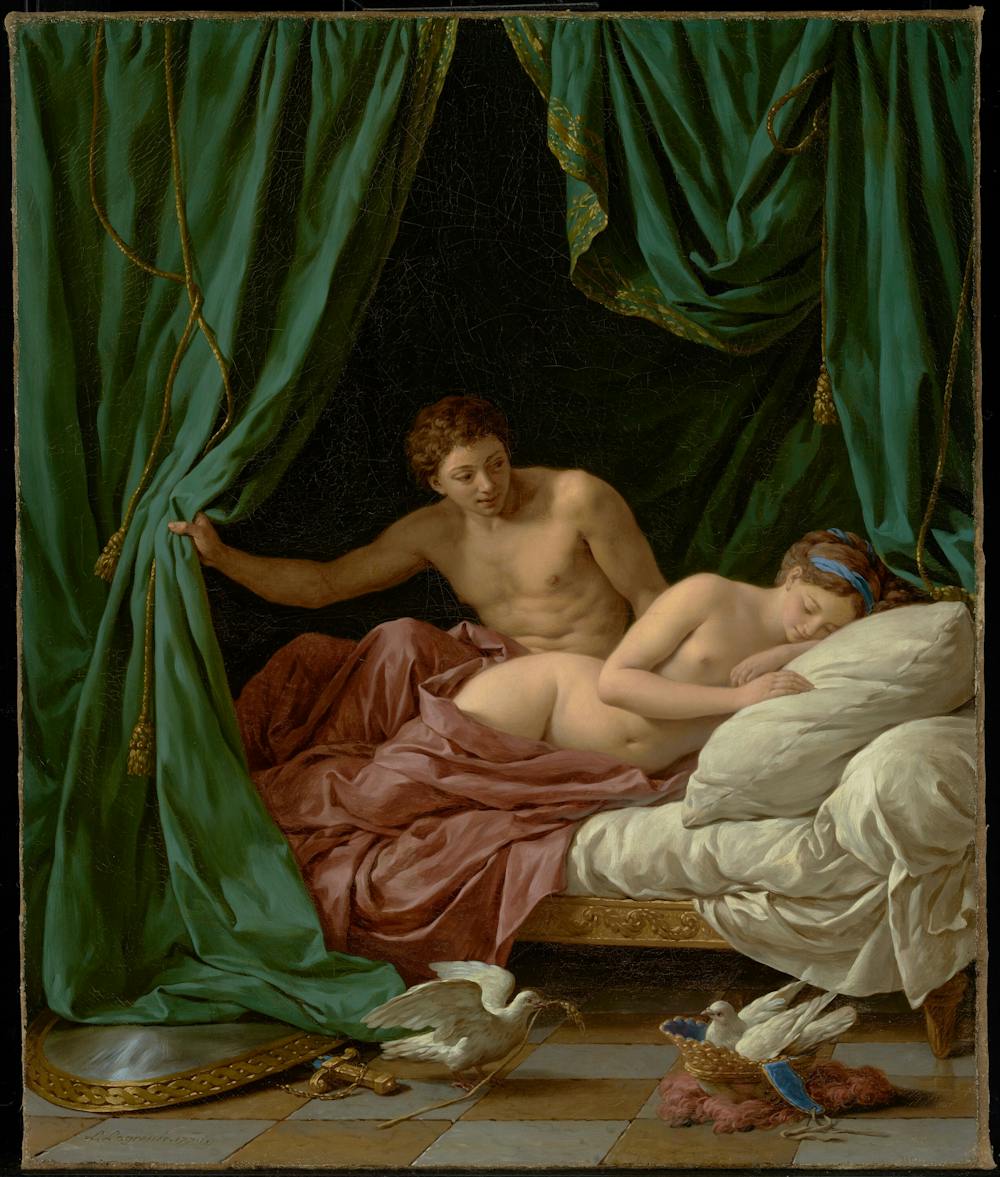 Louis Jean François Lagrenée, Mars and Venus, Allegory of Peace (Mars et Vénus, allégorie sur la Paix) 1770.
Getty Museum[36]
Louis Jean François Lagrenée, Mars and Venus, Allegory of Peace (Mars et Vénus, allégorie sur la Paix) 1770.
Getty Museum[36]
Today greening power is being celebrated and revived. Across the globe, there are calls for the growth of love. Whether we celebrate our relationships in pastel or Barbie pink, passionate red, or all the colours of the rainbow, perhaps, this Valentine’s Day, we can widen our arms to embrace a little green.
Read more: 'Freshly cut grass – or bile-infused Exorcist vomit?': how crime books embraced lurid green[37]
References
- ^ From Chaucer to chocolates: how Valentine’s Day gifts have changed over the centuries (theconversation.com)
- ^ heart organ (reporter.anu.edu.au)
- ^ chakra (www.researchgate.net)
- ^ © President and Fellows of Harvard College (harvardartmuseums.org)
- ^ CC BY-NC-SA (creativecommons.org)
- ^ Islam (www.amaliah.com)
- ^ Catholic (art.catholic.org.au)
- ^ Judaism (www.5tjt.com)
- ^ jade (www.worldhistory.org)
- ^ pounamu jade (teara.govt.nz)
- ^ serpentine (www.crystaldigest.com)
- ^ mediaeval folklore (www.tandfonline.com)
- ^ Mary Magdalene (www.christies.com)
- ^ Staatliche Kunsthalle Karlsruhe (www.kunsthalle-karlsruhe.de)
- ^ CC BY (creativecommons.org)
- ^ Green World (journals.openedition.org)
- ^ an erotic Eden (www.researchgate.net)
- ^ Renaissance madrigals (brians.wsu.edu)
- ^ The Cleveland Museum of Art (www.clevelandart.org)
- ^ romantic myth (www.classicfm.com)
- ^ Beltane (link.springer.com)
- ^ Rituals (www.sagegoddess.com)
- ^ The Museum of Fine Arts, Houston (emuseum.mfah.org)
- ^ female promiscuity (en-academic.com)
- ^ fertility and the loss of virginity (www.jstor.org)
- ^ fairies’ colour (britishfairies.wordpress.com)
- ^ unlucky for brides (www.bustle.com)
- ^ even today is warned against (www.weddingbee.com)
- ^ Getty Museum (www.getty.edu)
- ^ witches (www.ncbi.nlm.nih.gov)
- ^ green skin (www.history.com)
- ^ Green Sense (ro.ecu.edu.au)
- ^ Open Access Image from the Davison Art Center, Wesleyan University (photo: M. Johnston) (dac-collection.wesleyan.edu)
- ^ The Key of Green (press.uchicago.edu)
- ^ viriditas (hildegarden.com)
- ^ Getty Museum (www.getty.edu)
- ^ 'Freshly cut grass – or bile-infused Exorcist vomit?': how crime books embraced lurid green (theconversation.com)
Read more https://theconversation.com/this-valentines-day-embrace-green-as-the-new-colour-of-love-221003