Yhonnie Scarce’s glass works are a glistening, poignant exploration of how nuclear testing affected First Nations people
- Written by: Kit Messham-Muir, Professor in Art, Curtin University
Aboriginal and Torres Strait Islander readers are advised this article contains themes and references to historical events which may be distressing.
Yhonnie Scarce, a Kokatha and Nukunu artist, has emerged in recent years as one of Australia’s most significant contemporary artists. Yhonnie Scarce: The Light of Day, at the Art Gallery of Western Australia, curates a survey of significant works by Scarce from the last few years.
The exhibition presents a “best-of” for a wider West Australian public who may not be familiar with the South Australian artist. At the same time, it’s an opportunity for Western Australia’s art followers to see a range of works not previously assembled in Perth.
A translucent shower
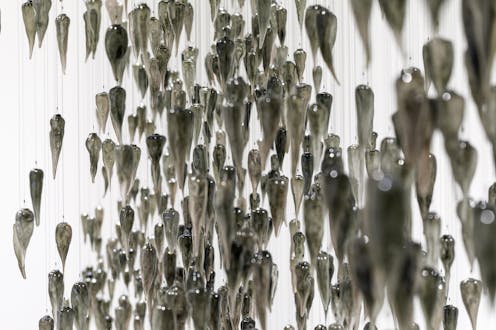
The exhibition is installed across two levels, conjoined through an architectural void that invites spectacle. In this void, Scarce’s glistening Thunder Raining Poison (2016-17) hangs from the ceiling by hundreds of wires.
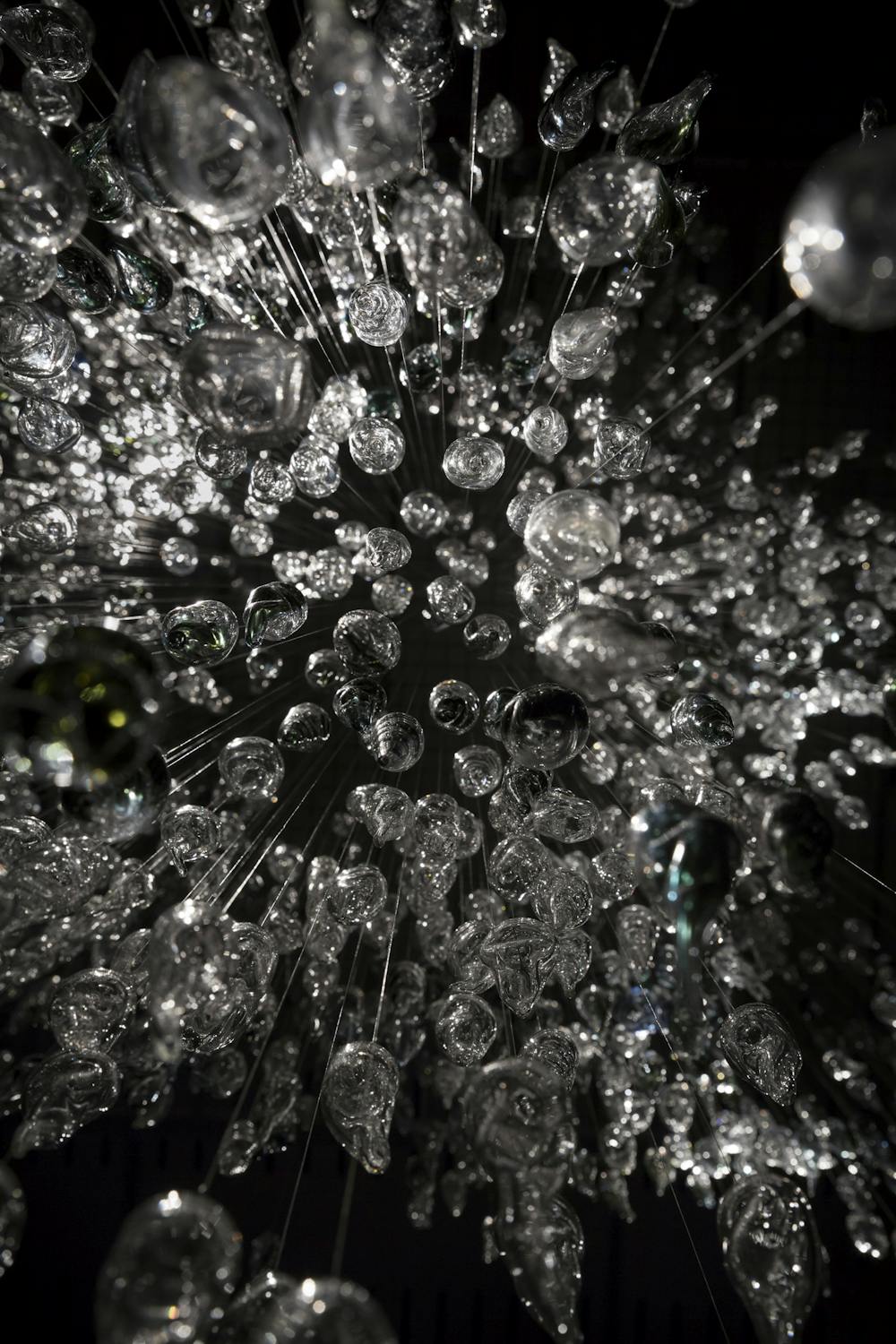
Scarce’s works are so steeped in the contemporary art idiom that, despite the centrality of glass throughout this exhibition, we might not at first consider her a “glass artist”. Yet in Thunder Raining Poison, and in her two other “cloud” works, Cloud Chamber (2020) and Death Zephyr (2016), the artist draws our attention to the fragility and beauty of the material.
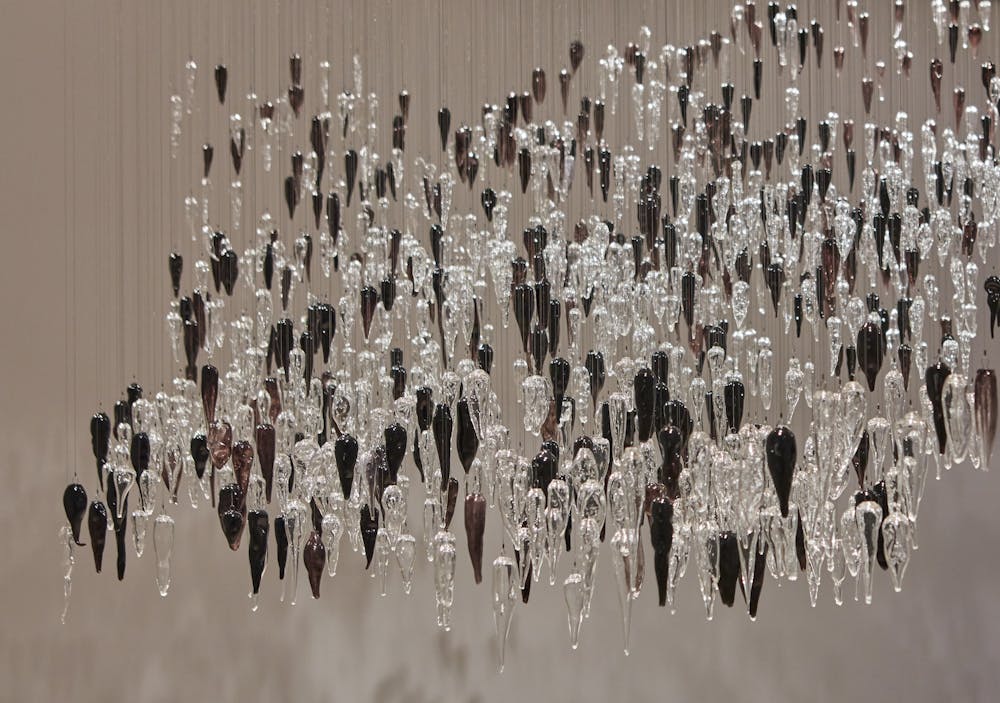 Death Zephyr (2016) (detail). Hand-blown glass, nylon and steel, dimensions variable. Art Gallery of New South Wales. Purchased with funds provided by the Aboriginal Art Collection Benefactors, 2017. © Yhonnie Scarce. Image © Art Gallery of New of New South Wales 14.2017.a-c.
Each of these cloud works are clusters of hanging glass yams. This potato-like tuberous root vegetable, which urban-dwelling Australians may not be familiar with, grows throughout the bush.
In Scarce’s aesthetic and material, yams signify death. The sensitivity of the exhibition’s themes, and perhaps the low lighting, seem to demand quiet in the space. In this silence we hear the gentle chiming of the hand blown yams, reinforcing their fragility.
Hanging in clusters, these clear and black glass yams evoke the dynamism of clouds collapsing into sheets of rain – black rain – falling after the nuclear bomb tests[1] that were carried out on Scarce’s traditional lands in South Australia, between 1952 and 1963. Born in Woomera, Scarce is descended from the Lake Eyre Kokatha people and the Southern Flinders Ranges Nukunu people.
The works resonate with another Indigenous work in the gallery’s collection that isn’t currently on display: Lin Onus’s installation work, Maralinga[2] (1990), which depicts an Aboriginal woman and children facing, in horror, a mushroom cloud signified by radioactive symbols. Yet Scarce’s material dialect is much more poetic.
Nuclear colonialism
Australian nuclear colonialism is a recurrent theme in the exhibition, with the upstairs gallery including three of Scarce’s Glass Bomb works from the Blue Danube series (2015).
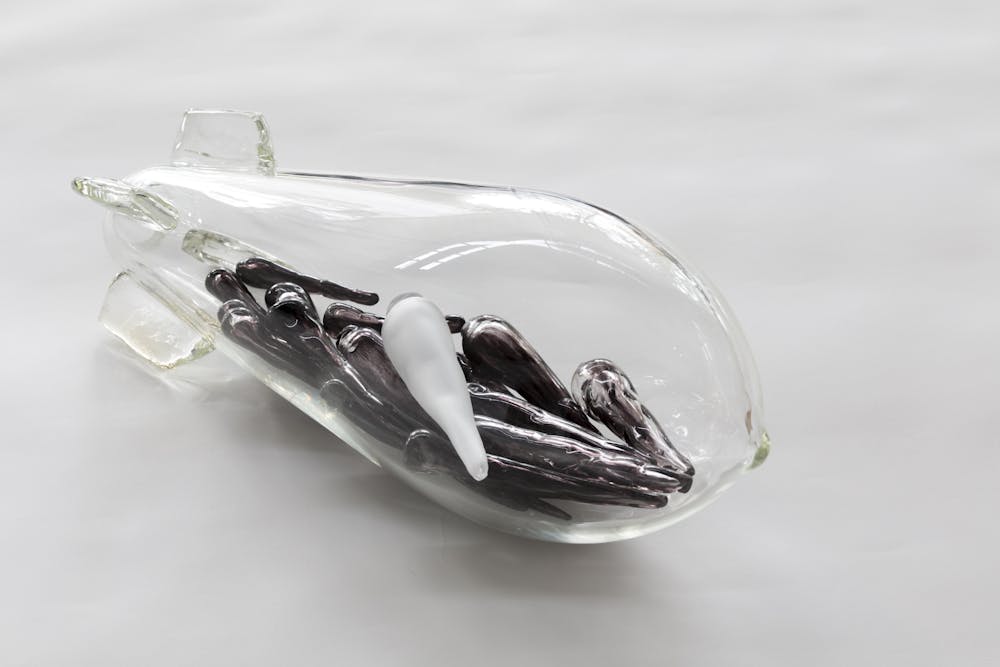 Glass Bomb (Blue Danube) Series 1, 11, 111 (2015). Hand-blown glass, yarn 18x48x18; 25x60x25; 22x64x22cm. Purchased 2016. Collection: National Gallery of Australia, Canberra. © Yhonnie Scarce.
Perhaps the most poignant work with this theme is Fallout Babies (2016). Set in a corner space, this work is partially surrounded by a floor-to-ceiling photograph of a graveyard with the buried bodies of children from communities that were exposed to the fallout from the bomb testing[3]. The bodies are metaphorically represented by bulbous glass plums, which speak of fertility and promise.
 Fallout Babies (2016). Blown glass, found hospital cribs, dimensions variable. Collection of the artist. Image courtesy of the artist and THIS IS NO FANTASY, Melbourne. © Yhonnie Scarce. Photographer: Janelle Low.
Hollowing Earth (2016-17) is made of materials quite literally infused[4] with trace amounts of uranium. It glows a luminous green under the black-lit gallery. The glass vessels in Hollowing Earth represent bush bananas, another recurrent bush food in Scarce’s aesthetic cypher. The glass surfaces of many of these voluminous glowing bodies are torn while the glass is still hot and malleable.
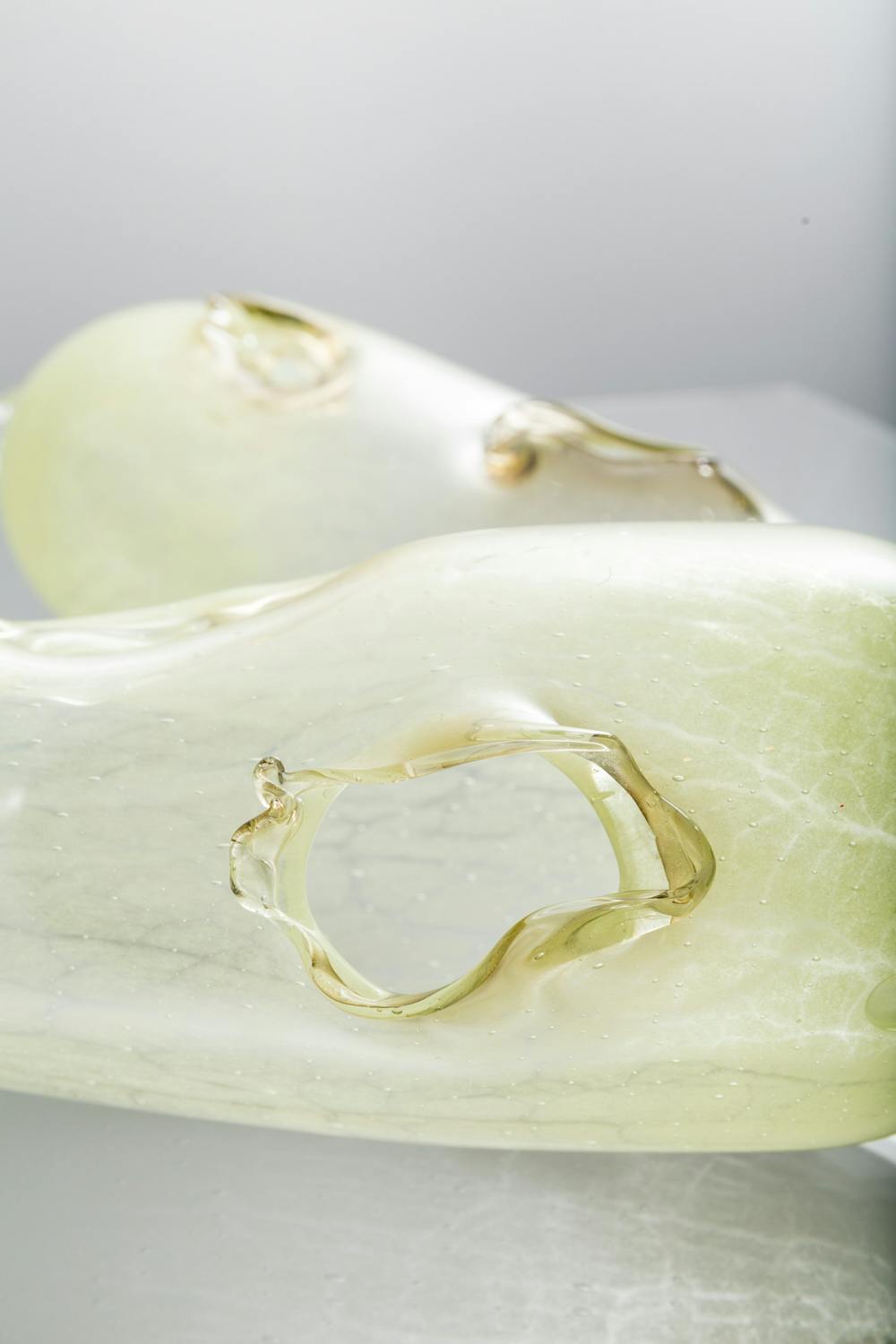 Hollowing Earth (2016-17) (detail). Blown and hot formed uranium glass, dimensions variable. Collection of the artist. Image courtesy of the artist and THIS IS NO FANTASY, Melbourne. © Yhonnie Scarce. Photographer: Janelle Low.
Read more: As the world pushes for a ban on nuclear weapons, Australia votes to stay on the wrong side of history[5]
Bush bananas also appear in the work In The Dead House (2020), a work previously installed in the old mortuary in Adelaide Botanic Gardens as part the 2020 Adelaide Biennial of Australian Art[6]. Laid out on a vintage mortuary trolley, fragile glass bodies are ripped wide open.
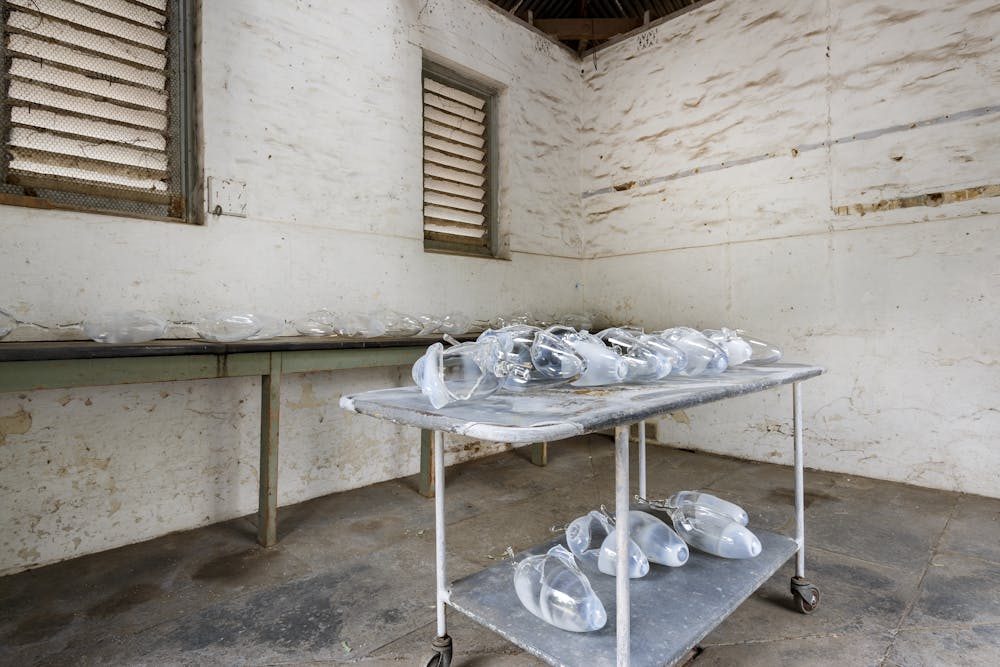 In the dead house (2020). Hand-blown glass, found mortuary trolley, dimensions variable. Collection of the artist. Image courtesy of the artist and THIS IS NO FANTASY, Melbourne. © Yhonnie Scarce. Photographer: Saul Steed.
The work references early 20th century Adelaide coroner, Ramsay Smith, who profited from exporting[7] Aboriginal remains to British museums. Smith is notorious for having decapitated the corpses – and the bush bananas echo heads and bodies that have been violently disgorged.
Moments of gentle beauty
Yhonnie Scarce: The Light of Day includes some moments of gentle beauty found in the love of family and tragic ancestry. Both Remember Royalty (2018) and Dinah (2016) belong to stories of trauma, institutionalised racism and inhumane colonial abuse. But these are also moments in this exhibition that actively seek to restore pride that was once brutally taken.
Dinah includes a cropped photograph of the artist’s great grandmother, Dinah Coleman, taken in the 1920s without her consent. She was at Koonibba, a Lutheran mission near Ceduna, South Australia.
As the wall text notes, the photo was quite possibly taken by the anthropologist Norman Tindale[8], who visited in 1924. This suggests it was an anthropological image that subjected Dinah to a dehumanising scientific gaze. Scarce’s cropped photograph of Dinah restores her dignity and humanity.
Similarly, Remember Royalty takes images of Scarce’s close ancestors and enlarges them on fine vintage fabrics. They look out at an audience in 2024, returning their gaze as equals. Not surprisingly, this complex and sensitively presented work was acquired by London’s Tate Modern gallery in 2022.
As with the other works in this exhibition, we have the opportunity to contemplate this work in its raw yet visually seductive materiality, before this and the other works are once again dispersed.
Yhonnie Scarce: The Light of Day is at the Art Gallery of Western Australia until May 19.
Read more: We sliced open radioactive particles from soil in South Australia and found they may be leaking plutonium[9]
References
- ^ nuclear bomb tests (www.nma.gov.au)
- ^ Maralinga (sc.artgallery.wa.gov.au)
- ^ bomb testing (www.nma.gov.au)
- ^ literally infused (www.decorativecollective.com)
- ^ As the world pushes for a ban on nuclear weapons, Australia votes to stay on the wrong side of history (theconversation.com)
- ^ 2020 Adelaide Biennial of Australian Art (theconversation.com)
- ^ profited from exporting (www.abc.net.au)
- ^ Norman Tindale (aiatsis.gov.au)
- ^ We sliced open radioactive particles from soil in South Australia and found they may be leaking plutonium (theconversation.com)