Mosquitoes can spread the flesh-eating Buruli ulcer. Here’s how you can protect yourself
- Written by: Cameron Webb, Clinical Associate Professor and Principal Hospital Scientist, University of Sydney
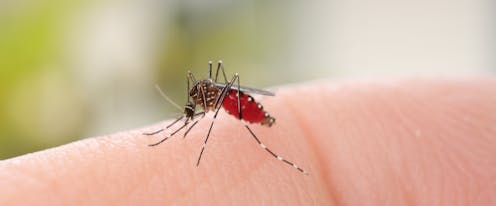
Each year, more and more Victorians become sick with a flesh-eating bacteria known as Buruli ulcer. Last year[1], 363 people presented with the infection, the highest number since 2004.
But it has been unclear exactly how it spreads, until now. New research[2] shows mosquitoes are infected from biting possums that carry the bacteria. Mozzies spread it to humans through their bite.
What is Buruli ulcer?
Buruli ulcer[3], also known as Bairnsdale ulcer, is a skin infection caused by the bacterium Mycobacterium ulcerans.
It starts off like a small mosquito bite and over many months, slowly develops into an ulcer, with extensive destruction of the underlying tissue.
While often painless initially, the infection can become very serious. If left untreated, the ulcer can continue to enlarge. This is where it gets its “flesh-eating” name.
Thankfully, it’s treatable. A six to eight week course of specific antibiotics is an effective treatment, sometimes supported with surgery to remove the infected tissue.
Where can you catch it?
The World Health Organization[4] considers Buruli ulcer a neglected tropical skin disease. Cases have been reported across 33 countries, primarily in west and central Africa.
However, since the early 2000s, Buruli ulcer has also been increasingly recorded in coastal Victoria, including suburbs around Melbourne[5] and Geelong.
Scientists have long known Australian native possums[6] were partly responsible for its spread, and suspected mosquitoes[7] also played a role in the increase in cases. New research[8] confirms this.
Our efforts to ‘beat Buruli’
Confirming the role of insects in outbreaks of an infectious disease is achieved[9] by building up corroborating, independent evidence.
In this new research[10], published in Nature Microbiology, the team (including co-authors Tim Stinear, Stacey Lynch and Peter Mee) conducted extensive surveys across a 350 km² area of Victoria.
We collected mosquitoes and analysed the specimens to determine whether they were carrying the pathogen, and links to infected possums and people. It was like contact tracing[11] for mosquitoes.
Molecular testing of the mosquito specimens showed that of the two most abundant mosquito species, only Aedes notoscriptus (a widespread species commonly known as the Australian backyard mosquito) was positive for Mycobacterium ulcerans.
We then used genomic tests to show the bacteria found on these mosquitoes matched the bacteria in possum poo and humans with Buruli ulcer.
We further analysed mosquito specimens that contained blood to show Aedes notoscriptus was feeding on both possums and humans.
To then link everything together, geospatial analysis revealed the areas where human Buruli ulcer cases occur overlap with areas where both mosquitoes and possums that harbour Mycobacterium ulcerans are active.
Stop its spread by stopping mozzies breeding
The mosquito in this study primarily responsible for the bacteria’s spread is Aedes notoscriptus, a mosquito that lays its eggs around water in containers in backyard habitats.
Controlling “backyard” mosquitoes is a critical part of reducing the risk of many global mosquito-borne disease, especially dengue[12] and now Buruli ulcer.
Read more: It's warming up and mozzies are coming. Here's how to mosquito-proof your backyard[13]
You can reduce places where water collects after rainfall, such as potted plant saucers, blocked gutters and drains, unscreened rainwater tanks, and a wide range of plastic buckets and other containers. These should all be either emptied at least weekly[14] or, better yet, thrown away or placed under cover.
There is a role for insecticides too. While residual insecticides applied to surfaces around the house and garden will reduce mosquito populations, they can also impact[15] other, beneficial, insects. Judicious use of such sprays is recommended. But there are ecological safe insecticides[16] that can be applied to water-filled containers (such as ornamental ponds, fountains, stormwater pits and so on).
Recent research also indicates new mosquito-control approaches that use mosquitoes themselves to spread insecticides[17] may soon be available.
Read more: Stickers and wristbands aren't a reliable way to prevent mosquito bites. Here's why[18]
How to protect yourself from bites
The first line of defence will remain personal protection measures against mosquito bites.
Covering up with loose fitted long sleeved shirts, long pants, and covered shoes will provide physical protection from mosquitoes.
Applying topical insect repellent to all exposed areas of skin has been proven to provide safe and effective protection[19] from mosquito bites. Repellents should include[20] diethytolumide (DEET), picaridin[21] or oil of lemon eucalyptus.
While the rise in Buruli ulcer is a significant health concern, so too are many other mosquito-borne diseases[22]. The steps to avoid mosquito bites and exposure to Mycobacteriam ulcerans will also protect against viruses such as Ross River, Barmah Forest, Japanese encephalitis, and Murray Valley encephalitis.
Read more: How can the bite of a backyard mozzie in Australia make you sick?[23]
References
- ^ Last year (www.premier.vic.gov.au)
- ^ New research (www.nature.com)
- ^ Buruli ulcer (www.betterhealth.vic.gov.au)
- ^ World Health Organization (www.who.int)
- ^ around Melbourne (www.theguardian.com)
- ^ Australian native possums (journals.plos.org)
- ^ mosquitoes (www.ncbi.nlm.nih.gov)
- ^ New research (www.nature.com)
- ^ achieved (www.health.vic.gov.au)
- ^ new research (www.nature.com)
- ^ contact tracing (theconversation.com)
- ^ especially dengue (journals.plos.org)
- ^ It's warming up and mozzies are coming. Here's how to mosquito-proof your backyard (theconversation.com)
- ^ emptied at least weekly (theconversation.com)
- ^ they can also impact (theconversation.com)
- ^ ecological safe insecticides (onlinelibrary.wiley.com)
- ^ mosquitoes themselves to spread insecticides (academic.oup.com)
- ^ Stickers and wristbands aren't a reliable way to prevent mosquito bites. Here's why (theconversation.com)
- ^ provide safe and effective protection (www.jaad.org)
- ^ include (www.phrp.com.au)
- ^ picaridin (www.phrp.com.au)
- ^ so too are many other mosquito-borne diseases (theconversation.com)
- ^ How can the bite of a backyard mozzie in Australia make you sick? (theconversation.com)