Queen Margrethe II is the first Danish monarch to abdicate in 900 years – but it is just a sign of the times
- Written by: Darius von Guttner Sporzynski, Historian, Australian Catholic University
Queen Margrethe II of Denmark’s announcement[1] of her abdication in her New Year’s Eve address, citing her age and health, was a significant shock[2] to the Danes.
Margrethe became Queen of Denmark following the death of her father, King Frederik IX, in 1972. When Queen Elizabeth II died in 2022, Margrethe became Europe’s longest-reigning monarch and is the world’s longest-serving current female head of state. She is also the world’s sole queen regnant – that is, a queen who reigns in her own right independent of her spouse’s rank and titles.
Her decision to abdicate marks a significant departure from what she had repeatedly said before: her intention was to remain on the throne for life, as did her predecessors. Queen Margrethe II will break the nearly 900-year-old tradition[3] of lifelong reign in Denmark.
The abdication ceremony is scheduled for Sunday January 14, coinciding with the 52nd anniversary of Margrethe’s accession to the throne[4]. This historic moment will also see Crown Princess Mary becoming the first Australian-born queen consort as wife of the new king, Frederik X.
But while this announcement may have come as a shock, royal abdications – once rare and often scandalous events – have become more frequent over the past century.
When it isn’t ‘duty first’
Abdications, whether influenced by personal, political or health-related factors, significantly impact royal families, state institutions and national identities. Each instance of abdication holds the potential to shift public perceptions regarding the monarchy’s value as an institution and ignite debates about the monarchy’s relevance.
In 2014, Juan Carlos I of Spain – once praised as a restorer of democracy – abdicated amid scandal[5] and self-exiled to Saudi Arabia. After his abdication, thousands of people across Spain marched[6] calling for a referendum into the future of the monarchy and Spain’s return to a republican system.
 Protestors carry a banner reading ‘for the third republic!’ during a protest against monarchy in Madrid in 2013.
AP Photo/Andres Kudacki
Protestors carry a banner reading ‘for the third republic!’ during a protest against monarchy in Madrid in 2013.
AP Photo/Andres Kudacki
The most notable abdication of the 20th century was of King Edward VIII of Britain in 1936. King for less than a year, Edward’s intention to marry Wallis Simpson – an American socialite in the process of her second divorce – created a constitutional crisis because the democratically elected government of the United Kingdom did not support his decision to both marry and remain king[7].
Edward VIII was further constrained by his role as the head of the Church of England, which then prohibited remarriage if a former spouse was still alive. He was the first British head of state to abdicate since James II/VII in 1688 was declared to have abandoned the throne[8], and Edward’s abdication in pursuit of personal happiness was a watershed moment in royal British history.
 Duke Windsor, formerly King Edward VIII, and his wife Wallis Simpson, Duchess of Windsor.
AP Photo, File
Duke Windsor, formerly King Edward VIII, and his wife Wallis Simpson, Duchess of Windsor.
AP Photo, File
Read more: A new monarch who is a divorcee would once have scandalised. But Charles' accession shows how much has changed[9]
This event’s lasting impact was epitomised by his niece, Queen Elizabeth II, who throughout her reign embodied the ethos[10] of placing “duty first, self second”.
Across the Channel, in Europe’s constitutional monarchies, the position of a monarch is not seen as sanctioned by divine command[11] but as established by secular law and abdications are not seen as a dereliction of duty.
In the last 25 years, monarchs of Belgium (King Albert II[12]), Luxembourg (Grand Duke Jean[13]) and the Netherlands (Queen Beatrix[14]) voluntarily handed down the office to their successors.
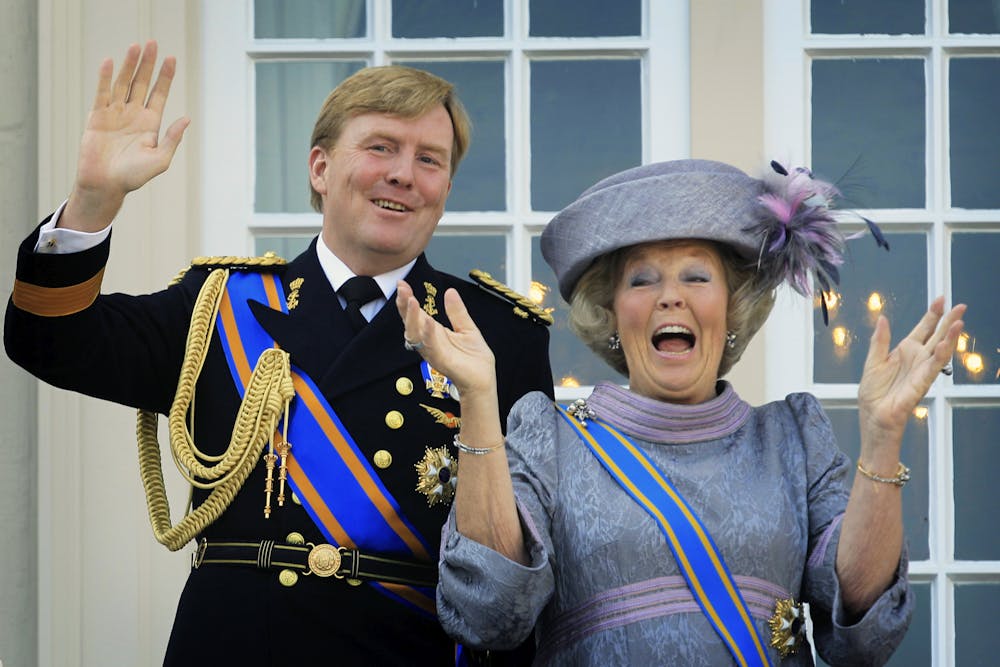 Dutch Queen Beatrix with Crown Prince Willem Alexander in 2010, three years before Queen Beatrix’s abdication.
AP Photo/Peter Dejong
Dutch Queen Beatrix with Crown Prince Willem Alexander in 2010, three years before Queen Beatrix’s abdication.
AP Photo/Peter Dejong
Their renunciation of the office was a novelty after most of their predecessors stayed in the role for life, but was seen as functional and symptomatic of the constitutional nature of their office.
Global abdications
The 2013 abdication of Pope Benedict XVI, the leader of the Roman Catholic Church and the head of state of the Vatican City, was as unexpected as it was unprecedented. Benedict XVI was the first pope to step down since Gregory XII[15], who was forced to resign in 1415, and the first pope to do so voluntarily since Celestine V in 1294[16].
The pontiff offered a frank justification[17] for his decision: someone of his age was no longer suited to the papacy in the modern world. His abdication paved the way for election of his successor and established a precedent for the retirement of popes with the retiring pontiff to be called “pope emeritus”.
Read more: Pope's resignation is a recognition of human frailty in an ageing world[18]
Outside Europe, Emperor Akihito of Japan abdicated in 2019[19], the first emperor to abdicate in 200 years. He explained his actions in similar terms to Benedict XVI and Margarethe II, citing his health and that it was time for a younger monarch to exercise a complex constitutional role.
 After the first abdication in 200 years, Emperor Akihito became Emperor Emeritus.
EPA/Imperial Household Agency Handout via Jiji Press
After the first abdication in 200 years, Emperor Akihito became Emperor Emeritus.
EPA/Imperial Household Agency Handout via Jiji Press
This century has also seen similar steps taken by rulers of Bhutan[20], Qatar[21], Kuwait[22] and Malaysia[23].
Queen Margrethe II’s abdication is a sign of times. Monarchs, after years of service, can exercise the right to retire, paralleling the rights of the citizens of their realms.
This shift, while upending centuries-old traditions, suggests a more relatable and empathetic view of monarchy, aligning it closer with contemporary values of personal agency.
Read more: Japan: a new emperor and a new era – but women are still excluded from the Chrysanthemum Throne[24]
References
- ^ announcement (www.kongehuset.dk)
- ^ significant shock (www.theguardian.com)
- ^ nearly 900-year-old tradition (www.kongehuset.dk)
- ^ accession to the throne (www.kongehuset.dk)
- ^ abdicated amid scandal (www.abc.net.au)
- ^ marched (www.theguardian.com)
- ^ marry and remain king (www.vogue.com)
- ^ declared to have abandoned the throne (www.jstor.org)
- ^ A new monarch who is a divorcee would once have scandalised. But Charles' accession shows how much has changed (theconversation.com)
- ^ embodied the ethos (widerimage.reuters.com)
- ^ sanctioned by divine command (www.firstthings.com)
- ^ King Albert II (www.bbc.com)
- ^ Grand Duke Jean (monarchie.lu)
- ^ Queen Beatrix (www.royal-house.nl)
- ^ Gregory XII (www.newadvent.org)
- ^ Celestine V in 1294 (www.britannica.com)
- ^ frank justification (insidethevatican.com)
- ^ Pope's resignation is a recognition of human frailty in an ageing world (theconversation.com)
- ^ in 2019 (www.bbc.com)
- ^ Bhutan (www.aljazeera.com)
- ^ Qatar (www.npr.org)
- ^ Kuwait (www.aljazeera.com)
- ^ Malaysia (www.smh.com.au)
- ^ Japan: a new emperor and a new era – but women are still excluded from the Chrysanthemum Throne (theconversation.com)