The Times Australia
Google AI
The Times World News

.

Government's employment white paper commits to jobs for all who want them – and help to get them

  • Written by Michelle Grattan, Professorial Fellow, University of Canberra

The employment white paper, released on Monday, has outlined multiple measures the Albanese government will implement to assist the about three million people who want jobs or more hours of work.

They include making permanent a temporary measure allowing pensioners to earn more, smoothing the transition to work for people on welfare, and alleviating the disadvantage many of the unemployed face.

In the white paper, prepared by Treasury, the government commits to full employment, which it defines as “everyone who wants a job [being] able to find one without having to search for too long”.

It does not put a number on the unemployment rate this represents.

The government will make permanent the current work bonus measure for older pensioners and eligible veterans so they can work more without reducing their pension.

It will double the period during which many income support recipients can receive no payment, thus allowing them to keep access to social security benefits such as concession cards for longer when they first get back into work.

Social enterprises will be backed to address persistent labour market disadvantage. TAFE will be boosted, and the take up of “higher apprenticeships” in the priority areas of net zero, the care and digitisation will be accelerated.

In addition to nine immediate measures the paper looks to longer term policies to enhance people’s access to the labour market.

“The government’s vision is for a dynamic and inclusive labour market in which everyone has the opportunity for secure, fairly paid work and people, businesses and communities can be beneficiaries of change and thrive. We are working to create more opportunities for more people in more places,” the paper says.

The paper comes as the unemployment rate is at 3.7%, which is expected to tick up as the economy slows. This is very low for modern times but the white paper highlights constraints to higher employment.

“Inclusive full employment is about broadening opportunities, lowering barriers to work including discrimination, and reducing structural underutilisation over time to increase the level of employment in our economy.”
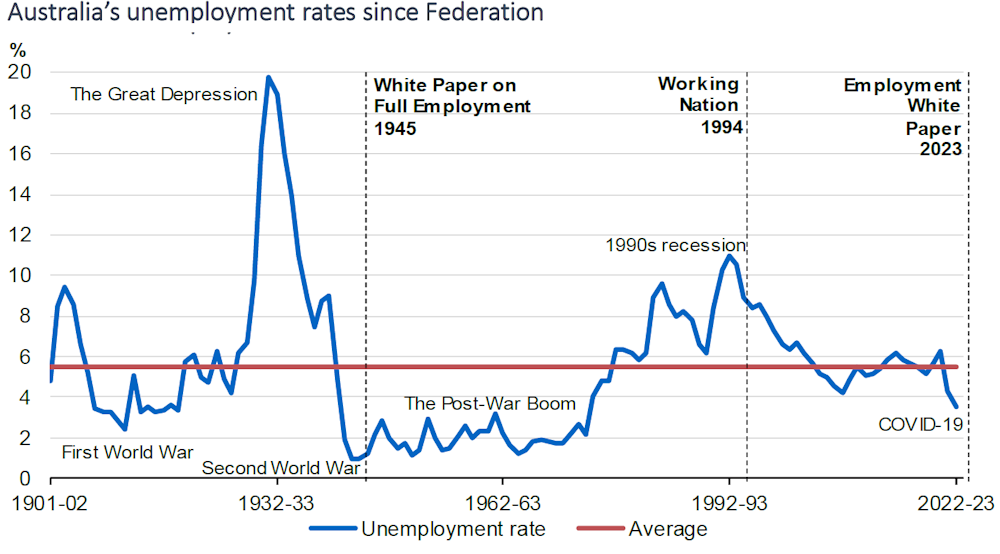
Commonwealth Treasury[1] Structural underutilisation is a mismatch between potential workers and available work. Reasons include workers’ skills not matching what the jobs need, workers and jobs being geographically apart, and barriers presented by disadvantage or discrimination. “The government will take a broad approach to achieving sustained and inclusive full employment. This includes sound macroeconomic management to help keep employment as close as possible to its current maximum sustainable level in the short term. We are also committed to addressing the structural sources of underutilisation to increase the level of full employment that can be sustained over time without adding to inflationary pressures,” the paper says. “We are taking comprehensive action, including improved education, migration and regional planning systems, and setting out reform directions to improve key enablers such as employment services, affordable and accessible child care, and housing. We are equipping the workforce with the skills needed for the jobs of the future, and enhancing the ability of individuals and businesses to adapt to the modern labour market”. The report says increasing participation in work promotes social inclusion as well as boosting the country’s economic potential. It notes the five regions with the highest long term unemployment make up 12% of all the country’s long term unemployed, although they have only 5% of the working age population. Disadvantage can led to “intergenerational cycles of joblessness”, the paper says. Complex personal circumstances and discrimination compound local factors. “Many people face multiple, interconnected barriers to employment such as a lack of access to services or secure and affordable housing.” Unemployment particularly affects certain cohorts, including Indigenous people, people with disabilities and the young. The paper points to the major forces that will shape the economy over coming decades. They are the ageing population, a rising demand for care and support services, the growing use of digital and advanced technologies, the global net zero transformation, and increasing geopolitical risk and fragmentation disrupting supply chains and making resilience more important. “These forces are changing the composition of our industries, workforce needs, and the nature of work itself.” The paper looks to renewable energy and digital technologies to improve productivity and says boosting productivity in industries such as care and support services will be increasingly important. “Rather than repeating previous waves of reforms, Australia’s productivity agenda needs to respond to current economic circumstances and identify modern strategies to advance enduring policy goals.” References^ Commonwealth Treasury (treasury.gov.au)

Read more https://theconversation.com/governments-employment-white-paper-commits-to-jobs-for-all-who-want-them-and-help-to-get-them-214256

Times Magazine

With Nvidia’s second-best AI chips headed for China, the US shifts priorities from security to trade

This week, US President Donald Trump approved previously banned exports[1] of Nvidia’s powerful ...

Navman MiVue™ True 4K PRO Surround honest review

If you drive a car, you should have a dashcam. Need convincing? All I ask that you do is search fo...

Australia’s supercomputers are falling behind – and it’s hurting our ability to adapt to climate change

As Earth continues to warm, Australia faces some important decisions. For example, where shou...

Australia’s electric vehicle surge — EVs and hybrids hit record levels

Australians are increasingly embracing electric and hybrid cars, with 2025 shaping up as the str...

Tim Ayres on the AI rollout’s looming ‘bumps and glitches’

The federal government released its National AI Strategy[1] this week, confirming it has dropped...

Seven in Ten Australian Workers Say Employers Are Failing to Prepare Them for AI Future

As artificial intelligence (AI) accelerates across industries, a growing number of Australian work...

The Times Features

Why Fitstop Is the Gym Australians Are Turning to This Christmas

And How ‘Training with Purpose’ Is Replacing the Festive Fitness Guilt Cycle As the festive season ...

Statement from Mayor of Randwick Dylan Parker on Bondi Beach Terror Attack

Our community is heartbroken by the heinous terrorist attack at neighbouring Bondi Beach last nigh...

Coping With Loneliness, Disconnect and Conflict Over the Christmas and Holiday Season

For many people, Christmas is a time of joy and family get-togethers, but for others, it’s a tim...

Surviving “the wet”: how local tourism and accommodation businesses can sustain cash flow in the off-season

Across northern Australia and many coastal regions, “the wet” is not just a weather pattern — it...

“Go west!” Is housing affordable for a single-income family — and where should they look?

For decades, “Go west!” has been shorthand advice for Australians priced out of Sydney and Melbo...

Housing in Canberra: is affordable housing now just a dream?

Canberra was once seen as an outlier in Australia’s housing story — a planned city with steady e...

What effect do residential short-term rentals have on lifestyle and the housing market in Brisbane?

Walk through inner-Brisbane suburbs like Fortitude Valley, New Farm, West End or Teneriffe and i...

The Sydney Harbour Bridge faces tolls once again — despite tolls being abolished years ago. Why?

For many Sydney motorists, the Harbour Bridge toll was meant to be history. The toll booths cam...

The Victorian Paradox: how Labor keeps winning elections even when it feels “unpopular”

If you spend any time in a Melbourne café, a tradie ute yard, a Facebook comments section, or th...