As Australia strengthens its ties with the Philippines, it's wading even further into the dangerous South China Sea
- Written by: Noel Morada, Director (Regional Diplomacy and Capacity Building) Asia Pacific Centre for the Responsibility to Protect, The University of Queensland
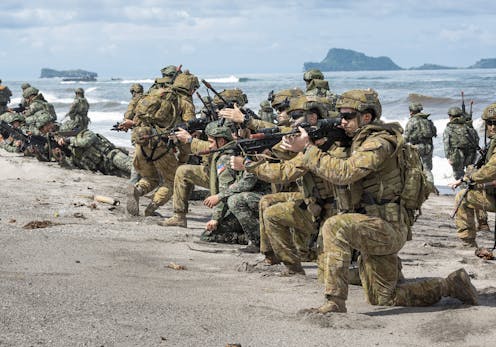
At the end of last week, 1,200 Australian troops took part in a joint military exercise[1] in the Philippines with hundreds of Filipino and American forces. Their mission: simulating the retaking of an island by a hostile force, presumably in the South China Sea.
Australian Defence Minister Richard Marles joined Filipino President Ferdinand Marcos Jr. to observe the drills, reportedly the largest ever between the two nations. Marles then announced[2] Australia would begin joint maritime patrols with the Philippines in the contested South China Sea very soon.
Next week, Prime Minister Anthony Albanese will also visit the Philippines, with maritime issues, defence and security on the agenda[3].
Although Marles was careful not to reference China directly during a press conference in the Philippines, Australia’s push to deepen its strategic ties with Manila comes at a time of heightened tensions with Beijing in the South China Sea. (It’s known as the West Philippine Sea in the Philippines).
In early August, a Chinese coast guard vessel used a water cannon[4] against a Filipino coast guard boat that was attempting to deliver supplies to soldiers manning a grounded naval vessel on Second Thomas Shoal[5] (or Ayungin in the Philippines).
Manila maintains the shoal is in its exclusive economic zone. China, meanwhile, claims it falls within its sovereign territory.
The incident is just the latest in a series of aggressive, harassing actions[6] by the Chinese coast guard and maritime militia in the area since the beginning of the year.
So, with tensions running so high in the sea, why is Australia getting involved by deepening its military ties with the Philippines? What impact could this have on the region?
Read more: Explainer: why is the South China Sea such a hotly contested region?[7]
Marcos solidifies defence commitments from the US
The Philippines is among five other competing claimants in the South China Sea, along with Brunei, Malaysia, Vietnam, Taiwan and China. Unlike China, which claims sovereignty over the entire South China Sea using the so-called “nine-dash line”, the others assert only limited sovereignty in the area.
In 2016, the Philippines won a landmark case against China in an international tribunal in The Hague that declared the “nine-dash line” invalid[8] and a violation of the United Nations Convention on the Law of the Sea. China did not recognise the ruling and has been continuing its military build-up in the sea and harassment of Philippine vessels.
Although the Philippines gained widespread international support with the ruling, it remains militarily weak and limited in its ability to thwart Chinese incursions in its exclusive economic zone.
This has been a main focus of the Marcos administration since taking office in June 2022. During a visit to the White House in May, Marcos and US President Joe Biden agreed to new guidelines[9] on the countries’ 1951 Mutual Defence Treaty[10].
This treaty commits both parties to respond in the event of an attack on either one “anywhere in the South China Sea”. Notably, the guidelines also acknowledge the threats posed by “grey zone tactics[11]”, such as blockades, intimidation and harassment.
This year, the Philippines also agreed to add four more military bases[12] the US can access under a separate defence agreement.
Due to China’s aggressive actions in the South China Sea and adamant refusal to recognise the tribunal ruling on the “nine-dash line”, public opinion[13] in the Philippines now shows a high level of distrust towards China (67%). In contrast, there is a high level of trust towards the US (89%), Australia (79%) and Japan (78%).
This lack of trust towards China is shared by many in the Philippine government, defence establishment and legislature.
Why deeper ties with Australia matter
At the same time it has re-pivoted towards the US, the Philippines government has also been busy enhancing its defence and diplomatic ties with Australia.
In May, Foreign Minister Penny Wong visited Manila and announced Australia’s readiness to elevate their relationship to a “strategic partnership”. She also reiterated Australia’s commitment to continue its presence in the South China Sea to promote peace and stability, as well as freedom of navigation.
Marles pointed out[14] last week that much of Australia’s trade goes through the South China Sea and Australia is committed to upholding the international rules-based order in the region.
Albanese’s upcoming visit to Manila will build on these diplomatic overtures. The two countries are expected to sign agreements that will formalise their strategic partnership. These will cover defence and maritime security cooperation, as well as enhanced economic, trade and cultural ties.
These stronger ties don’t come out of nowhere. While Australia doesn’t have the same kind of mutual defence treaty with Manila, it has a deep defence relationship[15] with the Philippines dating back to the second world war.
Australia and the US are also the only two countries with a “visiting forces[16]” agreement with the Philippines, which provides a legal framework for Australian and American troops to be in the country.
Given Australia has recently sought to steady its rocky relationship with China, this cooperation with the Philippines could come at a cost. As expected, China voiced its displeasure[17] over last week’s military drills.
Over the long term, both Australia and the Philippines should also be aware of the risks posed by their security alliances with the US, which could potentially involve them both in a conflict with China over Taiwan or the South China Sea.
As the military drills last week make clear, Australia seems prepared to take that risk and step up its cooperation with a key regional ally nonetheless. As Marles pointedly said in Manila, the global rules-based order is “deeply connected to our respective national interests” and “collective security”.
References
- ^ joint military exercise (abcnews.go.com)
- ^ announced (www.afr.com)
- ^ on the agenda (www.rappler.com)
- ^ used a water cannon (edition.cnn.com)
- ^ Second Thomas Shoal (www.aspistrategist.org.au)
- ^ aggressive, harassing actions (www.reuters.com)
- ^ Explainer: why is the South China Sea such a hotly contested region? (theconversation.com)
- ^ invalid (www.nytimes.com)
- ^ new guidelines (www.reuters.com)
- ^ 1951 Mutual Defence Treaty (www.officialgazette.gov.ph)
- ^ grey zone tactics (www.defense.gov)
- ^ four more military bases (www.defense.gov)
- ^ public opinion (globalnation.inquirer.net)
- ^ pointed out (www.reuters.com)
- ^ deep defence relationship (www.aspistrategist.org.au)
- ^ visiting forces (www.aph.gov.au)
- ^ voiced its displeasure (www.globaltimes.cn)