Australians' national wellbeing shows a glass half full: Measuring What Matters report
Written by: Michelle Grattan, Professorial Fellow, University of Canberra
Australia presents a mixed picture of national wellbeing, according to the government’s Measuring What Matters report released by Treasurer Jim Chalmers.
On the positive side, over the past two decades life expectancy has increased, income and job opportunities have improved, and we are better at accepting diversity.
But Australians now have more chronic health conditions, access to care and support services is more difficult, and there has been little progress on mental health.
While school outcomes have improved, they are falling behind other countries, and we are spending less time developing new skills.
After a trial run of a wellbeing statement in Treasurer Jim Chalmers’ first budget last year, he says this is the first proper national wellbeing framework.
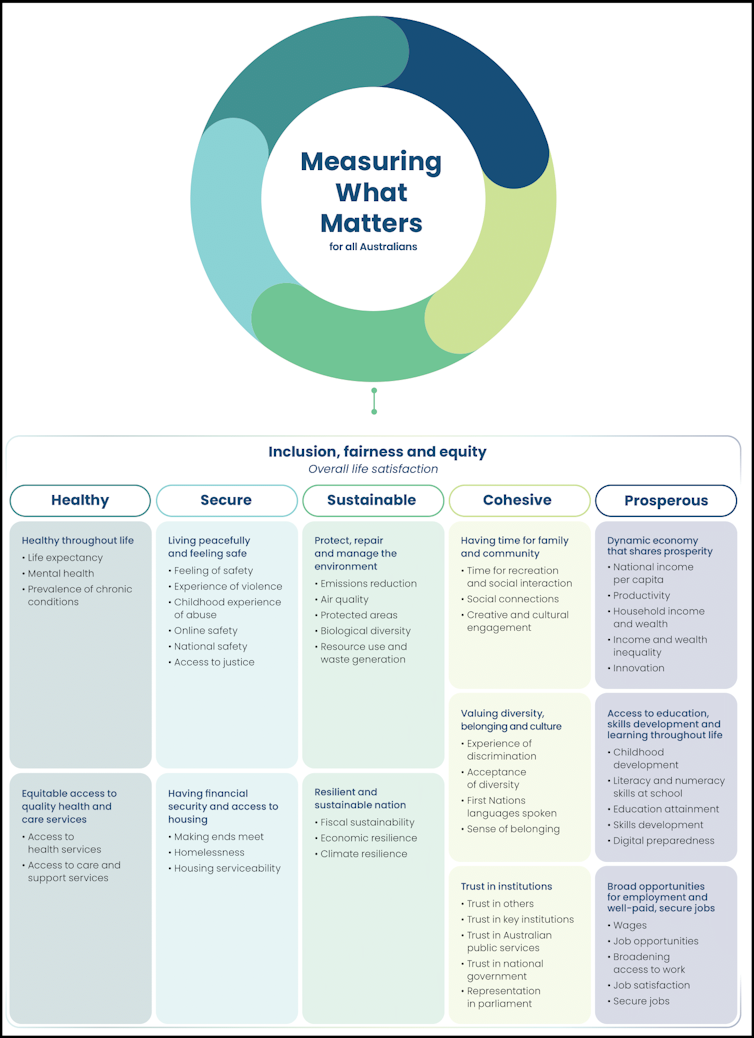
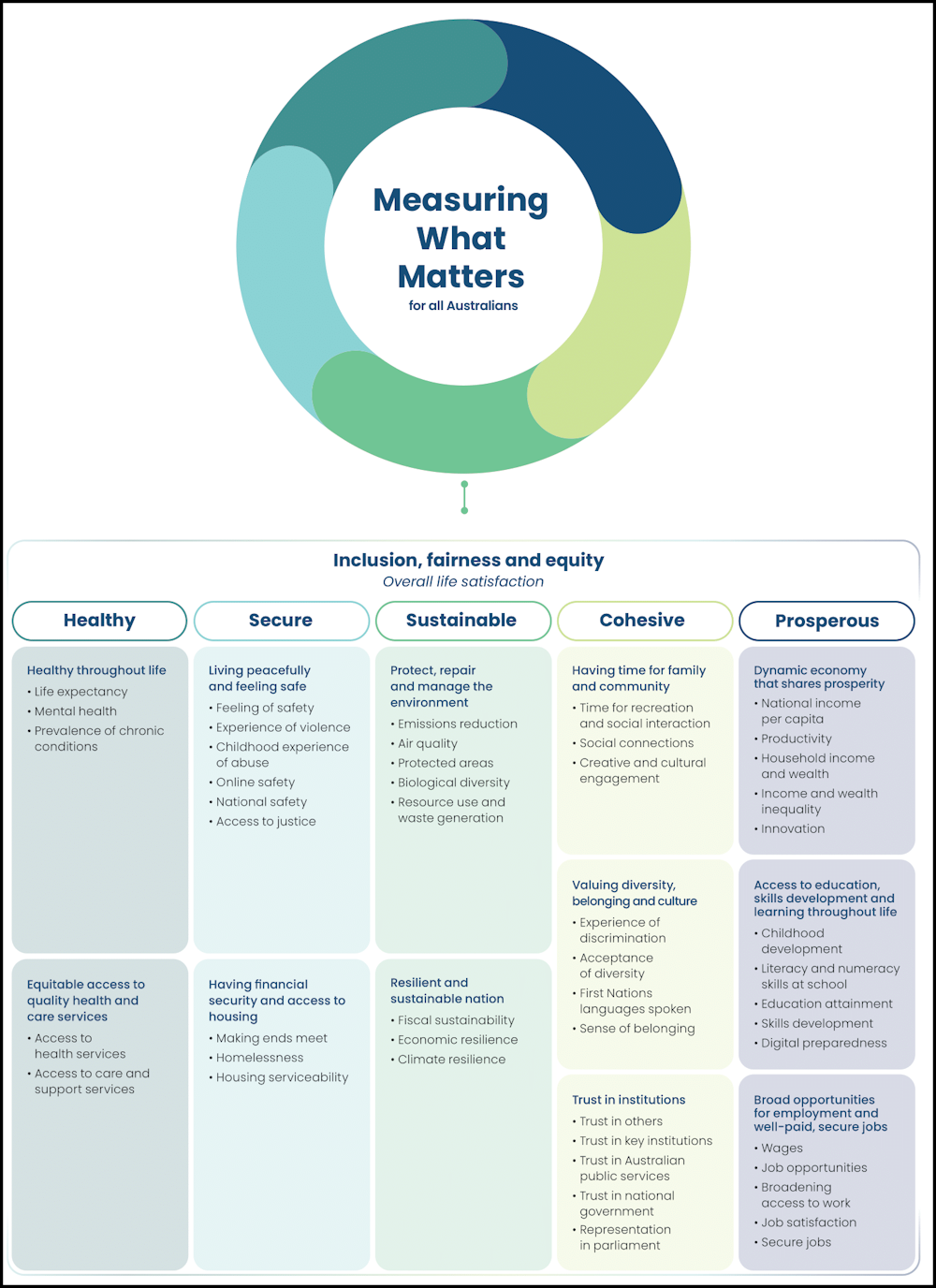
Fifty indicators are used to measure wellbeing under five themes: how healthy, secure, sustainable, cohesive and prosperous we are. The idea is to go beyond the traditional economic measures.
Measuring What Matters, Commonwealth Treasury
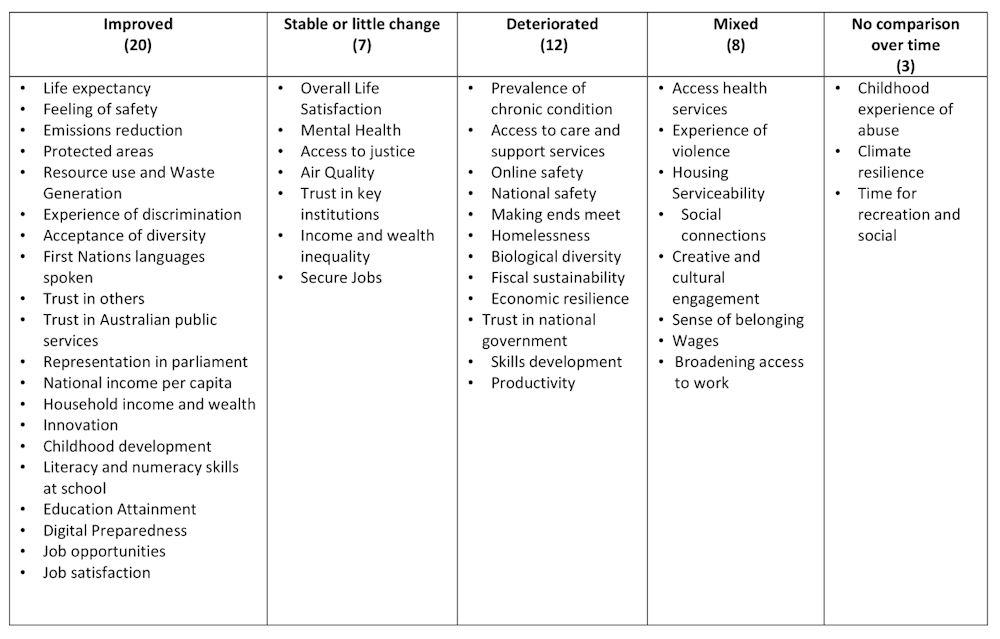
The report says that over recent decades there have been improvements in 20 of the 50 indicators, while seven have been stable or little changed, and 12 have gone backwards. Eight have mixed trends, and for three there is not comparable data.
There has been environmental progress: on emissions reduction, resources use and waste generation. But biological diversity has deteriorated.
Household income and wealth have improved, as has job satisfaction, but people are finding it harder to make ends meet and homelessness is worse. Fiscal sustainability and economic resilience have also deteriorated.
There’s been little change in income and wealth inequality. The outcome on wages is mixed.
Trust in national government has fallen, although trust in others has increased.
In relation to Indigenous Australians, the report says: “the concept of wellbeing has always been the result of preserving and maintaining culture, which directly affects mental, physical and spiritual health”.
As a result:
the whole of population indicators outlined in this Framework are not an accurate measure of First Nations wellbeing as they are limited in their ability to represent these intrinsic cultural differences or acknowledge the past practices that have had detrimental impacts
There has been little change in Australians’ overall life satisfaction in recent years.
“Between 2014 and 2020 the average overall life satisfaction in Australia (out of 10) was relatively stable at around between 7.5 between 2014 and 2019 before declining slightly to 7.2 in 2020,” the report says.
The decline was likely due to COVID.
Overall progress on Australians wellbeingMeasuring What Matters, Commonwealth Treasury


 Measuring What Matters, Commonwealth Treasury