Is Saudi Arabia using 'sportswashing' to simply hide its human rights abuses – or is there a bigger strategy at play?
- Written by: Ben Rich, Senior lecturer in History and International Relations, Curtin University
As Saudi Arabia continues to open up internationally, it is yet again in hot water over its human rights record[1]. The current controversy[2] revolves around the kingdom’s increasing presence in the sporting world and accusations of “sportswashing”.
In recent years, the Saudis have thrown the heavy weight of their Public Investment Fund[3] into partnerships with Western institutions like the PGA[4], Formula One racing[5] and World Wrestling Entertainment[6].
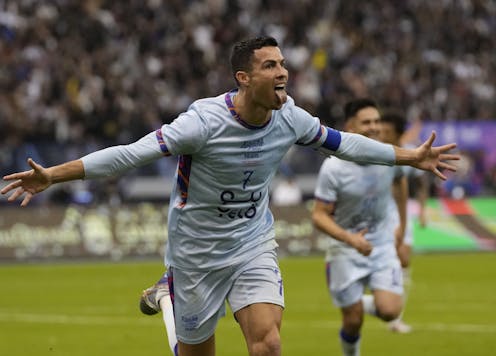
Riyadh is also luring top soccer players[7] like Cristiano Ronaldo to its national league and using Lionel Messi[8] as an influencer to promote the kingdom.
Recently, Saudi Arabia has signalled its interest in holding women’s tennis tournaments[9] and even potentially hosting the 2030 FIFA World Cup[10], as well.
While the precise dollar figure of all of these efforts is difficult to determine, it has easily reached into the billions[11].
‘Sportswashing’ atrocities?
But the Saudi sport blitz has been received with less enthusiasm by many[12] outside onlookers[13].
Human Rights Watch and many Western[14] commentators[15] describe it as simple “sportswashing[16]” – an effort to distract the world’s attention from its continual disregard for international human rights.
For instance, the kingdom has racked up a well-documented record[17] of human rights violations[18] during its eight-year proxy war in Yemen.
Despite Riyadh’s murky peace deal[19] with the Houthi fighters in Yemen in April, the war will remain a stain[20] on its humanitarian record for the foreseeable future.
The lack of any meaningful reparations following the peace deal[21] also raises the question whether the deal was simply a way for the Saudis to disengage from the war at a time when a serious rebranding campaign was needed.
Read more: Peace may finally be returning to Yemen, but can a fractured nation be put back together?[22]
At home, political freedoms and rights remain tightly constrained by the regime. Despite moves to relax some restrictions on women[23] and religious minorities, these reforms have paradoxically come with increasingly harsh measures towards peaceful dissidents.
Only last year, female activists Salma al-Shehab[24] and Nourah bint Saeed al-Qahtani[25] received prison terms of 34 years and 45 years, respectively, for their engagement with social media posts criticising the regime.
More recently, several Howeitat tribesmen were sentenced to death on terrorism charges[26] for peacefully protesting a megacity project that threatened their ancestral village.
Building a new Saudi brand
But while obfuscating human rights issues is certainly part of the equation when it comes to the kingdom’s sports mania, its motivations are far more strategic[27] than simple bait-and-switch tactics.
At their core, these actions fit within a broader effort outlined in the Saudi Vision 2030[28] campaign to rebrand the country and normalise it within the wider liberal international order.
For many outside observers, the kingdom has long been an outlier on the international stage. It’s been characterised as a primitive backwater cut off from the outside world and ruled over by a despotic monarchy that has relied on a combination of oil wealth and Islamic extremism to maintain its hold on power.
Such reductive depictions ignored a far more complex, rich and colourful history[29]. However, few in the West were keen to explore this more nuanced viewpoint (at least if my book sales[30] are anything to go by).
Saudi royals have historically been content with such stereotypes, too, provided they maintained their sovereignty and security at home. The kingdom made little effort with soft power[31] initiatives outside the Islamic world.
The international art, culture and sporting worlds were seen as being in stark contrast to the psychological and cultural norms[32] of the Wahhabi orthodoxy[33] that has long governed Saudi public life.
This all changed in 2015, however, with the ascension of King Salman and his chosen heir, Prince Mohammad bin Salman. The younger bin Salman quickly assumed[34] de facto control over many of the country’s key portfolios.
In contrast to his conservative predecessors, the prince was seen as a “disruptor[35]” with little regard for tradition. Like with many of the Silicon Valley tech-bros he emulates, bin Salman likes to move fast and break things. This includes everything from traditional religious institutions[36] to architectural rules[37].
Bin Salman’s vision is to remake the Saudi brand as a modern authoritarian technocracy in the mould of the United Arab Emirates or Qatar. He wants to emulate these successful case studies through economic reform, military modernisation, technological innovation, cultural modernisation and the opening of the kingdom to cosmopolitan cultural engagement and exchanges.
A new platform to engage with the world
These efforts took a hit, however, after the 2018 murder of journalist Jamal Khashoggi. Bin Salman denied[38] being personally involved in the murder, counter to what US intelligence reports concluded[39]. But some believed the global anger of Khashoggi’s killing could have damaged the prince’s reputation badly enough[40] to hamper his future as a statesman.
Memories can be remarkably short-lived, though. And five years on from the killing, bin Salman’s rebranding agenda is charging ahead with increased urgency. This is where the Saudi sporting onslaught comes in, and why it needs to be understood.
Control and influence over these sports provide the kingdom with enormous cachet. Saudi Arabia can use this new stature to engage in cultural outreach with the world, influence global opinion and portray itself as modern and dynamic.
To characterise all of this as mere sportswashing may be catchy, but reduces a much broader and strategic effort.
Indeed, implicit in the notion of sportswashing is that the Saudis are suddenly concerned about the country’s association with human rights violations.
But looking at the examples of Qatar and the UAE, authoritarian regimes are able to flout international norms and laws on human rights and still fit quite comfortably within the wider liberal international order. The reason: the countries serve a valuable function in sustaining that same system.
While human rights abuses will undoubtedly continue to plague the Saudis’ efforts, bin Salman is betting big they won’t stand in the way of other states and companies engaging with an increasingly open and cosmopolitan kingdom. If history is anything to go by, he may just be right.
Read more: Big money bought the PGA Tour, but can it make golf a popular sport in Saudi Arabia?[41]
References
- ^ in hot water over its human rights record (www.theguardian.com)
- ^ The current controversy (au.sports.yahoo.com)
- ^ Public Investment Fund (www.pif.gov.sa)
- ^ PGA (www.washingtonpost.com)
- ^ Formula One racing (www.formula1.com)
- ^ World Wrestling Entertainment (www.thesportster.com)
- ^ luring top soccer players (www.nytimes.com)
- ^ Lionel Messi (www.nytimes.com)
- ^ women’s tennis tournaments (apnews.com)
- ^ 2030 FIFA World Cup (www.dw.com)
- ^ billions (www.theguardian.com)
- ^ many (www.theguardian.com)
- ^ outside onlookers (www.cbsnews.com)
- ^ Western (www.abc.net.au)
- ^ commentators (www.sportingnews.com)
- ^ sportswashing (www.hrw.org)
- ^ record (reliefweb.int)
- ^ human rights violations (www.washingtonpost.com)
- ^ peace deal (www.theguardian.com)
- ^ will remain a stain (www.aljazeera.com)
- ^ peace deal (theconversation.com)
- ^ Peace may finally be returning to Yemen, but can a fractured nation be put back together? (theconversation.com)
- ^ restrictions on women (www.nytimes.com)
- ^ Salma al-Shehab (www.washingtonpost.com)
- ^ Nourah bint Saeed al-Qahtani (www.bbc.com)
- ^ sentenced to death on terrorism charges (www.ohchr.org)
- ^ are far more strategic (www.playthegame.org)
- ^ Saudi Vision 2030 (www.vision2030.gov.sa)
- ^ complex, rich and colourful history (www.mup.com.au)
- ^ book sales (www.amazon.com.au)
- ^ soft power (www.dfat.gov.au)
- ^ psychological and cultural norms (www.academia.edu)
- ^ Wahhabi orthodoxy (www.pbs.org)
- ^ assumed (www.theguardian.com)
- ^ disruptor (edition.cnn.com)
- ^ religious institutions (economictimes.indiatimes.com)
- ^ architectural rules (www.theverge.com)
- ^ denied (www.theguardian.com)
- ^ concluded (www.nytimes.com)
- ^ damaged the prince’s reputation badly enough (www.theguardian.com)
- ^ Big money bought the PGA Tour, but can it make golf a popular sport in Saudi Arabia? (theconversation.com)