Cricket's wicket ways: what the furore over a stumping tells us about Anglo-Australian relations (spoiler: they'll survive)
- Written by: Ben Wellings, Senior Lecturer in Politics and International Relations, Monash University
Someone’s got to say it: it’s just not cricket!
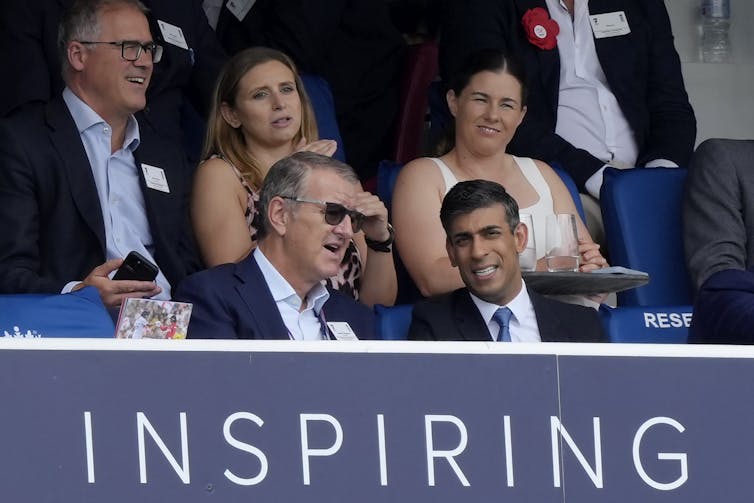
Prime ministers current[1] and former[2] have stepped up to the crease. UK Prime Minister Rishi Sunak is delivering spinners. Former Australian Prime Minister John Howard’s playing it with a straight bat. No-one is letting anything through to the keeper. I could go on.
The already febrile sporting pages of the English press have gone into overdrive about Jonny Bairstow’s controversial dismissal[3]. It’s obviously more than just a game.
The reason this is not just cricket is that the political furore over the Ashes playing out in England expresses old and new elements of the Australia-UK relationship. The old elements are that Anglo-Australian rivalries and tensions play out in the safety of social forms understood by both sides, in this case cricket.
The first Test ended in an exciting win for Australia. Much of this had to do with England’s questionable decision-making about when to declare, and a new approach to the game known as “Bazball[4]”. There’s been a lot of focus on questionable decision-making in England recently, given that June 23 marked the seventh anniversary of the UK’s referendum to leave the European Union.
Polls now show[5] many regret leaving, including those who voted to leave. The buccaneering spirit that Brexit was supposed to unleash has not materialised.
This is doubly bad news for the Conservatives, whose 2019 election-winning support[6], built on aggrieved leave-voting former Labour suporters in the north of England, has fallen away like a tail-order collapse. There’s a year and a half until the next general election is due, but trailing badly in the polls, the run chase for the Conservatives is daunting.
A cynic might say Sunak is using this Ashes contretemps as a distraction – weighing in makes the multi-millionaire prime minister look more like one of the people. He has steadied the Conservative government after the disastrous Boris Johnson and Liz Truss moments, but his wealth[7] plays against him in a cost-of-living crisis, and that mud has stuck. Bread and circuses might help.
Last week, a UK Court of Appeal deemed Sunak’s[8] “stop the boats” policy – the most obvious instance of contemporary Australia-UK policy transfer – unlawful, halting plans to send asylum seekers arriving by boat to Rwanda. This was one of Sunak’s five policy pledges[9] to the electorate when he became prime minister last year. Now that policy is on hold pending a government appeal to the supreme court.
The MCC altercation also taps into Australian defensive insecurities about being told how things work by posh English people. In fairness, lots of English people don’t like being told what to do by posh people either – another element in the Conservatives’ poor polling at the tail-end of their government.
The last time things were this tense in the cricketing sense was during the Bodyline tour in 1932. This occurred in the context of UK-Australia rivalries during the Great Depression, and financial tensions between the City of London and “Langite” Labor[10] in New South Wales.
But today the relationship has not been better since the UK joined the forerunner of the European Union 50 years ago. AUKUS has locked Australian security into UK nuclear submarine manufacturing capabilities. On the Labor left, this has revived memories of the last time Australian and British security was so closely aligned. Memories of the disaster at Singapore in 1942[11], or nuclear testing at Maralinga[12] in the 1950s, don’t bring much comfort.
And then there’s the Australia-UK free trade agreement[13] that came into force this year. This is largely seen as a win for Australia, because the UK needed a political symbol to make Brexit look like a success. Some of the fears of British sheep farmers[14] about the unequal nature of the FTA appear to be well-founded. It turns out the largest sheep station in Australia is slightly larger than Wales[15].
Mention of Wales draws attention to the fact that the Anglo-Australian cricketing rivalry is not a British thing. The Scots appear to be enjoying the moment and generally support two teams – Scotland, and anyone playing against England.
Sport and identity politics are never far apart. It is refreshing to see Sunak come out to bat for England so unselfconsciously. Some of his forebears in the Conservative Party would not have been so relaxed about this – the infamous “Tebbit Test[16]” rated support for the England cricket team as a determinant of being English.
The visual symbolism of Sunak’s support fits into the Conservatives’ culture-war position and magical thinking that there is no such thing as institutional racism in modern Britain. This conclusion sits uncomfortably with the Independent Commissions for Equity in Cricket’s report[17], released last week, that found racism, sexism and elitism were endemic in the English game.
Read more: There’s something wrong with British politics. It’s called the Conservative Party[18]
Fortunately, the MCC is not representative of the current UK-Australia relationship. People-to-people links remain very strong. Australia has a presence in the UK that other Commonwealth countries, with the possible exception of India, cannot match – and that’s even though we thought Neighbours had ended[19].
On Thursday, the sound of leather on willow will resume for the third Test. The Headingley crowd may still be smarting from the Bairstow incident, and confirmed in their views of how Australians play the game.
However, the UK-Australia relationship will go on much as it has boosted by this latest chapter: friends, allies and sporting rivals whose tensions are mitigated by the shared formats of deep historical connections.
References
- ^ current (www.theguardian.com)
- ^ former (www.foxsports.com.au)
- ^ controversial dismissal (www.youtube.com)
- ^ Bazball (www.abc.net.au)
- ^ Polls now show (www.statista.com)
- ^ 2019 election-winning support (theconversation.com)
- ^ his wealth (www.theguardian.com)
- ^ deemed Sunak’s (www.sbs.com.au)
- ^ five policy pledges (www.gov.uk)
- ^ “Langite” Labor (en.wikipedia.org)
- ^ Singapore in 1942 (www.nma.gov.au)
- ^ nuclear testing at Maralinga (www.nma.gov.au)
- ^ free trade agreement (www.austrade.gov.au)
- ^ fears of British sheep farmers (www.bbc.com)
- ^ slightly larger than Wales (ukandeu.ac.uk)
- ^ Tebbit Test (en.wikipedia.org)
- ^ Independent Commissions for Equity in Cricket’s report (theicec.com)
- ^ There’s something wrong with British politics. It’s called the Conservative Party (theconversation.com)
- ^ we thought Neighbours had ended (www.abc.net.au)
&media=https://thetimes.com.au/https://images.theconversation.com/files/535461/original/file-20230704-13224-ivyqgv.jpg?ixlib=rb-1.1.0&q=45&auto=format&w=754&fit=clip&description=Cricket's%20wicket%20ways:%20what%20the%20furore%20over%20a%20stumping%20tells%20us%20about%20Anglo-Australian%20relations%20(spoiler:%20they'll%20survive) "Pin It")