Do I need a booster vaccine if I recently had COVID? What if I'm not sure what I had?
- Written by: Adam Wheatley, Laboratory Head, Department of Microbiology and Immunology, The University of Melbourne
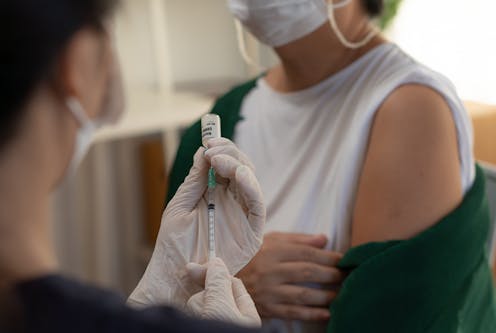
In early 2021, recommendations about COVID vaccines were pretty straightforward – get two doses, as soon as you are eligible. A year later, we knew getting a third dose was important[1] for protection against the new Omicron variant.
Today, though, the situation is far more complex – new updated vaccines are available, the majority of Australians have likely been infected[2] at least once with an Omicron strain, and waves of infection continue to occur.
So how should you manage and time your booster shots?
Read more: Over half of eligible aged care residents are yet to receive their COVID booster. And winter is coming[3]
Why do vaccines need boosters?
Vaccines work by training our body’s immune system to react harder, faster, stronger and better when we get infected by a pathogenic virus or bacteria.
Unfortunately, this protective benefit is not permanent and immunity tends to “wane” over time. The extent to which vaccine protection wanes is a function of two main factors.
First, your immune system[4] (in the form of antibodies, memory B cells and T cells) is not infinite, and the levels of vaccine-induced immune responses will gradually decline over time. Second, pathogens circulating in the community can mutate, which enables “escape” from being recognised by the immune system. The more the virus escapes, the less protection the vaccine can give you.
Read more: Why does my back get so sore when I'm sick? The connection between immunity and pain[5]
Some vaccines need frequent boosting, others last forever
Not all pathogens have the same ability to create or tolerate mutations. For viruses that change little (such as measles), your childhood vaccines remain highly protective and you might never need a booster.
In contrast, some viruses can rapidly and dramatically change (looking at you, influenza), quickly rendering our vaccines outdated and making updates necessary.
Read more: I need a flu shot and a COVID booster. Can I get them at the same time?[6]
So, where does COVID fit in?
SARS-CoV-2, the virus that causes COVID, has demonstrated an ability to rapidly change since emerging in 2019. Although the early pandemic in Australia featured vaccine supply constraints, we now lucky to have many different vaccine options.
Recommendations currently favour updated mRNA “bivalent” boosters from Pfizer or Moderna, each containing equal parts of the original virus strain and an Omicron strain.
But the virus continues to change (currently XBB strains are dominant[7], and further updates to the composition of the vaccine are to be expected in the future (most likely to target XBB.1.5[8]).
That’s great, but I recently had COVID, so …
Are you sure? Queuing for a PCR test seems like a fever dream from the past. Now, many of the RATs stacked in our cupboards are rapidly expiring. Influenza and RSV are back with gusto[9] (and cause similar symptoms).
If you did have confirmed COVID, our research[10] shows the majority of people mount a strong immune response[11] following each infection.
This means that once you recover, your immunity has been “updated” to reflect the virus variant that caused your infection and you will have higher protective antibody levels in your blood.
Well, I definitely had something. What does that mean for my COVID booster?
There are a couple of things to consider here.
Firstly, there is no such thing as “too much” immunity. Beyond the regular side-effects of a vaccine[12], there are no known additional risks to being re-vaccinated soon after an infection.
On the other hand, getting vaccinated quickly after recovery will not do much to further boost your immunity. Current recommendations[13] are to wait six months after infection or your last dose before seeking another booster.
This allows your immune system time to rest, so that it can be effectively re-activated by vaccination. If you’d prefer to minimise your risk of COVID, and you don’t know what caused a recent illness, “topping up[14]” your immunity via a booster may be the way to go.
How should we balance booster shots and infections in the community?
The short answer is, we need more information and time to figure that out.
Our communities now have high immunity (from both vaccines and infections), so balancing the risks and rewards of COVID boosters is increasingly complex.
Ultimately, your personal health care provider is best placed to offer specific advice. Generally however, those who are vaccinated (with three or more doses), younger (64 and under), and otherwise healthy have the least to gain.
For those who are older (especially over 65s) or who have health complications, regular COVID boosters are likely to be an important tool for staying healthy, especially over the winter season. While we still need more data, multiple studies[15] suggest booster vaccines can reduce the risk[16] of developing long COVID, providing another reason to keep up-to-date.
The bottom line
Unfortunately, COVID is among us and likely here for good. But like old mate influenza, we now have effective tools to blunt the impacts of COVID, and even better options will come through the pipeline to unlock further health improvements (like the transformative new vaccines for RSV[17]).
For now, stay tuned to the latest advice from the Australian Technical Advisory Group on Immunisation[18] (ATAGI) about additional vaccine boosters and rest assured scientists and public health officials are still working to better understand how best to maintain high levels of population immunity via regular immunisation.
References
- ^ was important (www.nature.com)
- ^ likely been infected (kirby.unsw.edu.au)
- ^ Over half of eligible aged care residents are yet to receive their COVID booster. And winter is coming (theconversation.com)
- ^ immune system (www.youtube.com)
- ^ Why does my back get so sore when I'm sick? The connection between immunity and pain (theconversation.com)
- ^ I need a flu shot and a COVID booster. Can I get them at the same time? (theconversation.com)
- ^ dominant (www.health.nsw.gov.au)
- ^ most likely to target XBB.1.5 (www.fda.gov)
- ^ back with gusto (www.abc.net.au)
- ^ our research (www.cell.com)
- ^ strong immune response (www.cell.com)
- ^ side-effects of a vaccine (www.health.gov.au)
- ^ Current recommendations (www.health.gov.au)
- ^ topping up (www.health.gov.au)
- ^ multiple studies (jamanetwork.com)
- ^ reduce the risk (www.thelancet.com)
- ^ new vaccines for RSV (www.nature.com)
- ^ advice from the Australian Technical Advisory Group on Immunisation (www.health.gov.au)