The great beauty of art is its absence of certainty
- Written by: Scott Davie, Deputy Head of School, Senior Lecturer in Piano and Musicology, School of Music, Australian National University

It can be surprising when things are not what they seem. Take books, for example.
I recently finished The Outsider (aka The Stranger) by Albert Camus. I’m told many people read it at a younger age, and to prove the point I was given it by a nephew who’d discovered it as a teenager.
It’s not a particularly long book, yet as I turned the pages it seemed to change, revealing something unexpected. To begin with, I thought it slightly dull: a first-person account of a young Frenchman in Algiers, learning his mother had died.
There follows some rather ordinary reports of him eating, sleeping and, for reasons unknown, feeling constantly tired. He finds a girl that he likes, but doesn’t love. We read about an old neighbour whose dog goes missing, and a younger man who asks him to write a letter. It’s all quite unremarkable.
But after he suddenly shoots a man dead, it’s doubtless a very different book. The portrayal of the lengthy prelude to his trial reveals there are many other things the author has in mind. It seems we are engaged with potentially profound reflections: on ethics, liberty, guilt, religion.
Ultimately, the book rests on a sole question: was the murder premeditated? The characters in the book don’t know. But from our privileged place as witness to the narrator’s inner thoughts from the first page, how could it have been? It’s a tricky position for a reader to be in.
One is led to wonder what it is really about. On the final page, Camus suggests that, rather than feeling the love of the deity to which we should aspire, he senses – and is comforted by – the “tender indifference” of the world.
Read more: Loin des Hommes, We Are All First Men: Camus’ Algerians and Oelhoffen’s Camus[1]
I’ve thought about this a while, and decided it’s a philosophical book.
Yet I’m aware that this might be simply how I’m interpreting these events. Indeed, tracing back through my thoughts, I see that for other readers this is possibly a modest story about a few months in the life of a man. Entertaining or not, he’s not a very appealing man at that!
So things like books can be something other than what they seem: what they are on the surface, and the stories we find within, can be wholly dissimilar. If absolute definitions are problematic, perhaps we can dispense with their application to other things.

Take music, for example. Among my friends who work professionally in the field, some are troubled that what to them is an artform is by others classified as just “entertainment”.
I grew up being used to people seeing music as a less-than-serious pursuit. When in my teens I told my grandmother that I wanted to be a musician, she replied that such a thing would be very nice but asked what I would do for a proper job.
(She meant well, she also played piano.)
So in precisely which ways could music be both entertainment and something that is rich and profound?
If you take a piece of music with a beat and play it with conviction, whether it is an Irish jig or a rollicking Baroque gigue by JS Bach, it can make people want to dance. This is a genuine form of entertainment, and perhaps one of music’s first utilities.
If you assemble some memorable words, a pleasing melody and suitable chords, it can make people want to sing along. This has long been the case in folksong traditions, and continues in popular entertainment cultures around the world. It’s notable that Beethoven found it the best solution when he was searching for an ending to his final symphony[2].
Yet there is something truly ineffable about music in its metaphysical otherness. Like the effect of certain fragrances but more compelling, it can transport us back through time. And not just in momentary bursts. Rather, immersed through its duration, music can move us to our inner core.
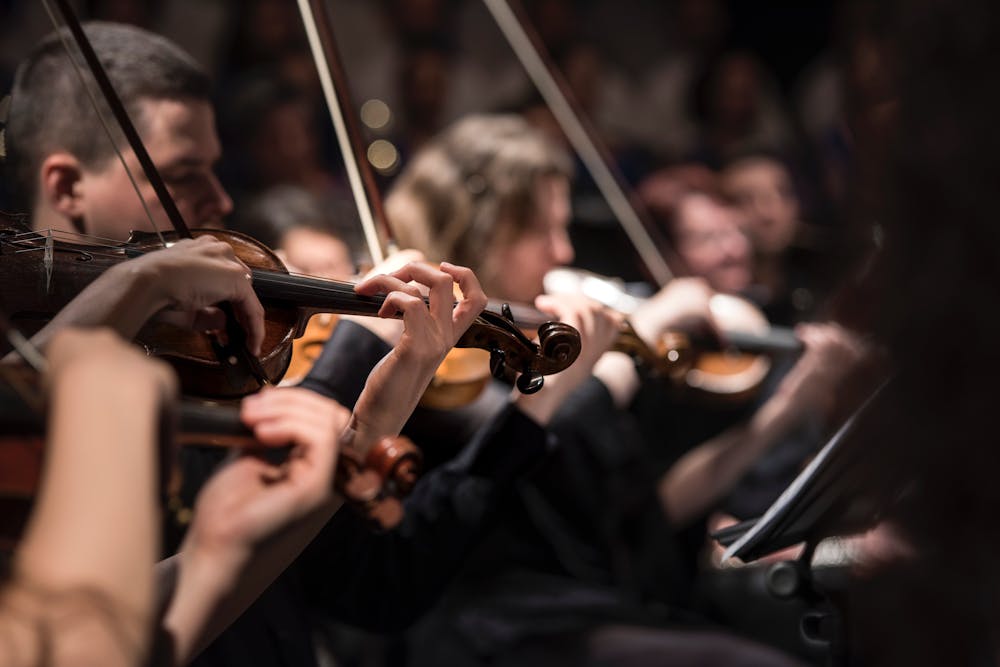 There is something truly ineffable about music in its metaphysical otherness.
Larisa Birta/Unsplash
There is something truly ineffable about music in its metaphysical otherness.
Larisa Birta/Unsplash
Like great authors, creators of music craft narratives of surprising complexity. This can be through the alignment of musical ideas, no matter how small, recurring at pivotal points. Or it can be in the timing of the larger whole, when one encounters a moment of vulnerability where something more exuberant was assumed.
It can be in the ephemeral arc of a melody, or it can be the return to an evocative chord. These things in music that truly speak to us rarely happen by accident. Rather, they reveal the hand of a creative artist, working in one of our most ancient mediums. In the works we hold most highly, it is even believed great music can attain the level of philosophy.
But again, I’m led to ponder how I interpret these events. Tracing back through my thoughts, I see that for other listeners these things might not seem to exist. Could the ears of some be tuned differently to others? Or might these really be just entertaining sounds?
The absence of certainty is the great beauty of it. And sometimes it’s wonderful to be surprised when things are not what they seem.
Read more: My pilgrimage to the site of Paul Klee's Hammamet with Its Mosque[3]
References
- ^ Loin des Hommes, We Are All First Men: Camus’ Algerians and Oelhoffen’s Camus (theconversation.com)
- ^ final symphony (www.youtube.com)
- ^ My pilgrimage to the site of Paul Klee's Hammamet with Its Mosque (theconversation.com)
Read more https://theconversation.com/the-great-beauty-of-art-is-its-absence-of-certainty-200172