


Health and housing measures announced ahead of budget, and NDIS costs in first ministers' sights
- Written by: Michelle Grattan, Professorial Fellow, University of Canberra
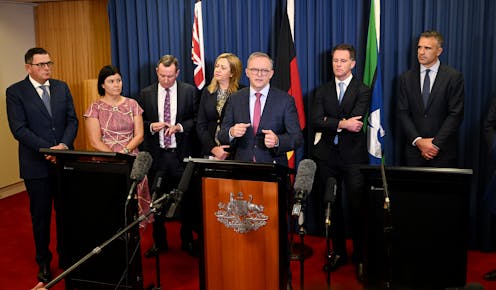
The May 9 budget will include a $2.2 billion suite of measures to seek to ease pressures in primary health care and hospitals, as well as containing initiatives directed towards the crisis in the rental market.
Prime Minister Anthony Albanese announced the measures after Friday’s meeting of national cabinet, that also looked at reining in the ballooning cost of the National Disability Insurance Scheme. This, if left unchecked, could approach $100 billion in a decade.
Among the health initiatives, which the PM said were practical and would “make a difference”, will be an incentive for doctors to keep practices open longer.
Health workforces, including pharmacists, nurses and paramedics, will be supported to work at their “top of scope” to reduce the burden on GPs, and the nursing workforce will be expanded.
A “MyMedicare” (voluntary) patient ID will be introduced to support “wraparound care” for patients registered with their local GP through new blended payment models. This would cover patients who regularly turn up in hospital emergency departments, for example with mental health issues, alcohol and drug problems, or other conditions.
The health package will include flexible funding for multi-disciplinary team-based models to improve quality of care, and also funding for digital health.
The spending is over the forward estimates and is a combination of new money and re-prioritised money. First ministers agreed to a dedicated national cabinet meeting on health reform in the second half of the year.
The leaders have endorsed an interim report from a review of regulatory settings for overseas health practitioners. This recommends measures to boost the health workforce and ensure Australia is competitive in attracting health workers internationally. Albanese said bureaucracy was delaying entries.
The initiatives come as many people have acute difficulty getting appointments with GPs within a reasonable time, bulking billing is hard to access, and hospitals are overburdened, especially in their emergency departments. The government’s Strengthening Medicare taskforce’s recent report outlined a range of measures for reform.
Under a timeline for tackling NDIS costs agreed by the meeting, there will be a target for the scheme’s annual cost growth to be no more than 8% by July 1 2026, “with further moderation of growth as the scheme matures”. The cost of the scheme is presently growing by 14% a year.
“Governments share the goal of reaching long term sustainability for the scheme and have elevated this objective to national cabinet,” the post national cabinet statement said.
“We know that the trajectory of NDIS expenditure is just not sustainable into the future,” Albanese said.
The minister for the scheme, Bill Shorten, has already announced reform areas to curb costs.
The housing and rental crisis was a major issue for the national cabinet meeting and it was agreed housing ministers will develop a proposal to strengthen renters’ rights across the country. This will be brought back to a later national cabinet meeting. Albanese said absolute uniformity was not being sought, because different states would have different circumstances.
Planning ministers are to develop a proposal for “reforms to increase housing supply and affordability”.
The government is also offering incentives to increase supply by
increasing the depreciation rate from 2.5% to 4% a year for eligible new build-to-rent projects where construction commences after May 9
reducing the withholding tax rate for eligible fund payments from managed investment trusts to foreign residents on income from newly constructed residential build-to-rent properties after July 1 next year from 30% to 15%.
The government will also support an extra $2 billion for more social and affordable rental housing by increasing the National Housing Finance and Investment Corporation’s liability cap from $5.5 billion to $7.5 billion from July 1.










