Since the late 19th century, adventurous female 'eclipse chasers' have contributed to science in Australia
- Written by: Toner Stevenson, Honorary history affiliate in the School of Humanities, Faculty of Arts and Social Sciences, University of Sydney
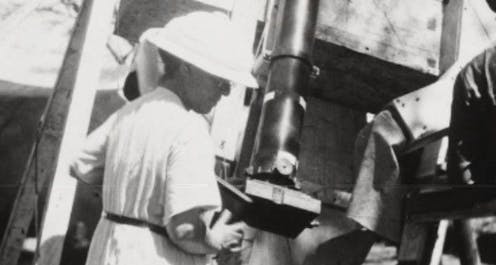
A total solar eclipse is a remarkable alignment of our Sun, Earth and the Moon, as the latter casts a perfect shadow across the former.
If you’re in the narrow path of the shadow of the Moon, at the moment of totality you are plunged into darkness. Stars and planets emerge in the sky, and the entire atmosphere changes. This immersion in a total solar eclipse is unforgettable.
As 21-year-old Australian Miriam Chisholm reported in 1922[1],
I looked up from the telescope just an instant before totality and thought I saw the Corona, a pale fringe around the Sun […] and then the light went out and we saw it in all its glory.
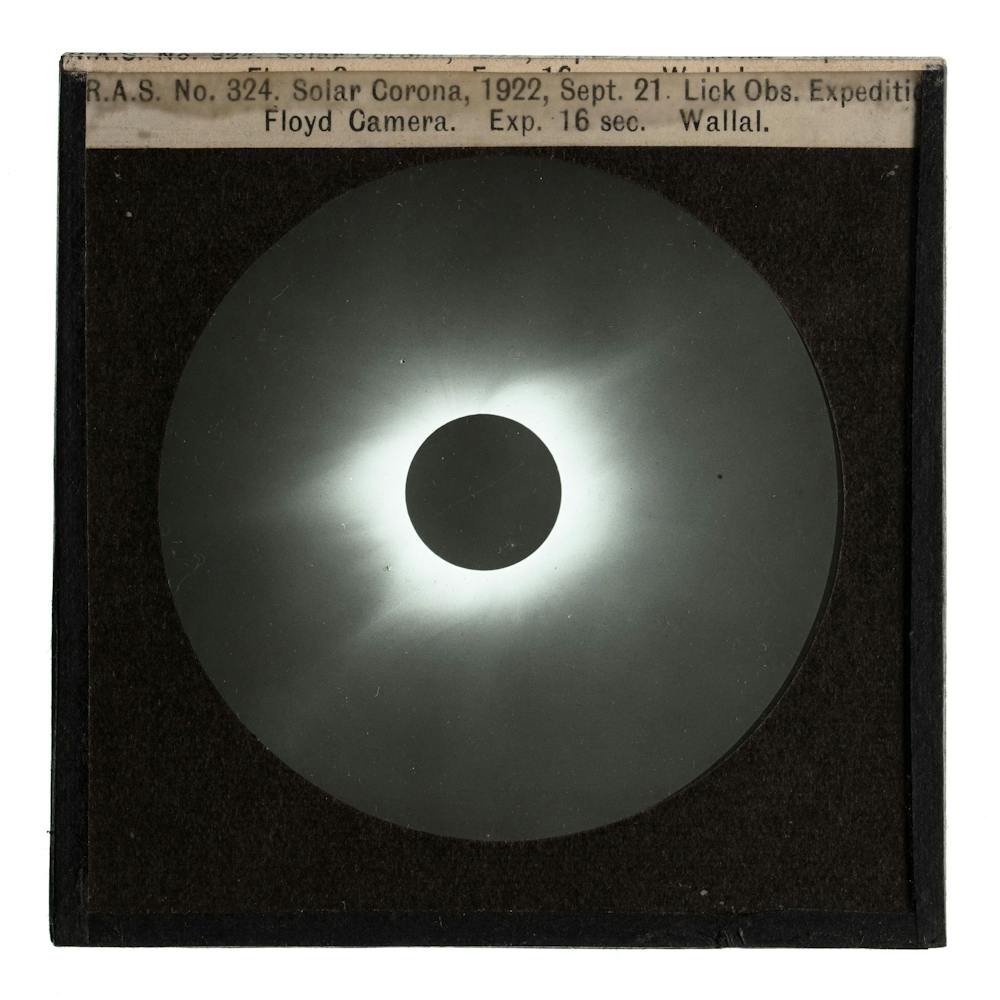
Historically, total solar eclipses were a unique opportunity to conduct scientific research about our Sun, the closest star. Using special instruments called spectroscopes, it was possible to decipher the chemical composition of the gases emitted by the Sun – but only during a total eclipse.
As I write in my recently co-authored book Eclipse Chasers[2], perhaps the best-known eclipse experiment was the proof of Albert Einstein’s general theory of relativity. In the early 20th century this theory could only be tested during the minutes of totality, requiring a clear sky around the covered Sun so you could photograph the stars.
Women in the field
Accounts of well-known historic discoveries in astronomy might leave the impression this work was only undertaken by men. But in the late 19th and early 20th century, women in Australia already participated in astronomy as female “computers”[3] and amateur astronomers. They were deeply involved in scientific expeditions to view total solar eclipses, but it was not easy.
The living conditions were rough, in tents with poor amenities open to the weather, and little or no privacy. The months needed to travel on solar eclipse expeditions meant leaving family responsibilities, one of the reasons it was unusual to find women in the field. When women did participate, they were usually the wives and daughters of male astronomers.
The first Australian woman whose total solar eclipse observations were officially reported was Annie Louisa Virginia Dodwell. She had a Bachelor of Science from the University of Adelaide and gained astronomy knowledge working with her husband George Dodwell, the South Australian Government Astronomer.
Together, they organised the Adelaide Observatory expedition to Bruny Island in Tasmania for the 1910 total solar eclipse. The party arrived by ship and for a month they camped in tents in almost constant rain to prepare. The eclipse day was clouded, nonetheless Annie successfully recorded the change in temperature, the only science of value that was achieved.
In the following years she presented talks about astronomy[4], published poems and participated in the inaugural International Astronomical Union assembly[5] at the Vatican Observatory in 1922. She arranged the logistics for her husband’s total solar eclipse expedition later that year, during which she transcribed his observations[6] to the newspapers.
Read more: A century ago, Australia was ground zero for eclipse-watchers – and helped prove Einstein right[7]
Seasoned eclipse chasers in the 1920s
In 1922 an international team of astronomers, led by William Campbell, Director of Lick Observatory, and assisted by the Australian Navy, travelled to a remote location in Western Australia to confirm Einstein’s general theory of relativity during the September 21 total solar eclipse.
There were five women participating in this expedition: Elizabeth Campbell, Jean Chant with her daughter Elizabeth, Eleanor Adams and Mary Acworth Evershed.
While they were the wives and daughter of respective male astronomers, each woman was a seasoned eclipse observer in her own right. They knew how to operate and use technical equipment and contributed substantially to reporting the scientific work.
Elizabeth Campbell organised the supplies and operated spectroscopic and photographic telescope equipment during the eclipse. Eleanor Adams worked with her husband on the large 12-metre eclipse camera. Jean Chant observed the shadow bands and changing brightness of the sky, and Elizabeth Chant operated a prism that polarised light.
Mary Acworth Evershed was an established expert in solar physics and worked alongside her husband, director of the Kodaikanal solar observatory in India. She photographed the spectra of the Sun’s corona. In 1896, on return to England, she published a pocket-sized Easy Guide to the Southern Stars with star maps of the constellations visible from the southern hemisphere.
A long drive across the country
On the other side of the continent, a very different eclipse expedition was organised by 21-year-old Miriam Chisholm with her school friend Frida Tindal. Chisholm’s father, Frank, drove them over 950 kilometres from Goulburn to southern Queensland.
They lost four days when their car was bogged in mud and almost didn’t make it to the line of totality. Thankfully, due to excellent time-keeping and navigation they had a successful eclipse. They drew the Sun’s corona, measured the temperature, observed how animals and birds became quiet and timed the shadow bands. Their report[8] is descriptive, inspiring and filled with detailed observations. It is still a useful guide on how to make the most of a total solar eclipse experience.
On April 20 2023 a total solar eclipse will be visible from Exmouth in Western Australia. This is the first total solar eclipse in Australia since 2012, when thousands of people flocked to northern Queensland. I was there, and for two minutes and five seconds of totality, I experienced a beautiful “diamond ring” effect as the Moon totally covered the Sun, revealing its misty corona.
There are four more total solar eclipses in the next 17 years. Following in the footsteps of early 20th century eclipse chasers, large numbers of Australians will soon be able to share a total solar eclipse experience they will treasure, record and retell throughout their lives.
References
- ^ reported in 1922 (articles.adsabs.harvard.edu)
- ^ Eclipse Chasers (ebooks.publish.csiro.au)
- ^ female “computers” (www.cambridge.org)
- ^ talks about astronomy (nla.gov.au)
- ^ inaugural International Astronomical Union assembly (www.iau.org)
- ^ transcribed his observations (nla.gov.au)
- ^ A century ago, Australia was ground zero for eclipse-watchers – and helped prove Einstein right (theconversation.com)
- ^ Their report (articles.adsabs.harvard.edu)