Pinchgut Opera's Médée demands to be heard
- Written by: Daniela Kaleva, Program Manager, Researcher Development, Deakin University

Review: Médée, directed by Justin Way and conducted by Erin Helyard, Pinchgut Opera
Known for specialising in baroque opera and historically informed music interpretations, Pinchgut Opera always programs pieces that not only delight with luscious baroque instruments and beautiful voices but bring forth characters and themes that speak to modern audiences.
Médée, by Thomas Corneille and Marc-Antoine Charpentier, is a masterpiece of French baroque opera, first performed in 1693 at the Académie Royale de Musique.
The story explores themes of justice, loyalty, migration and family annihilation with pertinent relevance for an audience of the 21st century still suffering the consequences of the COVID pandemic.
The voice of Médée
Médée is based on the ancient Greek tragedy Medea by Euripides (431 BC).
Knowing that her husband, the power-thirsty and spineless Jason (Michael Petruccelli), will betray her, Médée (Catherine Carby) attempts diplomacy. She is forced to enact justice by usurping her status and breaching the constricting social and political norms. In doing so, she breaks one of society’s greatest taboos: she kills her children.
In this production, the two sons are part of the action and their bodies are brought on stage covered in blood.
Corneille’s libretto emphasises the political manoeuvring at the Corinthian court to respond to the sensibilities of the French court of Louis XIV. Power tactics are used by everyone to gain advantage during a crisis.
In the Pinchgut production, the setting of the opera transports the imminent threat and negotiations at the Corinthian court to the 20th century with the respective civic and military connotations.
The strong voice of Médée dominates this story and resounds on the Australian operatic stage as a rare representation of a formidable female character who uses diplomacy and power to stand up for herself in a male-dominated world.
Read more: Why it's important to see women as capable ... of terrible atrocities[1]
Baroque sound and modern visual storytelling
Conducted by Erin Helyard, the Orchestra of the Antipodes play Charpentier’s music with elegance and restraint. It renders the melodious richness of orchestral colour and instrumentation with finesse. The choir enchants with the uniformity and depth of their sound. The beautiful solo voices of the cast leave the listener gasping for more.
The minimalist grey columns and walls of the set allow for effective contrast of costumes, movement and lighting and projection to play their role in the visual storytelling.
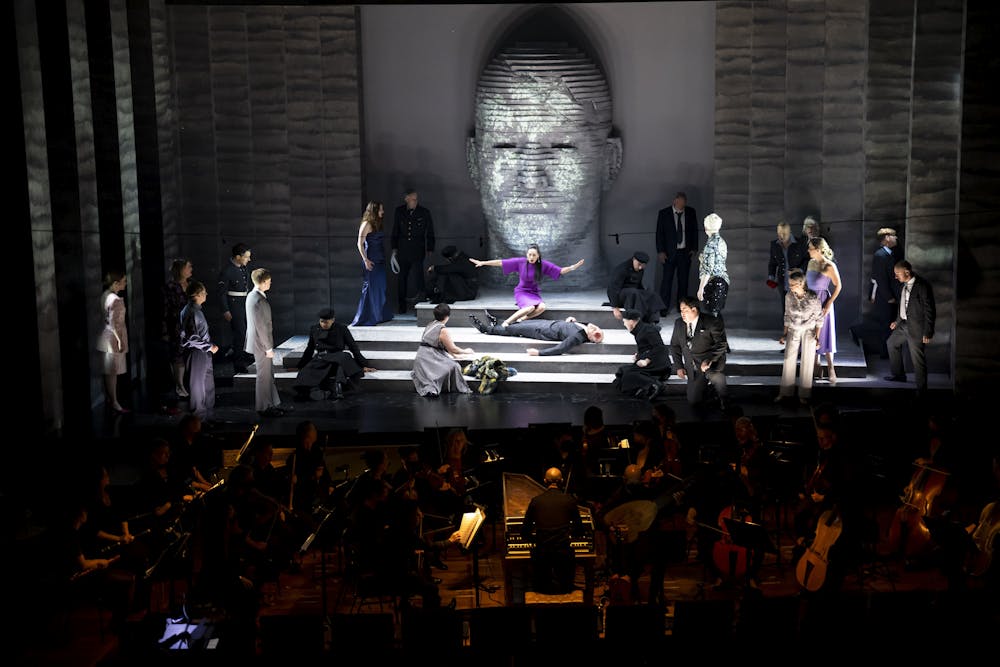 Costumes, movement, lighting and projection all play their role in the visual storytelling.
Cassandra Hannagan
Costumes, movement, lighting and projection all play their role in the visual storytelling.
Cassandra Hannagan
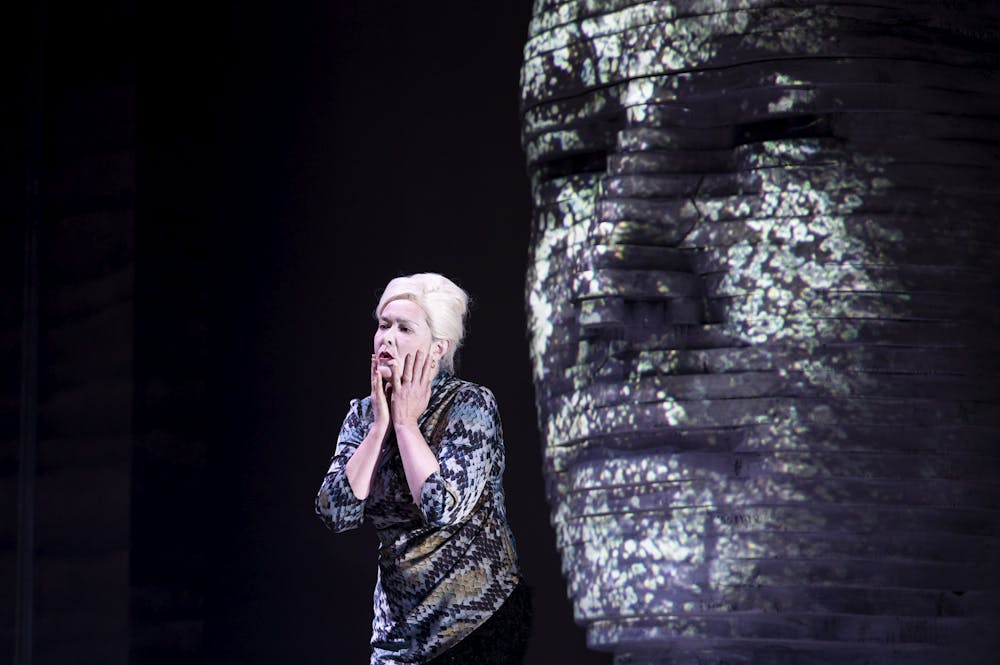
A supersized bust dominates the stage and remains malleable throughout, referencing the gradual disintegration of the Corinthian court and the humiliation the male characters suffer in this story.
Médée’s music is more often mournful and pleading than furious and destructive. Carby portrays well the inner turmoil of the character with a silky mezzo-soprano voice that soars over the tricky waves of Charpentier’s phrases and offers a variety of tonal qualities to express the emotional states of Médée’s complex character. Her touching rendition moves the audience with pity.
Carby is less successful in expressing physically the power of the sorceress or the sexual attraction her character feels for Jason, which is not helped by a reliance on the symbolism of costumes over bodily eloquence.
In this production, Médée is presented as a crone – white haired and having lost her physical allure, juxtaposed against the younger princess Créuse (Cathy-Di Zhang), stunning in a royal purple dress.
It is only in pursuit of Créuse that Petrucelli’s Jason shows virility and arduous persuasion. Zhang’s Créuse is sexy and cunning, negotiating well the political manoeuvres of the court.
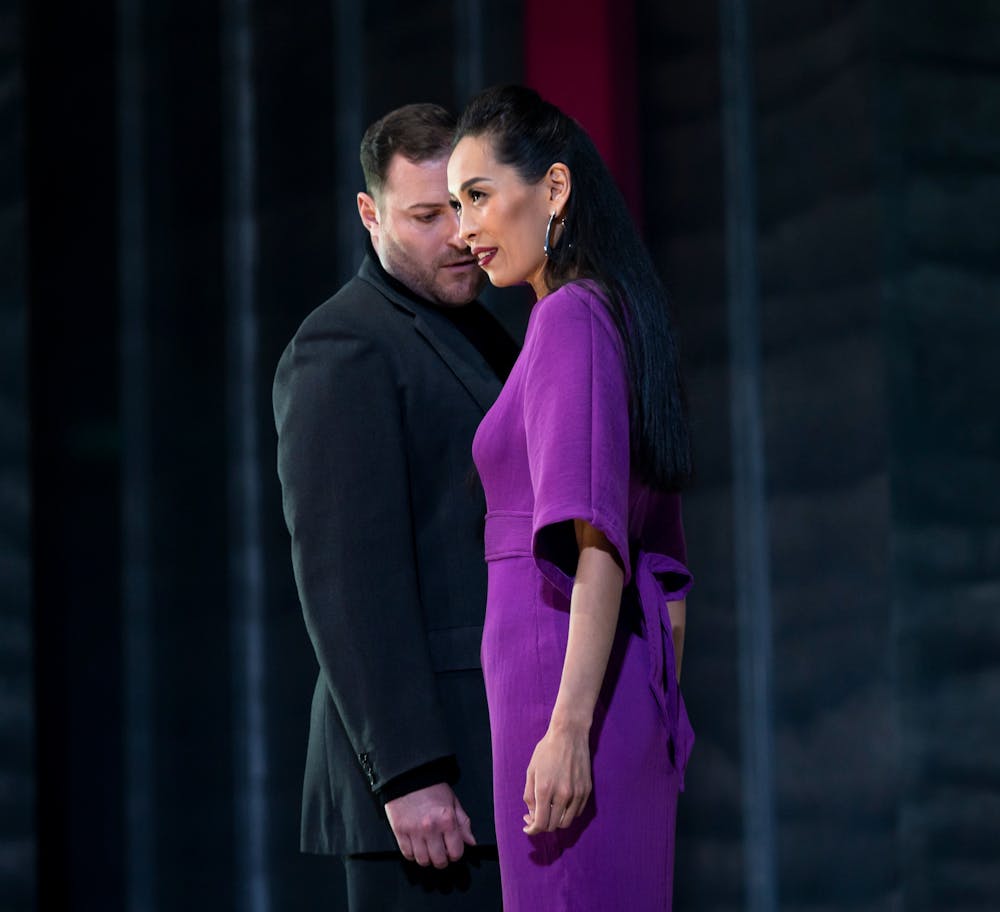 Zhang’s Créuse is sexy and cunning, negotiating well the political manoeuvres of the court.
Cassandra Hannagan
Zhang’s Créuse is sexy and cunning, negotiating well the political manoeuvres of the court.
Cassandra Hannagan
Adrian Tamburini’s Créon looks younger than Petrucelli’s Jason to be a father of Créuse, but he does his best to convey the authority and arrogance of the King by relying on his rich bass-baritone, crisp diction and good acting.
Andrew Finden is most convincing as Oronte with attention to text emphasis and strong commitment to the character.
Maia Andrews stands out among the secondary roles with a voluptuous voice and portrayal of the Italian entertainer.
Louis Hurley’s singing and acting deliver a compelling Arcas and La Vengeance.
Elevating the soul
If the purpose of art is to elevate the soul, provide an opportunity for contemplation and even salvation, then Médée’s performance delivers.
The music is elegant and noble, transporting the listener away from the crude noise of the modern world to a state of aesthetic pleasure and satisfaction.
The tragedy of Médée encourages reflection on justice and reciprocity and asks us to look within. Are we like Jason and Médée obsessed by our desires? Do we love too much someone who does not deserve it? Do we feel so vulnerable that violence is the only way to protect ourselves? How do we accept those that are different and more powerful than us? Do we have the courage to live on the edge and stand up for our ideals and consequently face the music – and do we condone or support those that do?
Pinchgut’s production of Médée is an opportunity not to be missed to enjoy baroque opera performed at the highest standards by expert baroque musicians and singers. The choice of an opera based on Greek tragedy provides intellectual stimulation to consider the human condition, loyalty and justice in the world we live today.
Médée is at City Recital Hall, Sydney, until December 7.
Read more: How theater can help communities heal from the losses and trauma of the pandemic[2]
References
- ^ Why it's important to see women as capable ... of terrible atrocities (theconversation.com)
- ^ How theater can help communities heal from the losses and trauma of the pandemic (theconversation.com)