Why you should know the exciting experimental, political and feminist work of senior Indian artist Nalini Malani
- Written by: Catherine Speck, Emerita Professor, Art History and Curatorship, University of Adelaide
Contemporary Indian artist Nalini Malani, born in 1946, is infinitely experimental.
Her work traverses video, photography, multi-media installation, painting and digital animations.
The latter is the medium employed in an evocative set of 88 stop-motion images viewers first encounter in Gamepieces at the Art Gallery of South Australia.
The vicious murder of an eight-year-old child in Karachi in 2018 was the springboard for the challenging series of highly emotive and immersive iPad drawings that are now digital animations.
These animations read like a stream of consciousness thoughts about contemporary life.
A cast of characters, including Alice from Lewis Carroll’s Alice in Wonderland, appear in the animations along with text from literary, philosophical, and linguistic figures including Samuel Beckett, Noam Chomsky and Paul Klee.
Fragments of text flash by ranging from “I am exhausted” and “dystopia” to those capturing a sense of wonder, such as “do clouds divide”.
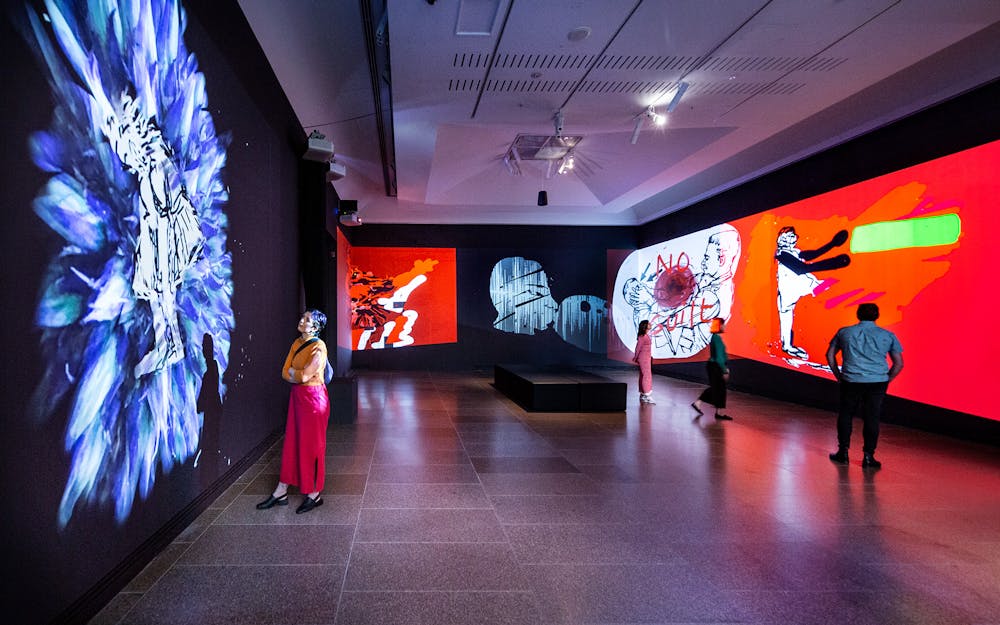
Malani says the ordered chaos of her Animation Chamber simulates the mind at work.
Maybe, but there is a simmering level of violence. An innocent Alice skipping on her rope, before we see her being abused. It is as if Alice calls out “can you hear me?”.
This is part of Malani’s wider practice of social critique.
Experimental art making
On display are early works made in a climate of idealism under the country’s first prime minister, Jawaharlal Nehru, a secularist who in the 1960s talked about[1] changing the class system and making a new India for all.
Read more: Jawaharlal Nehru's vision for a just and equitable post-colonial world, with India leading the way[2]
Malani, fresh out of art school and a member of the experimental Vision Exchange Workshop[3] in Mumbai began exploring the possibilities of image making with photography and film.
Stunning abstract photograms[4] (where objects are placed on photographic paper to make images) such as Precincts, 1969, are on display. Abstract shapes have been exposed on photosensitive bromide paper to light. They speak of an idealism present in modernism itself and in India.
Such idealism was short lived. Malani was in Paris amid the 1968 student demonstrations[5], and unable to access her university training there. She began making monochromes of photographic images superimposed on xrays.
 Installation view: Nalini Malani: Gamepieces, Art Gallery of South Australia, Adelaide.
Photo: Saul Steed.
Installation view: Nalini Malani: Gamepieces, Art Gallery of South Australia, Adelaide.
Photo: Saul Steed.
Again she is highly innovative in approach, protesting against nuclear testing in her Mushroom cloud, 1970/2018.
At the same time, Malani befriended influential literary, film and feminist practitioners and theorists in Paris which set her on the path of melding art with literature in numerous theatrical productions.
Idealism fails
That theatrical approach underscores her dramatic but chilling video play Unity in Diversity, 2003.
The impetus for the piece was the violent 2002 riots in Gujarat[6] between Hindus and Muslims where more than 1,000 people died – a dramatic reminder of the failure of the Nehru’s idealism for a peaceful, pluralistic India.
We are in a living room with its familiar décor. A sofa, reading lamp and framed photographs of yet another idealist for modern India, Mahatma Gandhi, hang tellingly on blood red walls.
 Installation view: Nalini Malani: Gamepieces, featuring Unity in Diversity by Nalini Malani.
Art Gallery of South Australia, Adelaide, photo: Saul Steed.
Installation view: Nalini Malani: Gamepieces, featuring Unity in Diversity by Nalini Malani.
Art Gallery of South Australia, Adelaide, photo: Saul Steed.
Across from the sofa, a video shows 11 culturally diverse Indian female musicians. Their performance is then disrupted by gunshots ringing out against a background of speeches by Nehru for nationalism, and footage of the riots showing bloodied victims, some taking on a deathly pallor.
But what to make of this compelling multi-laden narrative – that idealism fails, or as its title suggests, unity can be found in diversity?
Malani herself knows the price of racial and religious difference. As a Pakistani, she was relocated with her family to India during the traumatic Partition of 1947[7].
Read more: 75 years ago, Britain's plan for Pakistani and Indian independence left unresolved conflicts on both sides – especially when it comes to Kashmir[8]
An epic production
Malani’s political critique takes in environmental tragedies such as India’s worst chemical leak ever in 1984 at the Union Carbide Factory[9], which killed 15,000 people and left a lingering presence in deformities.
Her political critique has a distinct feminist bent too, focusing on protagonists such as Sita[10] and Yaśodharā[11] in traditional Hindu mythic paintings in her Stories Retold.
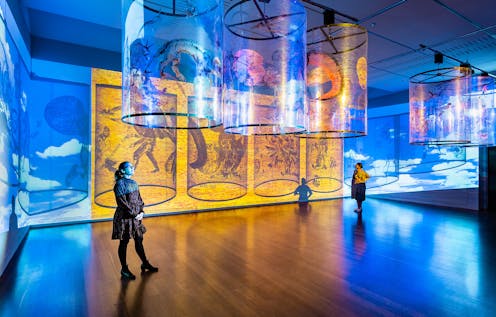
And then there is Gamepieces, 2003-2020. This is a wondrous video/shadow play, almost lo-tech in its fabrication, developed in response to nuclear tests[12] in India and Pakistan in 1998.
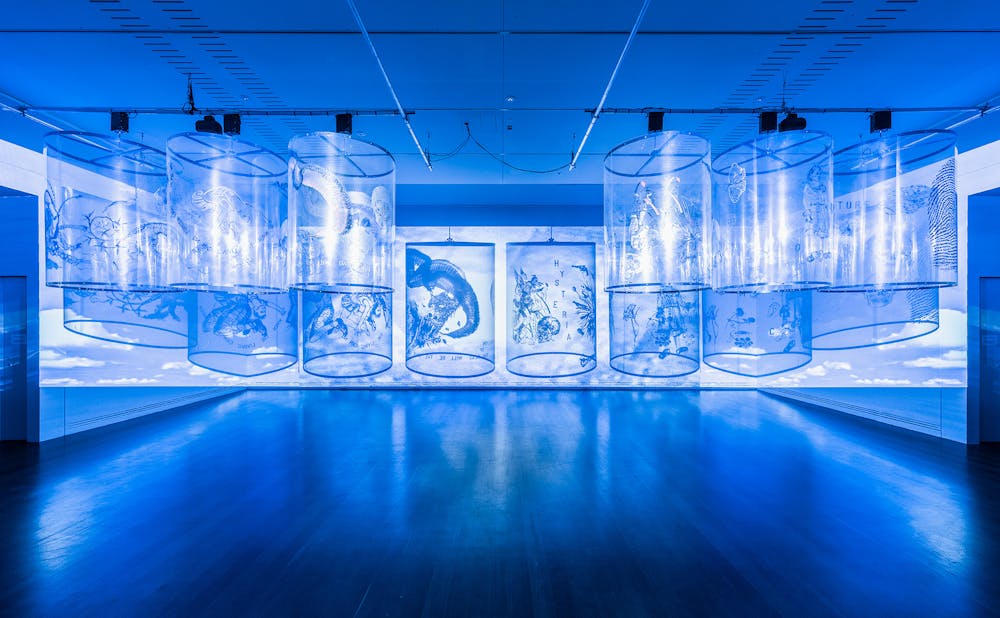 Installation view: Nalini Malani: Gamepieces, featuring Gamepieces by Nalini Malani.
Art Gallery of South Australia, Adelaide, photo: Saul Steed.
Installation view: Nalini Malani: Gamepieces, featuring Gamepieces by Nalini Malani.
Art Gallery of South Australia, Adelaide, photo: Saul Steed.
Reverse painting[13] is where a painting is created on glass, designed to be seen through the reverse side. Here, Malani has reverse painted six rotating transparent mylar cylinders.
The imagery on these cylinders is projected onto a screen mashed up with multi-directional video imagery of the nuclear attacks on Japan in 1945. A cast of mythical wounded characters and creatures parade by, all underscored by a Hindustani musical score.
The word “epic” best fits this wholly immersive affective encounter as Malani intended, knowing the audience would complete the narrative.
Nalini Malani’s powerful survey exhibition curated by gallery director Rhana Devenport is important in Australia’s exhibition calendar.
Malani is a senior contemporary artist whose theatrical installations, often based around historical events, meld with present global issues.
She moves easily from the past to present, from cultural memory to contemporary subjects by taking the viewing audience with her in immersive theatrical experiences, crossing artforms from the literary to visual to the musical, all the while underpinned by critique.
Nalini Malani: Gamepieces is at the Art Gallery of South Australia until 22 January.
References
- ^ talked about (theconversation.com)
- ^ Jawaharlal Nehru's vision for a just and equitable post-colonial world, with India leading the way (theconversation.com)
- ^ Vision Exchange Workshop (www.space118.com)
- ^ photograms (www.tate.org.uk)
- ^ 1968 student demonstrations (www.npr.org)
- ^ 2002 riots in Gujarat (www.bbc.com)
- ^ Partition of 1947 (theconversation.com)
- ^ 75 years ago, Britain's plan for Pakistani and Indian independence left unresolved conflicts on both sides – especially when it comes to Kashmir (theconversation.com)
- ^ Union Carbide Factory (www.theatlantic.com)
- ^ Sita (en.wikipedia.org)
- ^ Yaśodharā (en.wikipedia.org)
- ^ nuclear tests (www.theguardian.com)
- ^ Reverse painting (en.wikipedia.org)