The Jungle and the Sea reminds us war is profoundly local, with the intimate negotiation of human relationships
- Written by: Niro Kandasamy, Lecturer in History, University of Sydney
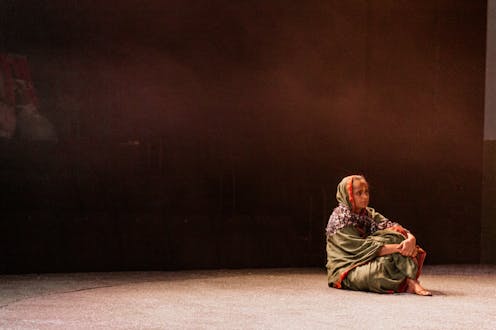
Review: The Jungle and the Sea, directed by Eamon Flack, Belvoir.
After the roaring success of their debut collaboration, Counting and Cracking[1], S. Shakthidharan and Eamon Flack have produced another play that will captivate audiences.
Sri Lanka was in a civil war from 1983 to 2009, about a Tamil national liberation struggle for independence in the north and east. This followed decades of discrimination by the Sri Lankan state against Tamils.
The Jungle and the Sea revolves around the story of one Tamil family who are separated after church bombings in 1995, following them through to 2009.
The Jungle and the Sea is an expression of the many stories of Tamils that remain untold. This play will hold immense value for the Tamil community in Australia, not least because there is very little in the way of Australian public acknowledgement about their war histories.
As The Jungle and the Sea reminds us, war is never only about nationalist politics. It is also profoundly local, intimate and involves negotiation of human relationships that can challenge political boundaries.
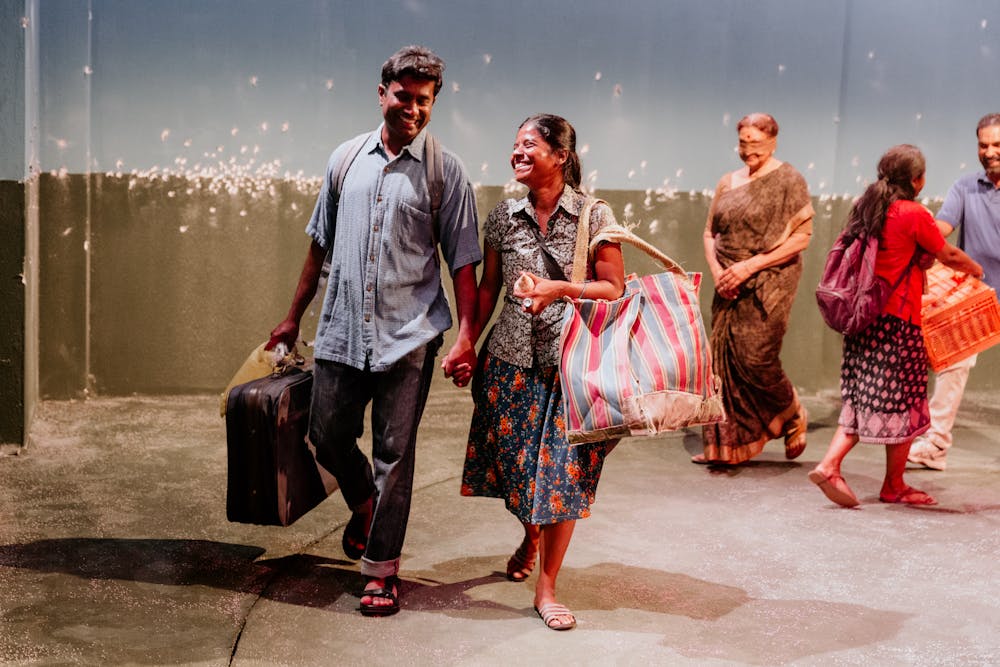
We are taken along the multiple trajectories of the members of one Tamil family.
A revolving floor symbolises the constant movement of the Tamil community, which endured 26 years of intense armed conflict. Accompanied by musicians Indu Balachandran and Arjunan Puveendran, the music takes the audience through constantly revolving worlds of loss and survival.
Read more: Sri Lanka's crisis is not just about the economy, but a long history of discrimination against minority groups[2]
Into the chaos of war
On July 9 1995, the Sri Lankan government bombed[3] St Peter’s Church in Navaly, following the collapse of peace talks between the government and the Liberation Tigers of Tamil Eelam, and the resumption of fighting.
Just days before, the government had dropped leaflets across the Jaffna peninsula instructing civilians to seek shelter in churches and temples ahead of the military’s new mission to capture Jaffna.
The opening scenes of The Jungle and the Sea reimagine this horrific moment.
Children go from playing a game of cricket to suddenly reorganising their lives to ensure their survival and the survival of those around them. The scenes foreshadow the rest of the play, which traces entanglements of violence, loss, joy and compassion.
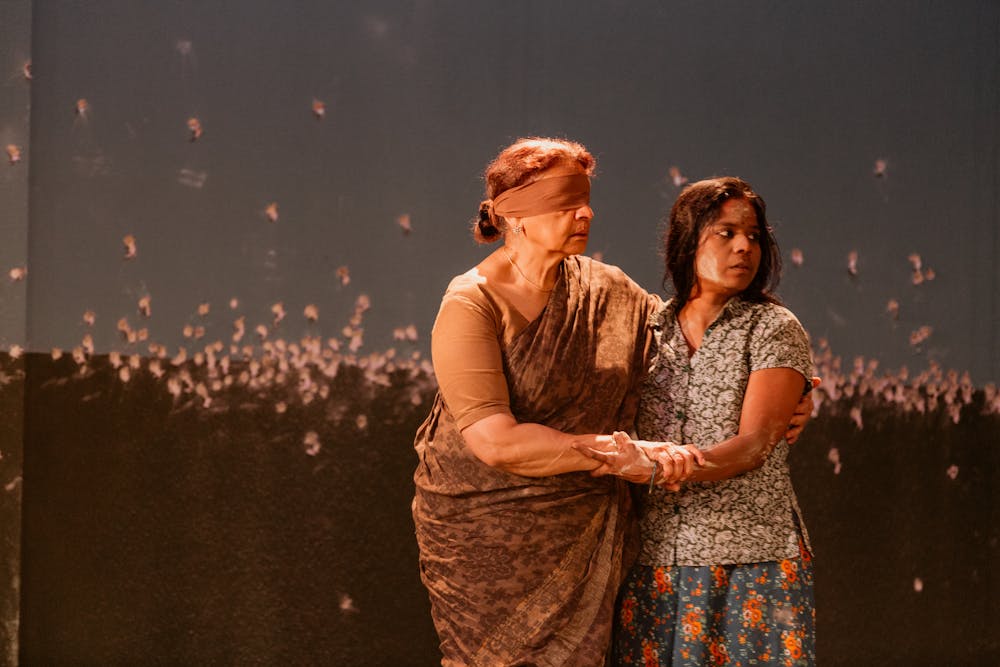 The mother Gowie puts on a blindfold until she can be reunited with her children.
Sriram Jeyaraman/Belvoir
The mother Gowie puts on a blindfold until she can be reunited with her children.
Sriram Jeyaraman/Belvoir
The Jungle and the Sea is about the vulnerabilities and agency of people navigating the chaos of war.
After the bombing, father Siva (Prakash Srinivasan) and daughter Lakshmi (Emma Harvie) seek refuge in Sydney. The son Ahilan (Biman Wimalaratne) is recruited into the Tamil Tigers. The mother Gowrie (Anandavalli) and two more daughters – Abi (Kalieaswari Srinivasan) and Madhu (Nadie Kammallaweera) – remain in the war zones foregoing the chance to escape.
In agony after the family’s separation, the mother decides to blindfold herself and refuses to leave her homeland until she can be reunited with all her children.
Shakthidharan gives us the diverse experiences of war: those of liberation fighters, civilians and refugees. We are given multifaceted identities, as the actors take us into their kaleidoscopic worlds.
In one of several comedic scenes, Lakshmi, the only child who flees Sri Lanka, celebrates her university graduation by taking her father to a candle-lit dinner by the Sydney Harbour Bridge. There, she comes out to him as a lesbian.
The father’s response to her being Tamil, atheist and lesbian highlights intergenerational tensions in a humorous and humbling manner.
Survivors of war are more than the traumas of war they carry with them.
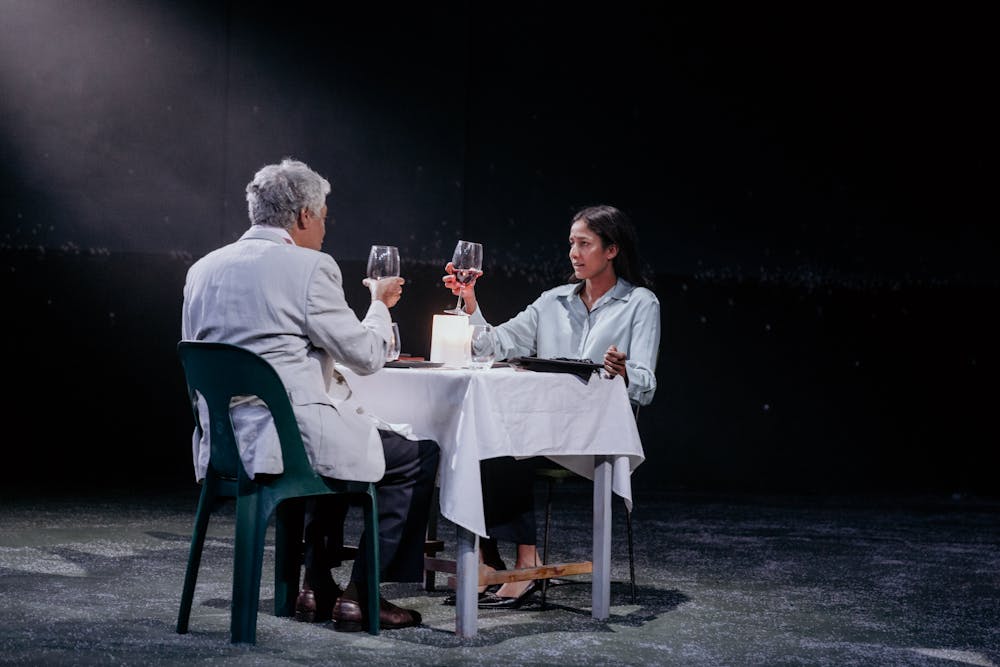 The play also has moments of humour and levity.
Sriram Jeyaraman/Belvoir
The play also has moments of humour and levity.
Sriram Jeyaraman/Belvoir
Truth-telling in the aftermath of war
In the final act, the cast takes up the contested terrain of remembering the atrocities against Tamils in the aftermath of the war.
Gowrie finally removes her blindfold when she is reunited with her family – those who survived, and those who died. Gowrie’s determination to continue searching for her children renders the war an internal fight to keep alive hope and resistance.
Played by Anandavalli, a renowned bharatanatyam dancer[4], Gowrie’s dance is a fitting close to the story and an ode to the genre of theatre as a creative medium through which stories about war can be used to reflect, mourn, and educate.
Gowrie captures the particular plight of Tamil mothers[5]. Some 13 years after the war ended, those mothers whose children were forcibly disappeared in the final days of the war continue to make visible through protesting that there can be no peace or reconciliation without justice.
History in the aftermath of the war is contested, especially for Tamils whose losses are beyond measure. The Jungle and the Sea is one story among many about a history that breathes in the present, serving as a reminder that there are hundreds of Tamil refugees in Australia without permanent protection, each of them carrying stories like this one.
The Jungle and the Sea is at Belvoir, Sydney, until December 18.
Read more: Why do Tamil asylum seekers need protection — and why does the Australian government say they don't?[6]
References
- ^ Counting and Cracking (www.theguardian.com)
- ^ Sri Lanka's crisis is not just about the economy, but a long history of discrimination against minority groups (theconversation.com)
- ^ bombed (en.wikipedia.org)
- ^ bharatanatyam dancer (www.smh.com.au)
- ^ Tamil mothers (countercurrents.org)
- ^ Why do Tamil asylum seekers need protection — and why does the Australian government say they don't? (theconversation.com)