


the best films of the 2022 Adelaide Film Festival
- Written by: Stuart Richards, Lecturer in Screen Studies, University of South Australia
The Adelaide Film Festival is well timed in the festival calendar, as it lands between many films premiering at the Venice Film Festival and their Australian theatrical release.
This year’s program balanced big films like My Policeman, TÁR and Banshees of Inisherin with smaller, edgier films.
Over the week, I saw a respectable 15 films. Here are my top five highlights.
Survival of Kindness
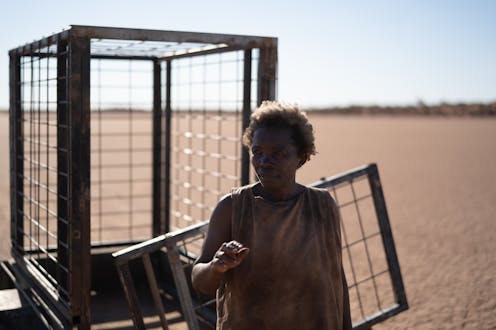
Rolf De Heer’s Survival of Kindness, supported by the festival’s investment fund, opens with BlackWoman (Mwajemi Hussein) abandoned in a desert, locked in a cage, left alone to die. As the film starts, we see her struggle to break free. Achieving this freedom, we follow her journey to the city, where she is challenged by several characters along the way.
The film’s gradual world building and use of genre continually subverts expectations. Is this a road movie? Is it a western? Is it perhaps science fiction? The film’s portrayal of Australia is equal parts strange and familiar.
De Heer depicts Australia as a dystopian landscape, where non-white folk are hunted down and exterminated by those in gas masks. The continuous subversion of expectations as the narrative unfolds makes this a compelling and confronting watch.
Triangle of Sadness
Ruben Östlund is fantastic at socially conscious comedies and he is at his best in the Palme d’Or winning Triangle of Sadness. The film is in two parts.
First, we are aboard a $250 million luxury yacht for the exceedingly wealthy, where jars of Nutella are helicoptered in and the staff are at the behest of the passengers. The staff must always say yes and never no.
Passengers include Carl (Harris Dickinson) and Yaya (the late Charlbi Dean), two influencers whose beauty is paying for the trip. We also meet the ship’s drunk captain (Woody Harrelson) who gets into a heated political debate with Russian businessman Dimitry (the brilliant Zlatko Buric).
“While you’re swimming in abundance, the rest of the world is drowning in misery,” the captain drunkenly rants over the ship’s PA system.
The film obscures its standout player, cleaner Abigail (Dolly de Leon), until the second act, when her character arc is revealed to be pivotal to the film’s objective.
The film’s social commentary loses any subtlety when the passengers all sit down to the captain’s dinner during a particularly rough storm. What precedes is a raucous, stomach-churning onslaught of physical humour. The humour is utterly carnivalesque.
Some critics[1] have reviewed the film as being too on the nose, which is the absolute point of this film. This havoc leads into the film’s second act, which deftly sees these class structures challenged and subverted. The tone of the film dramatically changes as well, with the laugh-out-loud comedy making way for a fallout of the social dynamics constructed in the first half.
Triangle of Sadness will be in Australian cinemas from December 22.
Senses of Cinema
Understandably, John Hughes and Tom Zubrycki’s Senses of Cinema was also a standout film in Adrian Dank’s highlights[2] for The Conversation from this year’s Melbourne International Film Festival.
The film examines the history of Sydney and Melbourne film co-operatives told by those at the forefront of independent filmmaking in Australia.
Those interviewed include important figures such as Martha Ansara, Jan Chapman, Albie Thoms and Phillip Noyce.
Key to this film is that there has always been an audience for these films and – regardless of the hurdles faced – artists will always persist.
The extensive use of films from the archives is wonderful, making this an important inclusion to any course on Australian cinema. The documentary also doesn’t shy away from political differences that formed during the collectives’ history, such as the surging feminist movement’s critique of the sexist representation of women in some early films or the role of class with a lot of the early filmmakers being products of private schooling.
Fascinating moments included early filmmaking with and, more importantly, by First Nations’ communities, such as the work by Essie Coffey. I was pleased to see Digby Duncan’s documentary Witches & Faggots, Dykes & Poofters discussed as these co-operatives were significant to the development of queer Australian filmmaking.
Read more: The best films at this year's Melbourne International Film Festival[3]
Phantom Project
This year’s festival had a strong queer presence, which is important as there is no dedicated stand-alone queer film festival in Adelaide.
Paul Struthers, previously the director of Queer Screen in Sydney and of San Francisco’s Frameline International LGBTQ Film Festival, was a guest programmer. Struthers’ talent for queer programming is indicative in the offerings in this year’s program. There were the big events with Bros and My Policeman, starring Harry Styles. There were also many smaller queer films that one would expect from a queer film festival, such as Will-O-The-Wisp and Uyra: The Rising Forest.
My highlight from the queer slate was Phantom Project, a small Chilean film dubbed as an urban gay ghost story.
The film opens with Pedro’s roommate moving out, owing him two months rent and leaving behind a cardigan.
Unbeknown to Pedro, this cardigan is possessed by a ghost, who begins to haunt him and his dog Susan during the night.
The film is a light-hearted take on the ghost genre, with crude animated squiggles representing the presence of the ghost, making it a silent character for the film.
Pablo is surrounded by young creatives, YouTubers, musicians, and actors, and yet, Pablo is at a creative block in his life that leaves him unfilled. Being haunted becomes an allegory for this fear of leading an unfulfilled life.
While the film does lose cohesion in the closing act, it is nonetheless fun and simple. This type of film, the small, independent production, is just as important for the film to support than the major titles coming out of Venice or Cannes.
Banshees of Inisherin
Martin McDonagh reunites with Colin Farrell and Brendan Gleeson from In Bruges to deliver another tragic comedy.
In 1923 on the small idyllic farming island Inisherin, Colm Doherty (Gleeson) tells Pádraic Súilleabháin (Colin Farrell) their friendship is over, and they are never to talk again.
In the small community of Inisherin, however, where the shopkeepers open your mail and the only place to go in the evening is the local pub for a singalong, it’s not easy for Pádraic to easily avoid Colm.
Ignoring the pleas from his sister Siobhan (a superb Kerry Condon), Pádraic continues to pester Colm, who declares that if Pádraic doesn’t heed his warnings, he will cut off his own fingers, one by one, for each time that Pádraic ignores the warning. For a man who lives to play his violin and yearns to leave a legacy in his music, this is a grim ultimatum.
In the background of this breakdown, the Irish civil war sounds off on the mainland, a constant reminder of the potential for destruction.
Both Farrell and Gleeson offer fantastic performances. With the slightest change in facial expression, both men can change the tone from humour to sadness. Pádraic is a gentle and ever-so slightly dull man whose deeply good nature is tested with this sudden change of character in Colm. He is very much like his pet mini-donkey, Jenny, with his humbleness and loyalty.
If there was one symbol of the Adelaide Film Festival this year, it would be the donkey. Given this film, EO and Triangle of Sadness, these humble, hardworking beasts appeared in many films in the program.
Much like the everyday men fighting over on the mainland, Pádraic and Colm are also driven down violent and destructive paths. While the wit of the dialogue is sharp, this is a deeply sad exploration of the love and fear that drive us.
Banshees of Inisherin will be in Australian cinemas from December 26.
The best of the rest
As always, there were a slew of other films I saw worth a mention.
Hirokazu Kore-Eda’s Broker is another strong offering from the director whose skill at presenting heartbreaking tales of family are like none other.
While I didn’t love TÁR as much as some other critics have, the experience of seeing the film in a sold-out session at the historic Capri cinema with Cate Blanchett in attendance was electrifying.
The closing night Adelaide-made Talk to Me is a smart horror film that will be popular in the months and years ahead.
There were also many films which I didn’t see due to programming clashes I now have to chase down, such as Monolith, EO and Hamlet Syndrome. The Adelaide Film Festival has been a huge success this year, firming its position as an important player in the Australian screen industry.
References
- ^ Some critics (www.theguardian.com)
- ^ Adrian Dank’s highlights (theconversation.com)
- ^ The best films at this year's Melbourne International Film Festival (theconversation.com)










