Mapping food supply chains, nanotech cancer diagnosis, and tracking bushfire recovery winners at 2022 Eureka Prizes
- Written by: Michael Lucy, Deputy Science + Technology Editor
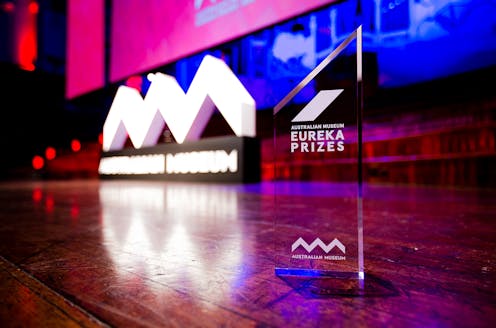
A microscope slide that can diagnose cancer, mapping how what we eat affects the environment, and a volunteer effort tracking bushfire damage. These were just a few of the scientific projects recognised at the 2022 Australian Museum Eureka Prizes[1], announced in Sydney.
The prizes have been awarded each year since 1990 to recognise contributions to science and the public understanding of science.
The ANSTO Eureka Prize for Innovative Use of Technology went to the NanoMslide team, comprising researchers from La Trobe University, the University of Melbourne, the Garvan Institute of Medical Research, and the Peter MacCallum Cancer Centre. Their invention uses a special nanotechnology coating for microscope slides for quicker, cheaper cancer diagnosis.
Eric Chow, Christopher Fairley, Catriona Bradshaw, Jane Hocking, Deborah Williamson and Marcus Chen, from Monash University and the University of Melbourne, won the Australian Infectious Diseases Research Centre Eureka Prize for Infectious Diseases Research. Their work on sexually transmitted infections (STIs) uncovered the role of saliva in transmitting STIs and pioneered tailored antibiotic treatments.
The Eureka Prize for Excellence in Interdisciplinary Scientific Research was awarded to Manfred Lenzen, David Raubenheimer, Arunima Malik, Mengyu Li and Navoda Liyana Pathirana from the University of Sydney, for their work on how what we eat affects the environment. They traced billions of supply chains that deliver food to consumers.
Read more: The world's affluent must start eating local food to tackle the climate crisis, new research shows[2]
The Environment Recovery Project, run by UNSW and the German Centre for Integrative Biodiversity Research, won the Department of Industry, Science and Resources Eureka Prize for Innovation in Citizen Science. The project gathered 1,600 volunteers to survey the damage caused by the devastating bushfires of 2019–20 and gather data on how the environment is recovering.
UNSW Professor Raina MacIntyre was awarded the Department of Defence Eureka Prize for Leadership in Science and Innovation for her “significant leadership role in the international response to the COVID-19 pandemic”. She has written a range of articles for The Conversation, including an early explainer[3] on the novel coronavirus.
The UNSW Eureka Prize for Scientific Research went to Justin Yerbury of the University of Wollongong. Since his diagnosis with motor neuron disease in 2016, he has made key discoveries about the molecular causes of the disease.
The Australian Museum Research Institute also awarded two medals. One went to Stephen Keable, a former manager of the Marine Invertebrates Collections at the Australian Museum, for his work on marine invertebrates. The second was awarded to Graham Durant, the recently retired director of Questacon, for his service to Australian science and science education.
Read more: Museum or not? The changing face of curated science, tech, art and culture[4]
Other winners included:
NSW Environment and Heritage Eureka Prize for Applied Environmental Research – Sustainable Farms, Australian National University
Macquarie University Eureka Prize for Outstanding Early Career Researcher – Tess Reynolds, University of Sydney
Celestino Eureka Prize for Promoting Understanding of Science – Veena Sahajwalla, UNSW
Australian Museum Eureka Prize for Science Journalism – Jackson Ryan, CNET
Department of Industry, Science and Resources Eureka Prize for STEM Inclusion – Kirsten Ellis, Monash University
University of Sydney Sleek Geeks Science Eureka Prize — Primary – Genevieve S., Bucasia State School, Qld
University of Sydney Sleek Geeks Science Eureka Prize — Secondary – Iestyn R., St John’s Anglican College, Forest Lake, Qld
Eureka Prize for Emerging Leader in Science – Sumeet Walia, RMIT University
University of Technology Sydney Eureka Prize for Outstanding Mentor of Young Researchers – Paul Wood, Monash University
References
- ^ Australian Museum Eureka Prizes (australian.museum)
- ^ The world's affluent must start eating local food to tackle the climate crisis, new research shows (theconversation.com)
- ^ early explainer (theconversation.com)
- ^ Museum or not? The changing face of curated science, tech, art and culture (theconversation.com)