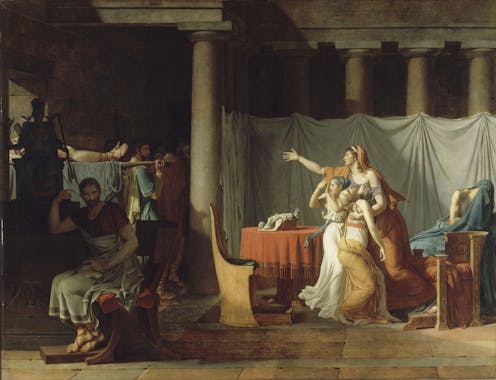
Jacques-Louis David's The Lictors Bringing to Brutus the Bodies of his Dead Sons is a gruesome and compelling painting
- Written by: Mark Ledbury, Professor of Art History and Visual Culture, University of Sydney
In this new series, our writers introduce us to a favourite painting.
How can anyone love this dark and gruesome painting?
We’re a long way from Monet, Van Gogh and the perennial favourites of museum visitors.
Jacques-Louis David’s The Lictors Bringing to Brutus the Bodies of his Dead Sons is a history painting[1]: a kind of art that attempts to give visual life to stories from history, religion and myth. This genre was regarded for centuries as the pinnacle of artistic achievement.
These days, many epic stories have faded from cultural memory and eyes used to modern art and the moving image can see history painting as dull, stilted dress-up.
But let’s not speed past the painting. Take a moment to dwell on its strange and compelling beauty.
Painting history
Jacques-Louis David[2] (1748-1825) was a leader among the painters of a generation enthused by the revival of interest in ancient histories, cultures and art we now call neo-classicism[3].
After a rocky start, and a life-changing stay in Rome, David made his reputation with spectacular paintings derived from ancient history, shown at the Salon[4] – the enormously popular public exhibitions of contemporary art held every two years in the Louvre palace.
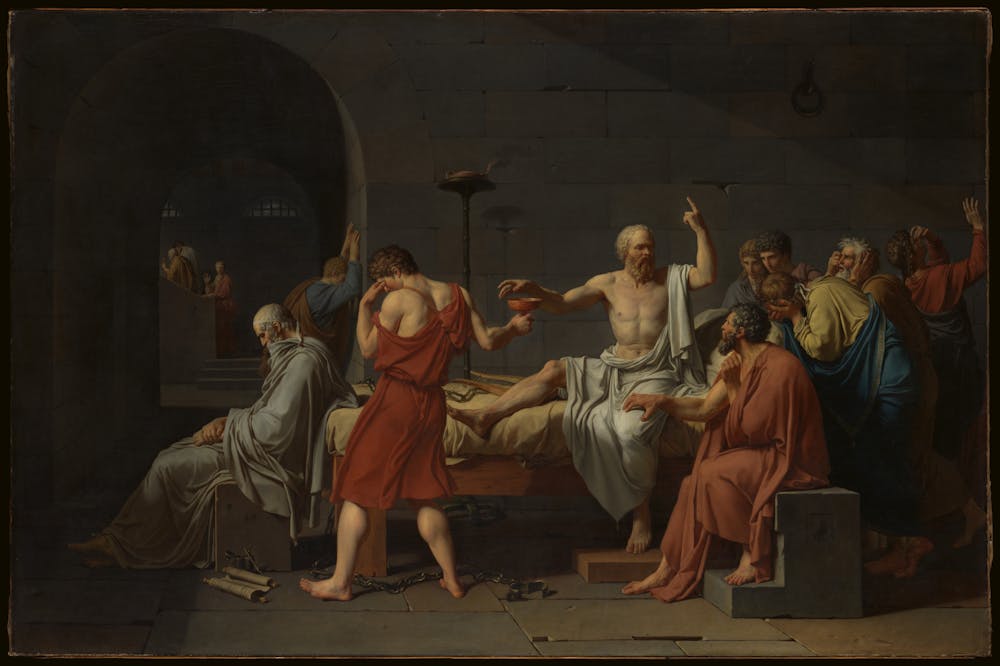
These works included the Oath of the Horatii[5], which caused a sensation in 1785[6] and the equally remarkable Death of Socrates[7].
He painted The Lictors Bringing to Brutus the Bodies of his Dead Sons over the course of two years, before it premiered at the Salon in 1789.
It was first seen six weeks after the storming of the Bastille. The exhibition closed on October 6, the same day a revolutionary crowd spearheaded by Parisian women[8] extracted Louis XVI and his family from the Versailles and placed them under house arrest in the Tuileries palace.
Read more: What is Bastille Day and why is it celebrated?[9]
An unorthodox composition
The Brutus depicts a terrible moment in the life of the (perhaps legendary) founder of the Roman republic Lucius Junius Brutus[10] who, after the brutalisation of his own family and the rape of Lucretia, led the successful revolt that ended the reign of Tarquinius Superbus[11] and founded the Roman republic.
After this coup, the exiled Tarquins attempted a counter-revolution. Brutus’s sons and his wife’s brothers were involved in this plot.
Uncovering their treason, Brutus was forced to follow his own anti-treason decree and presided over the judgement and execution of his sons.
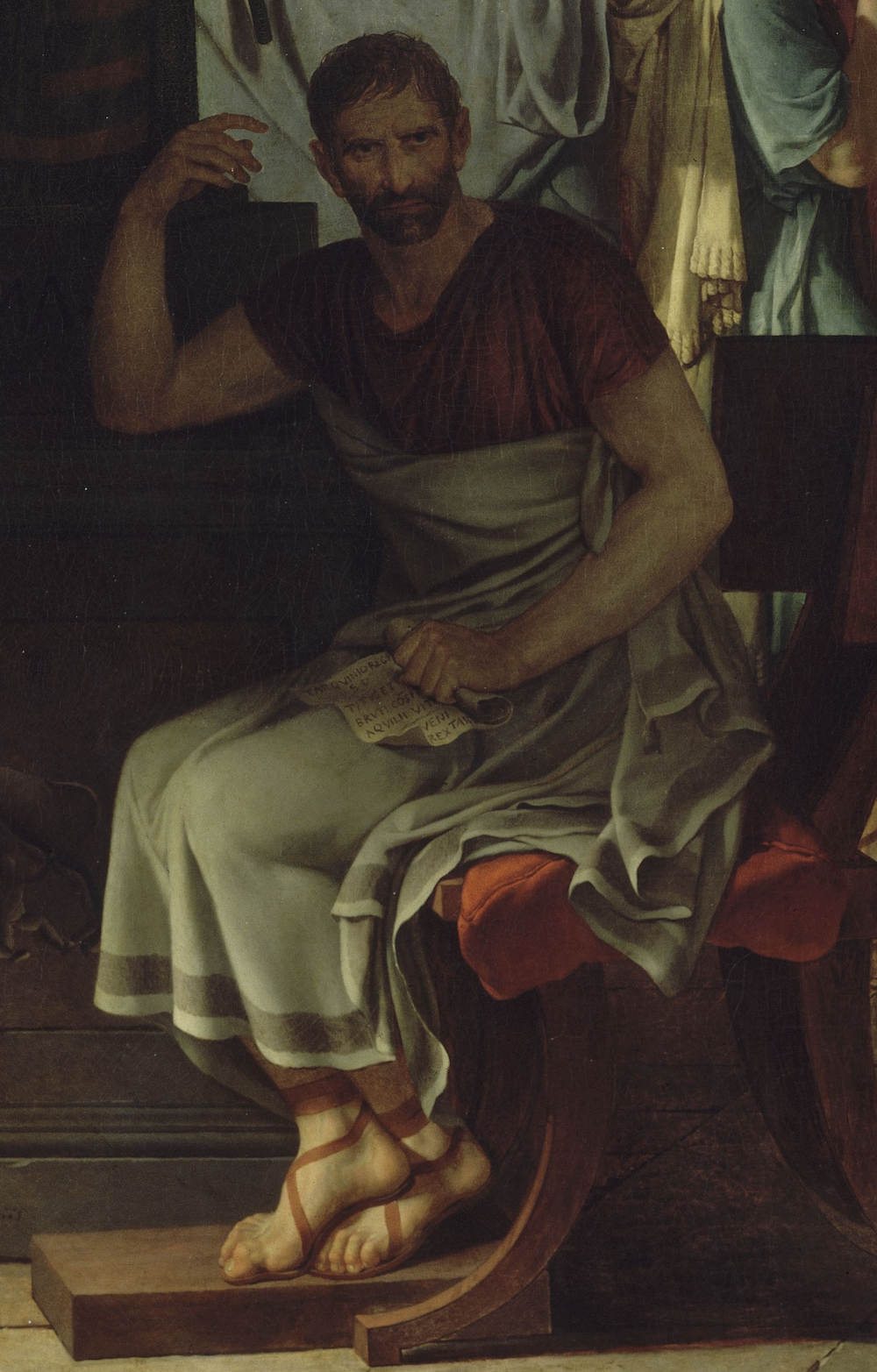 Notice the curled toes, and the tension in the gripping hand.
Musée du Louvre
Notice the curled toes, and the tension in the gripping hand.
Musée du Louvre
David chose not to show the execution itself, described in Livy[12] and Plutarch[13]. Instead he imagined the moment when the lictors – the physical executioners and the bodyguards of the Republic – return the bodies to Brutus’ household for burial.
At the left of the 14-square-metre canvas, we see the tense, numb Brutus seated, uncomfortably, in the shadow of the Goddess Roma[14].
His facial expression is inscrutable, but his clenched feet, toes and right hand, clutching his anti-treason decree, betray his tension and pain. The corpses and the weight of history, office and the law seem to impose on him a heavy bodily and psychic burden.
The centre, where we might typically find the main actor of the scene, is occupied by furniture, a sewing basket and empty space.
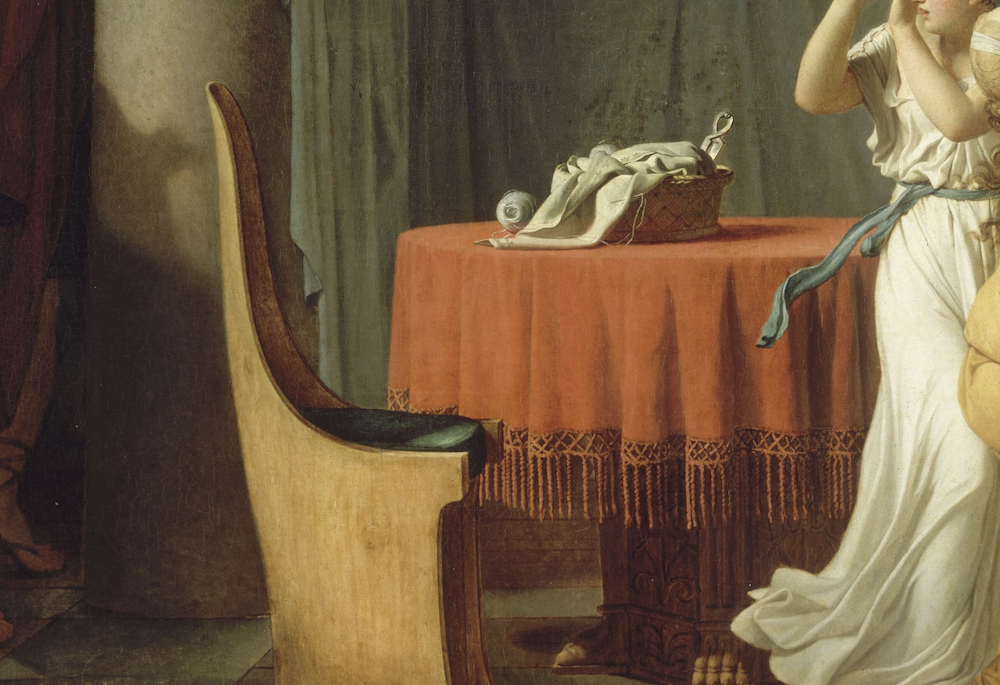 At the centre of the painting is a simple still life.
Musée du Louvre
At the centre of the painting is a simple still life.
Musée du Louvre
This central still life is as powerful as it is unexpected.
The empty chair is a brilliant metaphor for the disruptions, absences and family disintegration brought about by Brutus’ submission to his own law.
The sewing basket, a bold and beautifully painted detail, seems banal and domestic, but the pin and thread, the ball and the scissors recall in miniature the scourging and execution of the sons.
 The mother is defiant; the daughters slumped in grief.
Musée du Louvre
The mother is defiant; the daughters slumped in grief.
Musée du Louvre
To the right of this, brightly lit, is the maternal group.
The statuesque, shocked but defiant mother is the most active of all the figures. She makes eye contact with one of the executioners and past him to the corpses.
Her daughters collapse in grief, seeking shelter from the presence of death.
At the right edge of the painting sits another figure, a veiled servant, whose face David hides, perhaps echoing Timanthes’ depiction of the grieving Agamemnon[15]. Her tense muscles and veins hint at grief and despair.
Pointing to the future
This unorthodox compositional strategy – the gaps, reversals and displacements, nuanced, sublimated emotions, the disjointed and scattered nature of its participants – gives the painting its power.
But notice, too, the strange beauty of David’s rough stone floors, polished and incised wood surfaces and tensely folded fabrics, all heavy with the weight of loss and uncertainty of the future.
That uncertain future happened to be unfolding right around the display of the painting in Paris at the beginning of the French Revolution.
In this context, Brutus took on unexpected new meanings: virtue and sacrifice; the violence and courage needed to overthrow tyrannical kings and maintain liberty; vigilance, loyalty, treason and death.
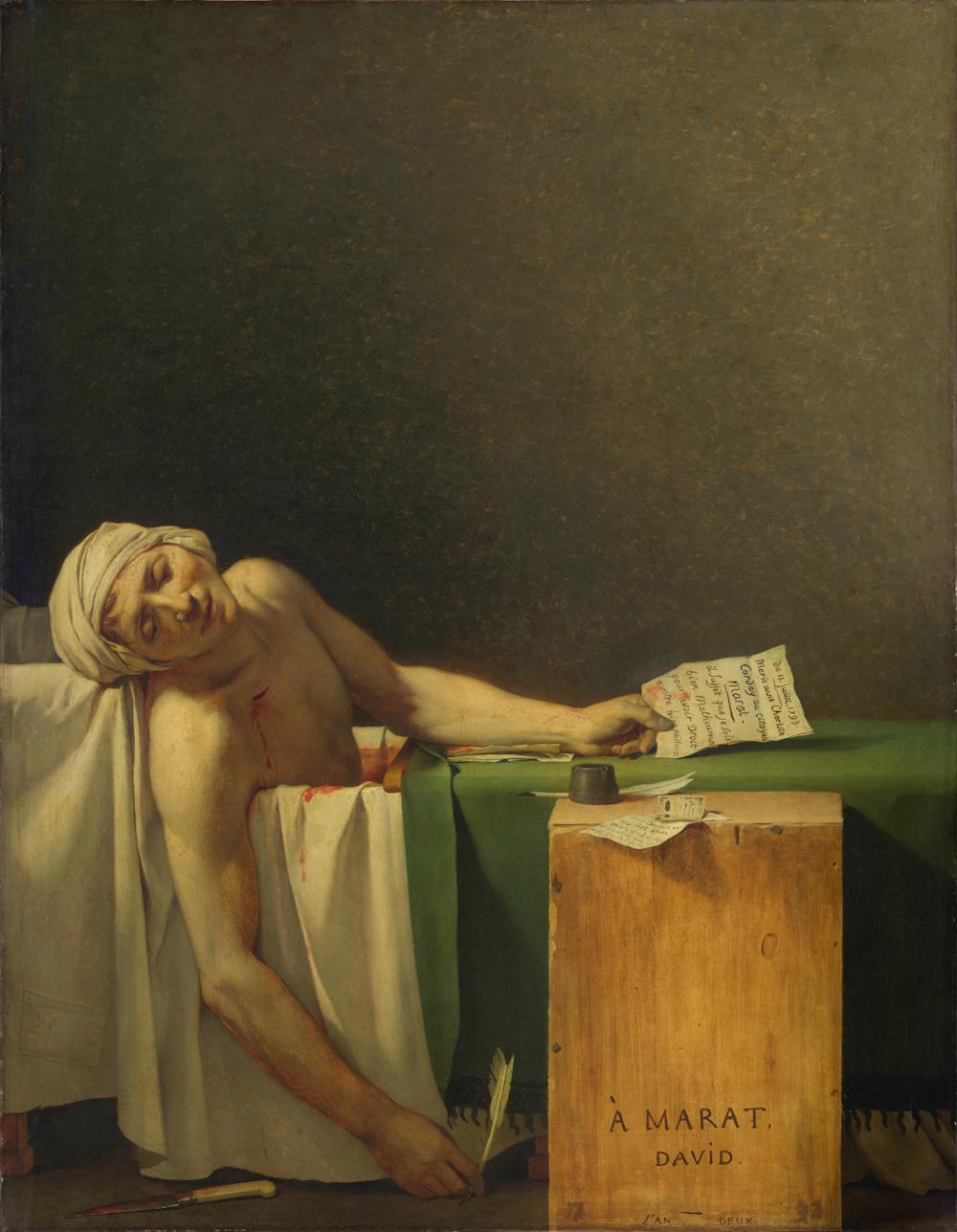 Jacques-Louis David, Death of Marat, 1793.
Royal Museums of Fine Arts of Belgium
Jacques-Louis David, Death of Marat, 1793.
Royal Museums of Fine Arts of Belgium
Events granted the painting new momentum and relevance and emboldened its creator, catalysing his transition from court artist to political painter.
David became ever more involved in Revolutionary politics, designing Revolutionary festivals and dress, signing death warrants and creating its most enduring image, the Death of Marat[16].
Brutus resonates not just because it demonstrates how politically alive painting can be, but also because it bends the rules of composition. By doing so, it enabled new generations of experiment. It broke the mould and redefined what is possible.
It points not to a distant past, but to the future.
Read more: Hidden women of history: Adélaïde Labille-Guiard, prodigiously talented painter[17]
References
- ^ history painting (www.tate.org.uk)
- ^ Jacques-Louis David (www.nga.gov)
- ^ neo-classicism (mymodernmet.com)
- ^ Salon (www.tate.org.uk)
- ^ Oath of the Horatii (collections.louvre.fr)
- ^ caused a sensation in 1785 (doi.org)
- ^ Death of Socrates (www.metmuseum.org)
- ^ revolutionary crowd spearheaded by Parisian women (omny.fm)
- ^ What is Bastille Day and why is it celebrated? (theconversation.com)
- ^ Lucius Junius Brutus (www.livius.org)
- ^ Tarquinius Superbus (en.wikipedia.org)
- ^ Livy (www.perseus.tufts.edu)
- ^ Plutarch (penelope.uchicago.edu)
- ^ Goddess Roma (en.wikipedia.org)
- ^ grieving Agamemnon (www.hellenicaworld.com)
- ^ Death of Marat (www.fine-arts-museum.be)
- ^ Hidden women of history: Adélaïde Labille-Guiard, prodigiously talented painter (theconversation.com)