military tech startup Anduril comes to Australia
- Written by: Julia Scott-Stevenson, Chancellor's Postdoctoral Research Fellow, University of Technology Sydney
Earlier this month, posters started going up around Sydney advertising an event called “In the Ops Room, with Palmer Luckey”. Rather than an album launch or standup gig, this turned out to be a free talk given last week by the chief executive of a high-tech US defence company called Anduril.
The company has set up an Australian arm, and Luckey is in town to entice[1] “brilliant technologists in military engineering” to sign on.
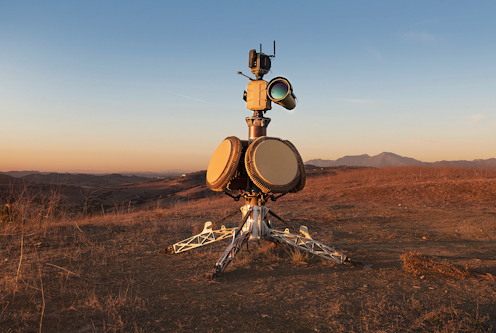
Anduril makes a software system called Lattice[2], an “autonomous sensemaking and command & control platform” with a strong surveillance focus which is used on the US–Mexico border[3]. The company also produces flying drones[4] and has a deal to produce three robotic submarines[5] for Australia, with capabilities[6] for surveillance, reconnaissance, and warfare.
The PR splash is unusual from the normally secretive world of military technology. But Luckey’s talk opened a window onto the future as seen by a company[7] “transforming US & allied military capabilities with advanced technology”.
From Oculus to Anduril
Unlike most defence tech moguls, Luckey got his start in the world of immersive tech and gaming.
While at college, the Anduril founder had a brief stint[8] at a military-affiliated mixed reality research lab at the University of Southern California, then set up his own virtual reality headset company called Oculus VR. In 2014, at the age of 21, Luckey sold Oculus to Facebook for US$2 billion.
In 2017 Luckey was fired by Facebook for reasons that were never made public. According to some reports[9], the issue was Luckey’s support for the presidential campaign of Donald Trump.
Luckey’s next move, with backing from right-wing venture capitalist Peter Thiel’s Founder’s Fund, was to set up Anduril[10].
Finding new markets
Since Luckey’s departure, Facebook (now known as Meta) has broadened its efforts beyond the virtual and augmented reality market. A forthcoming “mixed reality” headset[11] plays a key role in its plans for a metaverse being pitched to business and industry as well as consumers.
We can see similar pivots from consumers to enterprise across the immersive tech industry. Magic Leap, makers of a much hyped mixed-reality headset, later imploded and re-emerged focusing on healthcare[12].
Read more: 'Potential for harm': Microsoft to make US$22 billion worth of augmented reality headsets for US Army[13]
Microsoft’s mixed-reality headset, the HoloLens, was initially seen at international film festivals[14]. However, the HoloLens 2, released in 2019, was marketed solely to businesses.
Then, in 2021, Microsoft won a ten-year, US$22 billion contract to provide the US Army with 120,000 head-mounted displays[15]. Known as “Integrated Visual Augmentation Systems”, these headsets include a range of technologies such as thermal sensors, a heads-up display and machine learning for training situations.
Fulfilling work?
Speaking to the Sydney audience on Thursday, Luckey framed his own shift to defence not as one of economic necessity, but of personal fulfilment. He described saying “your job is worthless” to new recruits in social media companies making games or augmented reality filters.
That kind of work is fun but ultimately meaningless, he says, whereas working for Anduril would be “professionally fulfilling, spiritually fulfilling, fiscally fulfilling”.
Not all technology workers would agree that defence contracts are spiritually fulfilling. In 2018, Google employees revolted against Project Maven[16], an AI effort for the Pentagon. Staff at Microsoft[17] and Unity[18] have also expressed consternation over military involvement.
‘Billions of robots’
The first audience question on Thursday asked Luckey about the risks of autonomous AI – weapons run by software that can make its own decisions.
Luckey said he was worried about the potential of autonomy to do “really spooky things”, but much more concerned about “very evil people using very basic AI”. He suggested there was no moral high ground in refusing to work on autonomous weapons, as the alternative was “less principled people” working on them.
Luckey did say Anduril will always have a “human in the loop”: “[The software] is not making any life or death decisions without a person who’s directly responsible for that happening.”
This may be current policy, but it seems at odds with Luckey’s vision of the future of war. Earlier in the evening, he painted a picture:
You’re going to see much larger numbers of systems [in conflicts] … you can’t have, let’s say, billions of robots that are all acting together, if they all have to be individually piloted directly by a person, it’s just not going to work, so autonomy is going to be critical for that.
Read more: UN fails to agree on 'killer robot' ban as nations pour billions into autonomous weapons research[19]
Not everyone is as sanguine about the autonomous weapons arms race as Luckey. Thousands of scientists have pledged[20] not to develop lethal autonomous weapons.
Australian AI expert Toby Walsh, among others, has made the case[21] that “the best time to ban such weapons is before they’re available”.
Choose your future
My own research[22] has explored the potential of immersive media technologies to help us imagine pathways to a future we want to live in.
Luckey seems to argue he wants the same: a use for these incredible technologies beyond augmented reality cat filters and “worthless” games. Unfortunately his vision of that future is in the zero-sum framing of an arms race, with surveillance and AI weapons at the core (and perhaps even “billions of robots acting together”).
During Luckey’s talk, he mentioned that Anduril Australia is working on other projects beyond the robotic subs, but he couldn’t share what these were.
Read more: Australia's pursuit of 'killer robots' could put the trans-Tasman alliance with New Zealand on shaky ground[23]
References
- ^ entice (prwire.com.au)
- ^ Lattice (www.anduril.com)
- ^ the US–Mexico border (www.washingtonpost.com)
- ^ flying drones (www.cnet.com)
- ^ three robotic submarines (www.theguardian.com)
- ^ capabilities (www.anduril.com)
- ^ by a company (www.anduril.com)
- ^ a brief stint (www.latimes.com)
- ^ some reports (www.cnet.com)
- ^ set up Anduril (www.forbes.com)
- ^ “mixed reality” headset (www.techradar.com)
- ^ focusing on healthcare (www.theverge.com)
- ^ 'Potential for harm': Microsoft to make US$22 billion worth of augmented reality headsets for US Army (theconversation.com)
- ^ international film festivals (docubase.mit.edu)
- ^ 120,000 head-mounted displays (theconversation.com)
- ^ against Project Maven (www.fastcompany.com)
- ^ Microsoft (www.theverge.com)
- ^ Unity (www.vice.com)
- ^ UN fails to agree on 'killer robot' ban as nations pour billions into autonomous weapons research (theconversation.com)
- ^ pledged (www.cnet.com)
- ^ made the case (www.nytimes.com)
- ^ own research (immerse.news)
- ^ Australia's pursuit of 'killer robots' could put the trans-Tasman alliance with New Zealand on shaky ground (theconversation.com)