Australians favour more defence spending in Lowy poll, as Labor extends ADF chief Angus Campbell's term
Written by: Michelle Grattan, Professorial Fellow, University of Canberra
Australians are becoming more fearful in an insecure world, and want to see the country armed up, favouring more defence spending and the planned acquisition of nuclear-powered submarines.
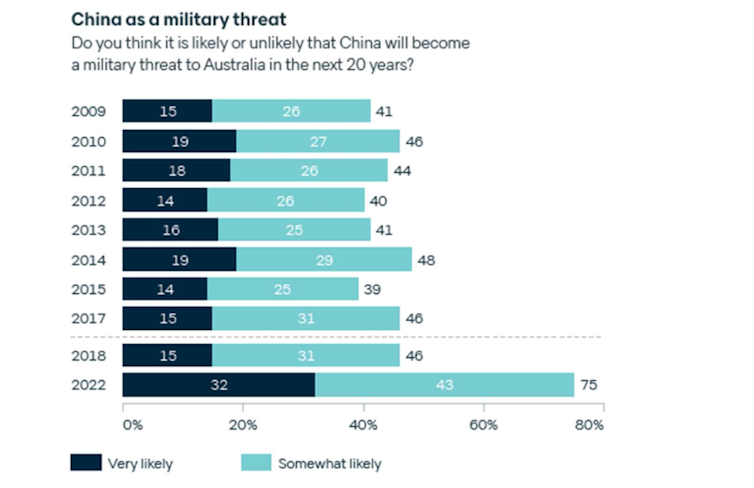
Three quarters of Australians say it is likely China will become a military threat to Australia in the next 20 years, according to the 2022 Lowy Institute’s Poll[1]. This is an increase of 29 points since 2018.
Moreover, for the first time a majority (51%) would favour Australian military forces being used if China invaded Taiwan and the United States intervened. This was an eight-point rise since 2019 when the question was last asked.
Just over half (51%) say Australia should boost defence spending – a 20-point rise since 2019. Seven in ten favour the plan to acquire nuclear-powered submarines. More than six in ten support the American military being based in Australia.
Defence Minister Richard Marles, who is acting prime minister, on Tuesday announced the government is extending the terms of the Chief of the Defence Force, Angus Campbell, and the ADF’s vice chief, Vice Admiral David Johnston, by two years. The government has also asked the CDF to extend the term of the Chief of Joint Operations, Lieutenant General Greg Bilton.
Marles said the extensions were because it was “a time which is as strategically complex as any since the end of the Second World War in terms of our national security and the needs of our defence procurement”.
In his preface to the poll, Lowy executive director Michael Fullilove writes:
“Australians are increasingly concerned about the potential for great power competition to spill over into confrontation.
"In 2022, Australians report feeling unsafe, and as the potential for conflict in our region feels more possible, support for Australia’s alliance with the United States has returned to a record high.”
Nearly seven in ten (68%) believe Russia’s foreign policy poses a critical threat to Australia’s vital interest in the next decade – a 36-point increase since 2017. Russian foreign policy tops the list of threats to Australia’s vital interests, narrowly ahead of China’s foreign policy (65% – up 29 points since 2017).
In general, anxiety about Russia, China and a war over Taiwan have overtaken Australians’ concerns about COVID-19 and climate change.
The poll was conducted March 15-28 with a sample of 2006. It is the 18th in the Lowy Institute’s annual series and is authored by Natasha Kassam.
In the election campaign the Coalition tried to make national security and fears about China an issue to its advantage but this backfired when it came under attack for having been unable to head off the China-Solomons security pact.
The poll found 88% of people were concerned about China potentially opening a military base in a Pacific Island country.
While there has been a 11-point (to 58%) fall in confidence in US President Joe Biden since 2021, this is still 28 points above the confidence expressed in President Donald Trump in 2020 (30%).
On climate change, there is overwhelming support for federal government subsidies for renewable technology (90%), committing to a more ambitious emissions target for 2030 ((77%), and Australian hosting a United Nations climate conference (75%). Nearly two thirds (65%) support reducing coal exports, and banning new coal mines (63%).
COVID has receded but not disappeared as a threat in the minds of Australians. Only just over four in ten (42%) see COVID as a critical threat to Australia’s interests, 17 points down on 2021 and 34 points down on 2020.
More than six in ten people (62%) are optimistic about Australia’s economic performance in the world over the next five years, but this is a 17-point fall from 2021.
With Anthony Albanese’s visiting Paris later this week, in the poll 49% blame both Australia and France for the tensions in the relationship over the cancellation of the submarine contract; 35% say Australia is more to blame, while 12% blame France more.
Making his announcement about the defence chief, Marles said the Albanese government “is putting a premium on continuity. This applies to strategic advice and the timely and effective delivery of key procurements including through the AUKUS framework. Australia cannot afford any further delay in the next generation of submarines.”
Marles announced new chiefs of the navy, army and air force.
Navy: Rear Admiral Mark Hammond.
Army: Major General Simon Stuart.
Air Force: Air Vice-Marshal Robert Chipman.
References^Lowy Institute’s Poll (poll.lowyinstitute.org)