Is this the game-changer for Aussie kids?
- Written by: Wendy Boyd, Associate Professor, Faculty of Education, Southern Cross University
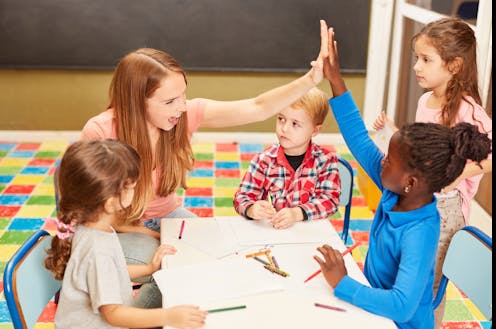
Celebrations greeted Thursday’s co-ordinated announcement[1] by the NSW and Victorian governments that they will invest $6 billion and $9 billion, respectively, to provide 30 hours a week of play-based learning for all children in the 12 months prior to primary school. It’s a promising indication of growing public and political support for valuing our children and the voices of women and families.
There is clear evidence that quality early childhood education and care benefit children not only at the time they attend[2] but is likely to have an enduring life-long impact[3].
Read more: Play-based learning can set your child up for success at school and beyond[4]
Investment in children is worth it
This investment in resourcing children with opportunities for play-based early childhood education is likely to have positive impacts on children’s learning and development. The benefits include:
- social and emotional well-being
- cognitive development
- communication and language development
- physical development.
This week’s announcements are extremely important for the nation’s children as 2022 data[5] from the Australian Early Development Census (AEDC) show that 21% of children in NSW and 19% in Victoria are assessed as “vulnerable” in at least one area of development when they start school.
Read more: Report finds every $1 Australia spends on preschool will return $2, but this won't just magically happen[6]
But beware ‘schoolification’
Australia’s mandatory national curriculum framework, the Early Years Learning Framework[7] (EYLF), states:
“Play-based learning is a context for learning through which children organise and make sense of their social worlds, as they engage actively with people, objects, and representations.”
Within the framework there is:
“a specific emphasis on play-based learning [that] recognises the importance of communication and language (including early literacy and numeracy) and social and emotional development”.
Children have a right to play[8]. Care needs to be taken to ensure this right is upheld with the rollout of 30 hours a week of early childhood education.
Early childhood educators need to be fully versed in the power of play. They will have to take care to ensure this “play-based” approach does not result in “schoolification[9]” of our early childhood programs. It will be essential to assure parents[10] of the importance and value of play.
Read more: A failure at 6? Data-driven assessment isn't helping young children's learning[11]
How does Australia compare to other countries?
Provision of 30 hours-a-week access to early childhood education and care for all children is termed universal access. It’s deemed to be the gold standard for early childhood service provision.
In addition to the state governments’ initiative, the newly elected federal government has commissioned a Productivity Commission review of early childhood care and education to support a universal 90% childcare subsidy. Access to good-quality and affordable early education and care is regarded as a fruitful investment in children.
Equitable access in the Nordic countries is one reason they are renowned as world exemplars of excellence in early childhood services. A 2017 UNICEF report on quality education ranked Finland first and Norway ninth. Australia was 39th[12] of the 41 countries.
This suggests Australia has a long way to go to reach international standards used by UNICEF to determine if programs are meeting all preschoolers’ needs.
Read more: More diversity can help solve twin problems of early childhood staff shortages and families missing out[13]
Children will still miss out for years to come
Based on the NSW and Victorian governments’ plans for a new free year of preschool from 2030 and 2025[14] respectively, is Australia finally on the road to achieving authentic and universal access to excellent early childhood education and care? Or does our slow approach throw up other problems that may become barriers to achieving quality early learning experiences for all children now and in the future? The extended rollout period means many children may miss out.
Our children and parents deserve more than just promises. If it is truly universal access, it should be available at no cost to all children across all ages in the years before school.
Many key issues must be considered before rolling out free preschool. Factors such as ensuring equity in attendance, meeting demand, and evenly distributed availability[15] are critical for flexibility and choice.
The NSW government announcement[16] included measures to provide for better access. Equitable access arrangements will enable mothers and fathers to participate equally[17] in the workforce. This means parents can fully engage in paid work with suitable hours for children and their paid work.
Don’t compromise on quality
Parents also need to feel assured their children are getting good-quality education and care, so the focus on quality must be maintained.
Resourcing of the sector has to be carefully considered to safeguard free access when rolled out. A recent report[18] on Norway emphasises that to sustain a quality play-based preschool program it must be underpinned by:
- clear values and principles
- appropriate level of resources to ensure long-term viability
- inclusivity
- a well-qualified, engaged and supported workforce.
However, there is already a shortage[19] of qualified teachers in the early childhood education and care sector. A key reason is they suffer poor work conditions[20] compared to primary school teachers.
Attending a quality play-based program for 30 hours a week will provide children opportunities to develop and enhance their development. To achieve those outcomes, it is imperative that the newly announced initiatives are genuinely resourced for quality learning experiences and equitable opportunities.
If that happens, we’ll ensure Australian children thrive during their childhood and have a seamless and positive transition to school. And that will set them up for the life we all want for them.
References
- ^ co-ordinated announcement (www.theguardian.com)
- ^ at the time they attend (journals.sagepub.com)
- ^ life-long impact (www.thefrontproject.org.au)
- ^ Play-based learning can set your child up for success at school and beyond (theconversation.com)
- ^ 2022 data (www.aedc.gov.au)
- ^ Report finds every $1 Australia spends on preschool will return $2, but this won't just magically happen (theconversation.com)
- ^ Early Years Learning Framework (www.acecqa.gov.au)
- ^ right to play (www.unicef.org)
- ^ schoolification (www.oecd.org)
- ^ assure parents (theconversation.com)
- ^ A failure at 6? Data-driven assessment isn't helping young children's learning (theconversation.com)
- ^ Australia was 39th (www.unicef-irc.org)
- ^ More diversity can help solve twin problems of early childhood staff shortages and families missing out (theconversation.com)
- ^ from 2030 and 2025 (www.abc.net.au)
- ^ evenly distributed availability (childcarecanada.org)
- ^ announcement (www.abc.net.au)
- ^ enable mothers and fathers to participate equally (onlinelibrary.wiley.com)
- ^ report (childcarecanada.org)
- ^ shortage (labourmarketinsights.gov.au)
- ^ poor work conditions (journals.sagepub.com)