The media has reached 'peak passivity' in the lead up to the 2022 election
- Written by: Rodney Tiffen, Emeritus Professor, Department of Government and International Relations, University of Sydney
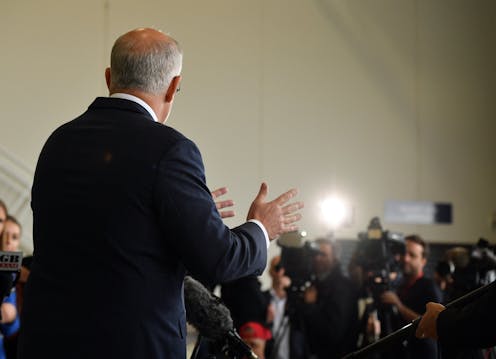
With severe staffing cuts, pressures for instant productivity and a priority on producing clickbait[1], few would think we are in a golden age for journalism. Few, either, would think that the media have distinguished themselves in this election campaign.
There have been periods in the past – such as the last three years of Menzies’ reign or the first four to five years of the Fraser government – where the Canberra press gallery achieved peak passivity.
In my view, sadly, those periods are now matched by the gallery’s poor performance in the lead up to the 2022 election. Exploiting this passivity has also become a key part of the government’s re-election strategy.
Car parks and the 2019 campaign
During the 2019 election campaign, the Morrison government promised A$660 million[2] to build 47 car parks near train stations, justified as part of its strategy to reduce urban congestion. Two-thirds of the car parks were in Melbourne, even though Sydney had a majority of the nation’s most congested roads, and three quarters of them were allotted to Liberal-held electorates.
The government pledged[3] six to the marginal Liberal seat of Goldstein, and three to Liberal-held Dunkley. The Labor-held seat of Isaacs lies between these two, and has almost a dozen railway stations, but it was not allocated any. After Labor won Dunkley, two of the car parks were cancelled[4].
In June 2021, the auditor-general found[5] that in the lead up to the government’s announcements, there were no data produced on current car parking, or commuter numbers, and decisions were made with no input from the relevant bureaucrats. Several of the projects involved funding from state or local governments, but little if any consultation had been had with those governments before the announcements. Tellingly, a major working document was titled[6] “top 20 marginals”.
In November 2021, the government said that just three of the 47 car parks had been completed, and that work had started on another six.
Read more: The 'car park rorts' story is scandalous. But it will keep happening unless we close grant loopholes[7]
Shrugging off the auditor-general
The government endured some embarrassment in July 2021 after the publication of the auditor-general’s report, but largely shrugged it off.
The infrastructure minister leading up to the 2019 election, Alan Tudge, denied[8] ever having seen the document titled “top 20 marginals”, while Morrison avoided answering[9] the question.
Finance Minister Simon Birmingham dismissed the criticism[10] because the Coalition had won the 2019 election. Move over John Stuart Mill and Thomas Jefferson: according to the Birmingham Doctrine, democracy is anything you can get away with.
It was a policy cynically conceived and then cynically abandoned. It was based on the belief that thanks to media passivity and lack of curiosity, they could get away with it.
The Age/Sydney Morning Herald journalists Shane Wright and Katina Curtis did some excellent reporting[11] digging into the auditor-general’s report - and government grants more generally[12] - and there was a Senate inquiry[13] and some freedom of information requests[14]. But their efforts failed to generate traction elsewhere in the media.
The passivity continues: in October 2021, the government claimed[15] 33 of the projects would be either completed or under construction by the end of 2022. I have not seen any media reports testing whether this assertion is still true.
Morrison won his gamble.
Part of a pattern
If the lack of news coverage of the broken promises on the car parks were a single example, it would be bad enough, but it seems to be part of a pattern.
After the Hayne banking royal commission[16] reported in February 2019, the government said it would implement all its recommendations. Since then, it has quietly abandoned[17] several of the key ones. The Age/Sydney Morning Herald economics editor Ross Gittins recently wrote a scathing column[18] about it, but it has received little attention elsewhere.
Similarly, the government pledged to implement the recommendations of the aged care royal commission[19], released last year. How many media have since followed up their implementation[20]? Minister for Senior Australians and Aged Care Services Richard Colbeck has been allowed a convenient invisibility throughout the election campaign.
Early in the campaign, an excellent ABC Four Corners investigation[21] by Linton Besser highlighted how well-connected company Aspen Medical had won several government contracts, some without any open tender process. Neither that report nor more general probing of whether the government’s widespread outsourcing has delivered value for money to the public has been widely pursued by the media.
Journalism is hard, but needs to be better
Media coverage is not helped by the fact the largest commercial employer of journalists in the country – News Corp[22] – is simply a propaganda arm for the government, and their mediocrity sets a tone for others. Nor is performative aggression at media conferences a substitute for probing reporting.
The Morrison government has been able to campaign in the comfortable belief that with a few exceptions such as its failure to establish an integrity commission, its record over the past three years would not be subjected to probing examination by the news media.
Read more: Below the Line: What issues are politicians ignoring this election? – podcast[23]
References
- ^ producing clickbait (theconversation.com)
- ^ promised A$660 million (www.smh.com.au)
- ^ government pledged (www.smh.com.au)
- ^ cancelled (baysidenews.com.au)
- ^ found (www.anao.gov.au)
- ^ was titled (www.abc.net.au)
- ^ The 'car park rorts' story is scandalous. But it will keep happening unless we close grant loopholes (theconversation.com)
- ^ denied (www.abc.net.au)
- ^ avoided answering (www.smh.com.au)
- ^ dismissed the criticism (www.theguardian.com)
- ^ excellent reporting (www.smh.com.au)
- ^ government grants more generally (www.smh.com.au)
- ^ Senate inquiry (www.smh.com.au)
- ^ freedom of information requests (www.9news.com.au)
- ^ government claimed (www.smh.com.au)
- ^ banking royal commission (www.royalcommission.gov.au)
- ^ quietly abandoned (www.theguardian.com)
- ^ recently wrote a scathing column (www.smh.com.au)
- ^ aged care royal commission (agedcare.royalcommission.gov.au)
- ^ implementation (www.theguardian.com)
- ^ investigation (www.abc.net.au)
- ^ News Corp (theconversation.com)
- ^ Below the Line: What issues are politicians ignoring this election? – podcast (theconversation.com)