Why Morrison's ‘can-do’ capitalism and conservative masculinity may not be cutting through anymore
- Written by: Carol Johnson, Emerita Professor, Department of Politics and International Relations, University of Adelaide
Scott Morrison’s election strategy was clear at the end of last year. As borders were opened up and restrictions eased, Morrison argued the Coalition would be winding back the big government measures that were necessary during the pandemic.
The Coalition would be relying instead on so-called “can-do capitalism[1]” to build the economy and improve standards of living.
It was a post-pandemic form of neoliberal, free market populism. It aimed to attack Labor big government on the left while also countering Clive Palmer’s critique of big government attacks on freedom from the right.
The strategy built on the Coalition’s successful 2019 election campaign[2]. Then, Morrison argued the Liberals would protect voters from a big-spending Labor government that would rip off ordinary taxpayers via higher taxes.
Morrison’s masculine image as an suburban “daggy dad” reinforced that economic message, suggesting he empathised with ordinary Australians. It also undercut Bill Shorten’s arguments the Liberals favoured the “top end of town”.
However, Morrison’s strategy faces a number of challenges in 2022.
Read more: Centre-left parties worldwide have struggled to reinvent themselves – what kind of ALP is fighting this election?[3]
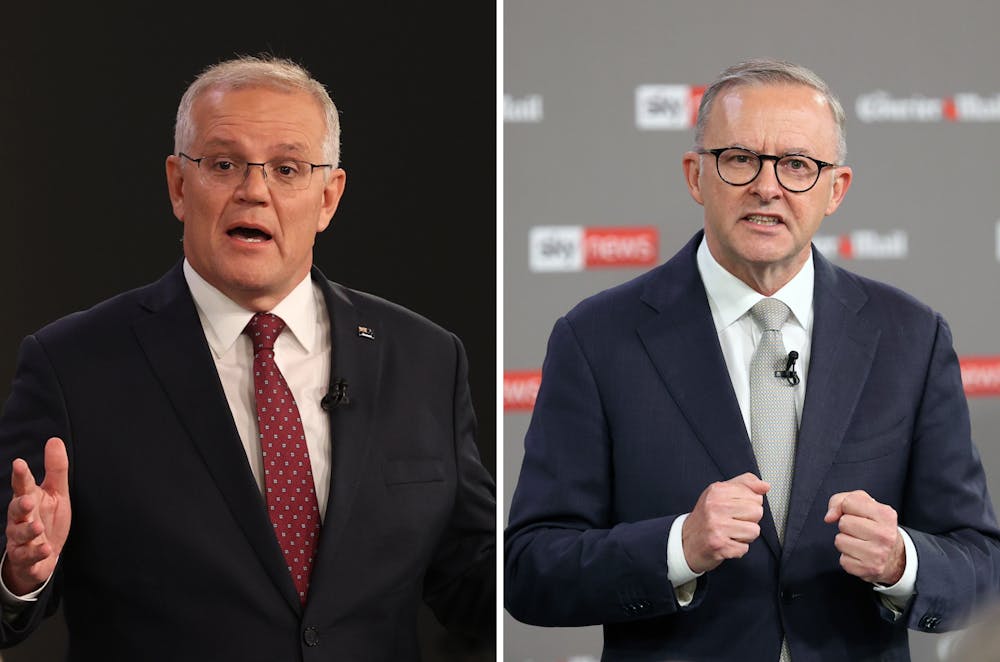
Deeper problems for Morrison
Having been burned by Bill Shorten’s big government policy agenda in 2019, Labor has now decided to pursue a small target strategy.
But Morrison’s problems go deeper. All too often, “can-do capitalism” involves leaving things to the market, not government.
The result, as business commentator Alan Kohler has observed[4], has been inadequate government action on several key issues, including RAT tests.
Meanwhile, criticisms of big spending governments no longer cut through in a time of record pandemic-related Coalition deficits.
Morrison no longer highlights “can-do capitalism”, but he has retained an emphasis[5] on the market and a smaller role for government.
However, relying on the market rather than government actually reinforces Labor’s attacks[6] on Morrison for not holding a hose and for denying issues are his job.
It’s also a difficult strategy when the market is delivering higher interest rates, inflation and low wages growth.
Relying on the market also opens up opportunities for Labor to say it’ll take action, unlike the Coalition government.
For example, it allows Labor to build a case for minimum wages keeping pace with inflation and for higher wages in female dominated professions such as aged care. It reveals opportunities for Labor to say[7] it would be better at supporting aged care, Medicare, childcare and the NDIS.
In short, there is an ideological contest between neoliberal free market views and Labor’s argument that government action can make an important difference[8].
Labor’s social democratic ideology may not be quite as obvious as in the 2019 campaign[9], when it emphasised addressing inequality, increasing taxation and tackling the “top end” of town.
As researcher and writer Rob Manwaring observes[10], today’s Labor offering is a somewhat “thin”, watered down, form of social democratic ideology.
Nonetheless, the idea of governments protecting and caring[11] for people in hard times is a very social democratic focus.
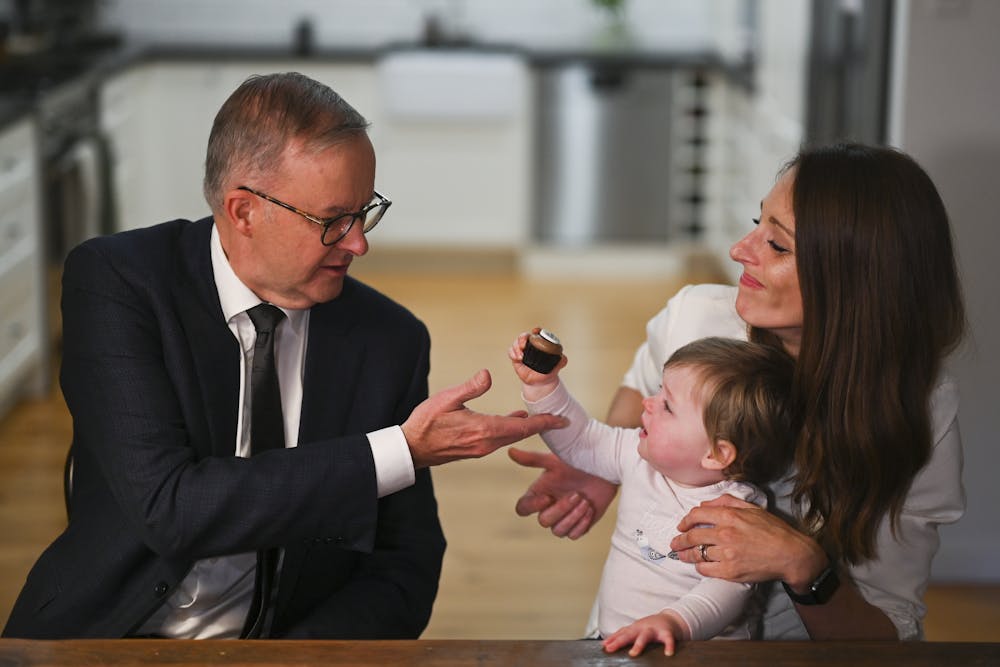 Albanese’s more caring form of masculinity, including around costs of living issues, may be cutting through.
AAP Image/Lukas Coch
Albanese’s more caring form of masculinity, including around costs of living issues, may be cutting through.
AAP Image/Lukas Coch
A masculinity contest – but times have changed
The ideological contest involves not just a contrast between different economic and social visions, but between different masculine images related to them.
Male political leaders tend to draw on the traditional familial male role of being both protector and economic provider[12].
Bob Hawke and Kevin Rudd both won against Coalition governments partly by depicting themselves as more caring[13] than their political opponents. Joe Biden used a similar strategy[14] against Trump.
The Coalition has responded to Labor’s care agenda by suggesting Albanese is weak, promising instead[15] strong leadership, a strong economy and a stronger future.
In other words, Morrison has tried to emasculate Albanese just as he attempted[16] to do with Shorten in 2019.
Researcher Blair Williams has characterised it as a masculinity contest between conservative “daggy dads” and caring[17] “state daddies”.
However, times have changed. Morrison’s masculine “daggy dad” image is not so relevant now that Labor is no longer targeting Liberal support for the “top end of town”.
And Morrison’s image as a strong male leader has been damaged by his failure to adequately protect[18] Australians from bushfires, floods and the pandemic. He also stands accused of failing to protect women politicians and staffers from parliament’s toxic culture.
Morrison’s attempts to suggest the Coalition is stronger than Labor on issues of national security have been undercut by China’s Solomon’s deal.
Given falling real wages, rising costs of living and interest rates, many voters are now concerned about whether Morrison can fulfil another traditional aspect of a “masculine” persona – being a good economic provider.
Labor has attacked not just Morrison’s performance and personality but his masculinity, suggesting he is all spin and no delivery. Morrison, it argues, has repeatedly failed to protect Australians.
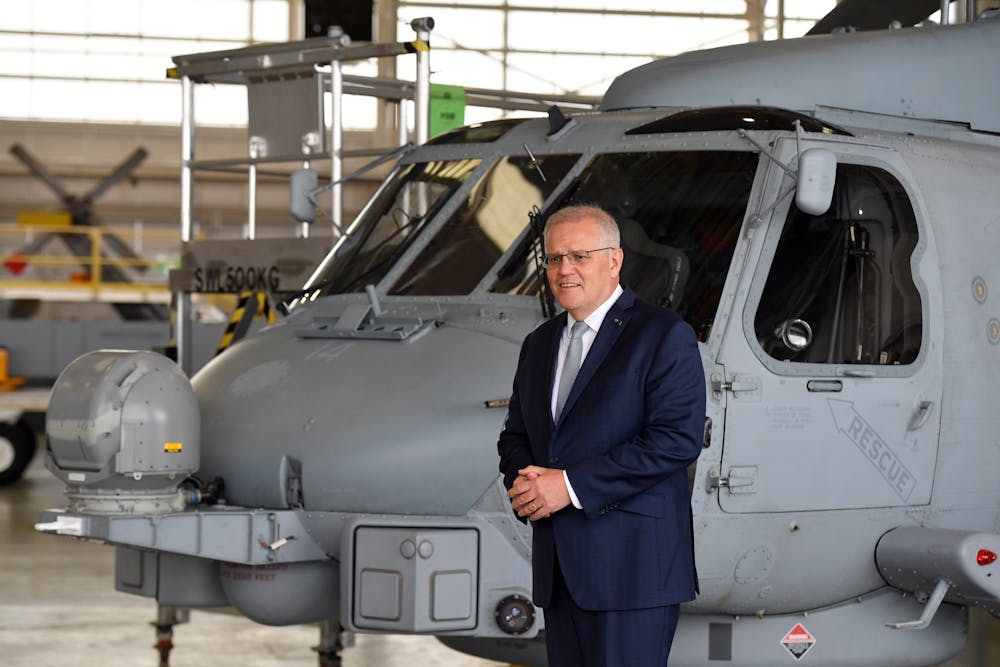 Morrison’s attempts to suggest the Coalition is stronger than Labor on issues of national security have been undercut by China’s Solomon’s deal.
AAP Image/Mick Tsikas
Morrison’s attempts to suggest the Coalition is stronger than Labor on issues of national security have been undercut by China’s Solomon’s deal.
AAP Image/Mick Tsikas
The Deves strategy
Morrison has faltered in his subsequent attempts[19] to establish a masculine image that cuts though.
His support for transgender critic and Liberal candidate Katherine Deves reflects a long[20] history[21] of trying to mobilise traditional gender identities.
Such strategies have been successful overseas[22] but may not be so effective here, even in the outer suburban seats Morrison is targeting.
Some of Deves’ extreme comments[23] are seen as not just conservative. They’re seen as cruel to an extremely vulnerable section of the population.
Rather than successfully depicting himself as protecting women from a claimed influx of transgender athletes in women’s sport, Morrison’s support[24] for Deves risks alienating moderate Liberals and reinforcing Labor’s argument he is uncaring.
Morrison’s recent attempts to suggest he will change[25] his personality from being a bulldozer to an emphathetic listener are interesting. It seems to be a recognition that Albanese’s more caring form of masculinity, including around costs of living issues, may be cutting through.
Meanwhile, Albanese has appealed to traditional conceptions of masculinity as well, suggesting[26] that while bulldozers just knock things down, he will be a builder.
When a positive becomes a negative
In short, the positive nexus between Morrison’s economic agenda and his masculine leadership image in 2019 may have turned into a negative one in 2022.
This reinforces Labor narratives about Morrison’s uncaring character and poor performance as prime minister.
Whether those challenges will facilitate a Labor election win remains to be seen.
However, some factors that assisted Morrison’s “miracle[27]” victory in 2019 no longer seem to be working quite so well for him.
Read more: Women have been at the centre of political debate in the past two years. Will they decide the 2022 election?[28]
References
- ^ can-do capitalism (www.pm.gov.au)
- ^ campaign (press-files.anu.edu.au)
- ^ Centre-left parties worldwide have struggled to reinvent themselves – what kind of ALP is fighting this election? (theconversation.com)
- ^ observed (thenewdaily.com.au)
- ^ emphasis (www.liberal.org.au)
- ^ attacks (www.theguardian.com)
- ^ say (anthonyalbanese.com.au)
- ^ difference (anthonyalbanese.com.au)
- ^ campaign (press-files.anu.edu.au)
- ^ observes (theconversation.com)
- ^ protecting and caring (link.springer.com)
- ^ provider (insidestory.org.au)
- ^ caring (www.newsouthbooks.com.au)
- ^ strategy (bristoluniversitypressdigital.com)
- ^ instead (www.liberal.org.au)
- ^ attempted (press-files.anu.edu.au)
- ^ caring (www.canberratimes.com.au)
- ^ protect (insidestory.org.au)
- ^ attempts (insidestory.org.au)
- ^ long (twitter.com)
- ^ history (www.pm.gov.au)
- ^ overseas (www.cogitatiopress.com)
- ^ comments (www.abc.net.au)
- ^ support (www.smh.com.au)
- ^ change (www.reuters.com)
- ^ suggesting (www.theguardian.com)
- ^ miracle (press.anu.edu.au)
- ^ Women have been at the centre of political debate in the past two years. Will they decide the 2022 election? (theconversation.com)