The federal election winner will get a big opportunity to change the face of the High Court
- Written by: Patrick Leslie, Research Fellow in Politics, Australian National University
The leaked Roe v Wade draft opinion[1] this week has shown us the power of the legal system when it comes to facilitating (or winding back) social change.
Read more: The end of Roe v. Wade would likely embolden global anti-abortion activists and politicians[2]
This is why judicial appointments are so critical, and why there has been so much debate around the recent appointment of Ketanji Brown Jackson.
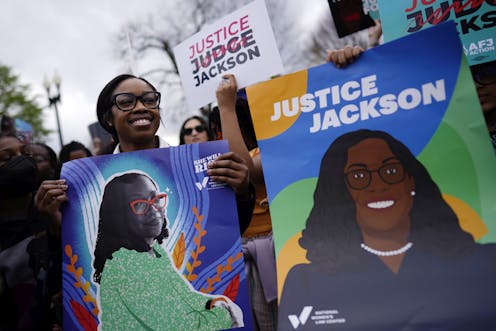
In April, Brown Jackson made history[3] after being confirmed as the first black woman appointed to the US Supreme Court. She will take up her post in the middle of the year (and was not part of the Roe v Wade vote).
Despite Brown Jackson’s impressive background – she has been a judge of the US Court of Appeals – her appointment has been fraught with divisive racial politics and toxic partisan commentary.
In Australia, we rarely have debates of this sort. We don’t have much diversity in the judiciary, either.
Read more: Ketanji Brown Jackson confirmed as Supreme Court justice: 4 essential reads[4]
Every Justice of the High Court of Australia since Federation in 1901 has been white, and all but six have been men. This is reflected elsewhere in the judicial system, where the vast majority of senior judges are male[5] and virtually all are from British and European ancestry[6]. For any Indigenous person or person of colour who finds themselves charged with and convicted of a crime, it is almost certain their sentencing will be decided upon by a white judge.
With the mandatory retirement of Chief Justice Susan Kiefel and Justice Patrick Keane due in the next parliamentary term, there is a significant opportunity to make the seven-member High Court more diverse.
Labor hints at change
There are signs a prospective Labor government would at least consider this.
In a recent article for the Australian Financial Review[7], Labor MP Andrew Leigh (who is not the party’s shadow attorney-general) hinted Labor was thinking about how to improve the representation of women and other minorities on the bench.
As he wrote:
In 120 years, no judge of colour has ever been appointed to the High Court of Australia […] the demography of the bench will never perfectly match the nation, but people should be able to see themselves in the faces of those chosen to dispense justice.
In response to criticism about gender diversity in senior judicial positions, a spokesperson for Attorney-General Michaelia Cash has previously pointed[8] to the Coalition appointing Jacqueline Gleeson[9] to the High Court and Jennifer Howe[10] to Melbourne’s Federal Circuit Court in 2021.
Read more: No selection criteria, no transparency. Australia must reform the way it appoints judges[11]
Ideological decision-making
Would it really make a difference? Given the lack of diversity on the Australian benches, it is difficult to answer this question directly. However, we do know Australia’s highly politicised selection process – it is decided by the prime minister and attorney-general – results in consistently ideological judicial decision-making.
In a recent study[12] on the High Court, colleagues and I found a highly conservative High Court justice (such as Dyson Heydon) was around 30 percentage points less likely than a left-wing justice (such as Michael Kirby) to make an ideologically liberal decision. This includes being pro-civil liberties, Indigenous rights, freedom-of-information and the environment.
In a follow-up study[13], we also looked at whether justices vote in ways that demonstrate loyalty to the prime minister who appoints them. In some ways, this is a more serious question because it concerns judicial independence from government interference. We find that where the federal government is a party in High Court cases, justices are slightly more likely to rule in favour of the government who appointed them than subsequent governments.
These findings are not necessarily evidence of a malfunctioning justice system. After all, prime ministers are democratically elected and justices are not simply legal “robots” – they are people too. As such, it’s only natural their background and personal experience plays a part in the courtroom.
Judicial diversity outside Australia
We can also look to the experiences of other countries, who have found that increased judicial diversity positively affects case outcomes for minority litigants.
Research shows panels of US Federal Circuit Court Justices[14] with one woman and two men (as opposed to all men) are significantly more likely to rule in favour of the plaintiff in cases regarding race, colour, religion and sex discrimination. Importantly, these results held for appointees of both Democratic and Republican parties, suggesting that women’s representation can cut across ideological divides.
Read more: Meet Australia's new High Court judges: a legal scholar's take on the Morrison government's appointees[15]
Similarly, the presence of a black judge on a judicial panel[16] was associated with a nearly 40 percentage point increase in the likelihood a court found in favour of policies that aim to increase the representation of black and other underrepresented people in government, universities, and private organisations.
In Israel[17], the presence of an Arab judge on panels (as opposed to all Jewish panels of judges) made a sizable improvement to the prospects of Arab defendants in criminal sentencing.
What happens now?
Whichever party wins the federal election, an emphasis on diverse appointments could make a lasting difference to justice for marginalised groups.
With two High Court appointments to be made in the next three years (and others on the Federal Court), this is a huge opportunity to recognise Australia’s diversity in one of the most important systems in our society.
References
- ^ Roe v Wade draft opinion (www.politico.com)
- ^ The end of Roe v. Wade would likely embolden global anti-abortion activists and politicians (theconversation.com)
- ^ made history (www.theguardian.com)
- ^ Ketanji Brown Jackson confirmed as Supreme Court justice: 4 essential reads (theconversation.com)
- ^ judges are male (www.theage.com.au)
- ^ British and European ancestry (www.aala.org.au)
- ^ Australian Financial Review (www.afr.com)
- ^ previously pointed (www.theage.com.au)
- ^ Jacqueline Gleeson (www.hcourt.gov.au)
- ^ Jennifer Howe (ministers.ag.gov.au)
- ^ No selection criteria, no transparency. Australia must reform the way it appoints judges (theconversation.com)
- ^ recent study (www.journals.uchicago.edu)
- ^ follow-up study (www.tandfonline.com)
- ^ US Federal Circuit Court Justices (onlinelibrary.wiley.com)
- ^ Meet Australia's new High Court judges: a legal scholar's take on the Morrison government's appointees (theconversation.com)
- ^ black judge on a judicial panel (scholar.princeton.edu)
- ^ Israel (onlinelibrary.wiley.com)