experts debunk Morrison government claim of 53,000 fewer jobs from coal and gas ban
Written by: Alison Reeve, Deputy Program Director, Energy and Climate Change, Grattan Institute
In an analysis recently released to News Limited newspapers[1], the Morrison government claims[2] banning new coal and gas projects in Queensland would risk 53,000 jobs and A$85 billion in investment.
But we checked the job claims and found them highly exaggerated.
The government analysis, released by federal Resources Minister Keith Pitt, came in response to a call[3] by the Greens for a six-month moratorium on new coal, oil and gas projects.
We analysed the most recent government data[4]. We found even in an extreme scenario where all new coal and gas projects are banned, reductions in future Queensland jobs would be at most one-tenth of what the minister claims.
A ban won’t affect every project
The most recent government dataset lists 44 coal projects and nine gas projects in Queensland. Two of the gas projects have already started production, so we discounted these from our analysis.
The rest of the dataset comprises the following projects:
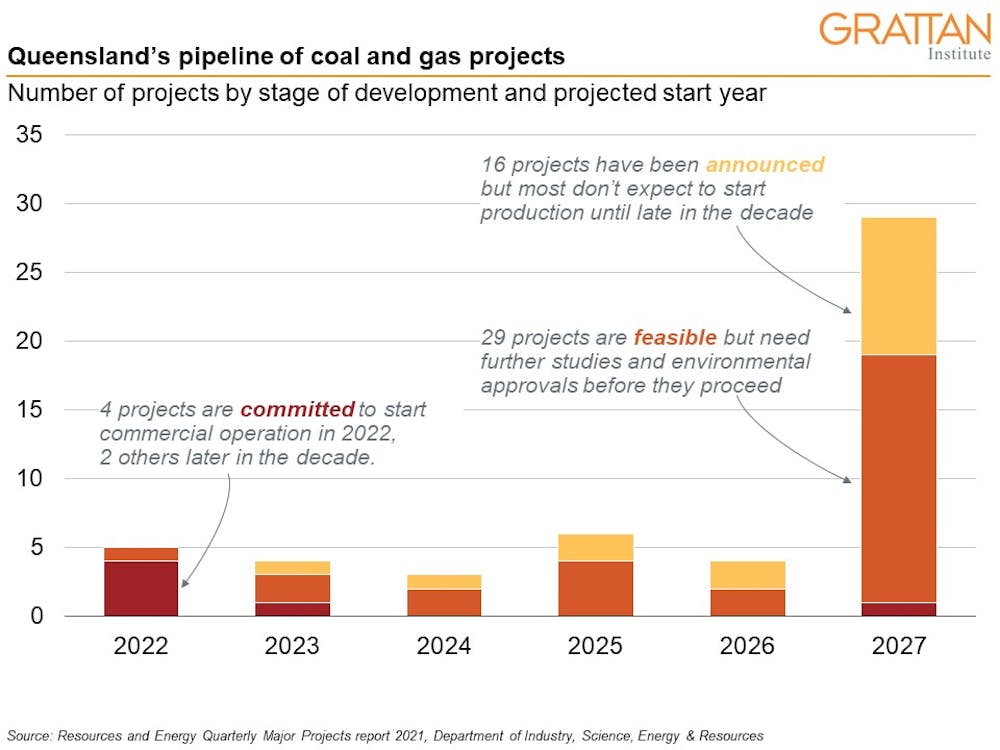
six “committed” projects: those with environmental and planning approvals and a final investment decision
29 “feasible” projects: undergoing detailed analysis on their commercial viability, and awaiting environmental and planning approvals
16 “announced” projects with no detailed work behind them yet.
Committed projects wouldn’t be affected by a ban, because authorities have already approved them. That means associated jobs won’t be affected either. Some 2,700 construction jobs and 2,086 operational jobs are associated with these projects.
The ban would only affect projects not yet approved – the 45 projects classified “feasible” or “announced”. From now on we’ll refer to these projects as “uncommitted”.
If all 45 of these projects went ahead, it would create 26,853 additional construction jobs in Queensland and 19,131 operational jobs – or about 46,000 jobs in total.
Read more:
Labor's plan to green the Kurri Kurri gas power plant makes no sense[5]
Not every project will be developed
Most of these uncommitted projects will only ever exist on paper.
Official data[6] reveals 29 of the 45 uncommitted projects have been on the books for five years or more without moving to “committed” status.
Of the projects that were uncommitted in 2017, only five were listed in 2021 as committed or operating. This progress rate is much worse for coal than gas. Half the gas projects on the books in 2017 are now committed or operating, compared to just 6% of coal projects.
If this trend is repeated over the next five years, just one in two Queensland gas projects and one in 16 Queensland coal projects would proceed. This would mean Queensland could expect 4,406 new coal and gas jobs, comprising:
3,013 additional jobs in construction (1,488 in coal and 1,525 in gas)
1,393 additional operational jobs (1,168 jobs in coal and 225 in gas).
It’s these 4,406 jobs that wouldn’t be created if there was a ban on new coal and gas projects – a far cry from the 53,000 estimated by the Morrison government.
Some 18 projects in the dataset don’t report job numbers, and our analysis doesn’t assume any jobs from these projects. Three of these are committed or complete (so there are more jobs locked in than our estimate of 4,786 suggests). Fifteen are uncommitted, meaning our estimate of the jobs impacted by a ban might be slightly low.
We also examined historic data for the small number of committed projects where job number estimates were provided. None created more jobs than their initial estimate, and some provided fewer.
In one case, Adani’s Carmichael mine, there were 975 fewer construction jobs and 2,270 fewer operational jobs in the 2021 data than estimated in 2017.
So, all this suggests even the more realistic job numbers we calculated aren’t guaranteed to come to fruition.
Read more:
Japan wants to burn ammonia for clean energy – but it may be a pyrrhic victory for the climate[7]The progress rate is much worse for coal projects than gas.Shutterstock
Bigger worries for regional Queensland
Overall, at least 4,786 jobs are locked in for Queensland from committed projects. A further 4,406 could be expected over the next five years if other projects go ahead.
Those 4,406 jobs, most in regional areas, are a lot to give up. In a small regional town, even an extra ten jobs can mean the local primary school retains all its teachers, the bank stays open and the pub remains viable. We shouldn’t dismiss the importance of this.
Queensland relies on coal and gas jobs more than some other states. But scaremongering and inflated claims about foregone jobs don’t help the debate – or help people who live in regional areas.
If the world is serious about achieving its collective goal of net-zero emissions, we can expect Australia’s coal exports to fall by 60% between 2020 and 2030[8].
It is this falling demand, not a moratorium or a ban, which will have the biggest effect[9] on jobs and regional communities. And it is here that whichever party wins the 2022 election must focus its attention.
Read more:
45,000 renewables jobs are Australia’s for the taking – but how many will go to coal workers?[10]
References^News Limited newspapers (www.couriermail.com.au)^claims (www.heraldsun.com.au)^a call (adam-bandt.greensmps.org.au)^most recent government data (www.industry.gov.au)^Labor's plan to green the Kurri Kurri gas power plant makes no sense (theconversation.com)^Official data (publications.industry.gov.au)^Japan wants to burn ammonia for clean energy – but it may be a pyrrhic victory for the climate (theconversation.com)^by 60% between 2020 and 2030 (grattan.edu.au)^biggest effect (cpd.org.au)^45,000 renewables jobs are Australia’s for the taking – but how many will go to coal workers? (theconversation.com)


 Some 18 projects in the dataset don’t report job numbers, and our analysis doesn’t assume any jobs from these projects. Three of these are committed or complete (so there are more jobs locked in than our estimate of 4,786 suggests). Fifteen are uncommitted, meaning our estimate of the jobs impacted by a ban might be slightly low.
We also examined historic data for the small number of committed projects where job number estimates were provided. None created more jobs than their initial estimate, and some provided fewer.
In one case, Adani’s Carmichael mine, there were 975 fewer construction jobs and 2,270 fewer operational jobs in the 2021 data than estimated in 2017.
So, all this suggests even the more realistic job numbers we calculated aren’t guaranteed to come to fruition.
Read more:
Japan wants to burn ammonia for clean energy – but it may be a pyrrhic victory for the climate[7]
Some 18 projects in the dataset don’t report job numbers, and our analysis doesn’t assume any jobs from these projects. Three of these are committed or complete (so there are more jobs locked in than our estimate of 4,786 suggests). Fifteen are uncommitted, meaning our estimate of the jobs impacted by a ban might be slightly low.
We also examined historic data for the small number of committed projects where job number estimates were provided. None created more jobs than their initial estimate, and some provided fewer.
In one case, Adani’s Carmichael mine, there were 975 fewer construction jobs and 2,270 fewer operational jobs in the 2021 data than estimated in 2017.
So, all this suggests even the more realistic job numbers we calculated aren’t guaranteed to come to fruition.
Read more:
Japan wants to burn ammonia for clean energy – but it may be a pyrrhic victory for the climate[7]