Why online groups are parents' best friends in getting ready for the school year
- Written by: Violetta Wilk, Lecturer & Researcher in Digital Marketing, Edith Cowan University
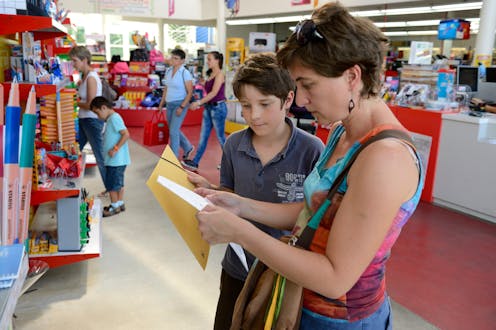
If you’re a parent, chances are that, like me, you are frantically trying to get a head start on the new school year. In coping with the stress of COVID-19 lockdowns, restrictions, empty shelves in stores, working from home and minimal communications by schools over the holidays, we’ve turned to our virtual community of friends for help.
Let’s face it, most of us probably don’t have the time to or simply can’t pop in for a cuppa with one of the other parents to just have a chat. And there are pressing things to discuss, such as the school book list that has gone missing over the holidays, where to get the best deal on a headset with a microphone suitable for an eight-year-old, which brand of white sport shoes will last more than a week in the dusty schoolyard, or where to get the two boxes of facial tissues the teacher asked children to supply when there are none at the shops!
This is where our online friends can help.
Our digital ‘tribes’
People have formed tribes since the dawn of time. We are no different in this digital age. Members of a tribe typically share some similarities, which are like glue that holds the group together. Our online groups, or digital “tribes”, connect us based on a common interest, topic, location or school. They include:
The pandemic has fuelled the rise in online tribes, as people have been restricted in their movement, locked down in their homes and limited in their access to family and friends. They now rely on their online connections for information, advice, help and friendship.
My team’s recent research[1] into online communities suggests these are rife with “prosumers”. Proactive consumers (“prosumers”) create and share online content, which makes them influential members of social networks. Our prosumer-friends are well informed, quick to respond and supportive when the school-work-life juggling act overwhelms us.
These are people like us. The digital tribe is much bigger than our real, physical community. We don’t have to know each member personally to be able to connect with them digitally.
And as our lives are so digitally integrated, we no longer differentiate between our real and virtual friends. Linda Thomas, who has two primary school-aged children, says:
“As a full-time working mum, I’m often unable to keep in touch with my friends in person, which can be quite isolating, especially now during COVID. Facebook and WhatsApp groups have been so important to me in maintaining contact and community support by networking with parents similar to me.”
Online marketplaces help with the budget
With the rise in online groups comes a rise in online consumer marketplaces. Facebook groups, such as Sustainable School Shop[2] and Perth Buy and Sell[3], can help parents manage the return-to-school budget.
Items that are no longer needed or unused, such as uniforms, books, electronics and stationery, are often given away, swapped or sold at a fraction of the original cost. An example is a Facebook local community group post by a mum giving away a spare laptop to someone who needs it for school.
In our research[4], my colleagues and I found social media users’ exchanges have not been all negative during the pandemic – there has been a lot of positivity. The support, information and advice that social media users provide one another in these online groups have been invaluable for navigating purchasing at stores affected by supply disruptions.
Such positivity often reflects online brand advocacy[5] (OBA[6]), with online group members recommending brands they have tried to others. This sort of advocacy is authentic as it is freely given and based on online group member’s actual experience with the brand. It is also influential as it is trusted more than brand-generated content, such as when a parent suggests trying Officeworks to find that headset for our eight-year-old.
Interestingly, targeted advertising is also rife online. When you interact with content on a school-related topic, be it kids’ shoes[7], school labels[8], tutoring[9] or kids sports, the platform’s algorithm will serve you ads that mirror your engagement. Such advertising is not necessarily a nuisance as it can help us in deciding what to buy.
As parents, we are in this “get our child ready for school” mission together. Online groups provide support, information and friendships beyond what we have access to in real life during these trying times.
So, if you haven’t already, join a digital tribe! It might make the start of the new school year that little bit easier.
References
- ^ recent research (doi.org)
- ^ Sustainable School Shop (www.facebook.com)
- ^ Perth Buy and Sell (www.facebook.com)
- ^ our research (www.inderscience.com)
- ^ online brand advocacy (doi.org)
- ^ OBA (doi.org)
- ^ kids’ shoes (www.facebook.com)
- ^ school labels (www.facebook.com)
- ^ tutoring (www.facebook.com)