Small-group learning can mitigate the effects of school closures – but only if teachers use it well
- Written by: Mark J. Van Ryzin, Research Associate Professor in Education, University of Oregon
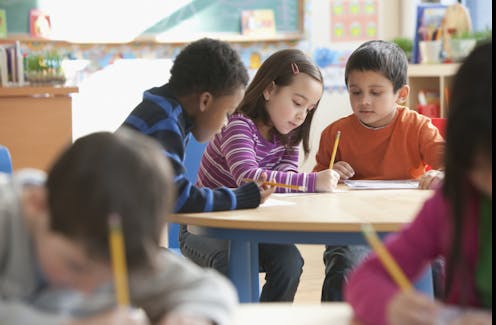
Schools aren’t just where kids go to learn reading, math, science and history. The social skills they learn – like how to build and maintain relationships with peers – are also critical[1]. This is particularly true as schools grapple with the aftereffects of school closures[2] due to the COVID-19 pandemic.
As an education researcher[3], I have dedicated my career[4] to understanding how peer relationships affect young people’s behavior, mental health and academic success, and how teachers can enhance peer relationships through the proper use of small-group learning[5].
Warm and supportive peer relationships have wide-ranging positive effects, most notably on children’s academic success[6]. On the flip side, anxiety and depression are often preceded by peer indifference or rejection[7] – or, during school closures, by social isolation[8]. Drug use and dependence often arise when socially marginalized youths band together[9] and experiment with delinquent behavior. Students with few or no friends are often the target of bullies[10], and racial disparities can be at least partially attributed to discrimination[11] by peers.
These challenges existed long before COVID-19, but the pandemic made them worse[12] – particularly for economically disadvantaged youths, who suffered disproportionately[13] during school closures.
A greater emphasis on improving peer relationships[14] through small-group learning – what educators refer to as “cooperative learning” or “peer learning” – can go a long way to addressing many of these setbacks.
How ‘peer learning’ works
Most parents have likely heard their child complain about a group activity at some point. Their child may have been involved in a group where there were no specified roles, no incentives to help one another and no accountability for individual contributions to group success. In such a lesson there can be conflict within the group or an unfair division of responsibility. This often results in a negative experience, both academically and socially.
Such informal small-group lessons lack the structure of peer learning, which calls for certain design features[15] that make small-group instruction much more likely to be successful.
First, well-designed small-group lessons give each student a unique role or task within the group so that the success of the group depends on each member’s contributions. The teacher designs the lesson with these roles or tasks in mind and ideally assigns them to group members at random.
Second, each student is held accountable for their specific role or task by both the teacher and the members of their group. This can be done by having a grading scheme for each lesson with both an individual grade and the opportunity for group members to earn additional credit tied to the success of the group as a whole.
Third, teachers define and reinforce the social skills that are needed to work successfully in small groups. For example, teachers can define a key social skill at the beginning of the lesson such as “encouraging others to participate in group discussions.” The teacher provides sentence starters – such as “What do you think about … ?” – for students to use and then listens for and reinforces the skill during the lesson.
Finally, teachers allow time at the end of the lesson for group members to reflect on their experience. Group members can pinpoint ways they can work together better next time and also provide one another positive feedback.
These four design features are vital to the success of cooperative or peer learning[16] and are relevant whether learning is conducted in person or online[17].
Benefits of positive peer relationships
Studies show that the positive relationships arising from peer learning can lead to lower stress levels[19], fewer mental health problems[20] and improved behavior[21], including less frequent bullying[22] and drug use[23].
Peer learning lessons can even serve to change attitudes[24] about members of other racial or ethnic groups, which can lead to less prejudice and discrimination[25] and fewer racial disparities[26]. And a vast amount of research finds that students simply learn better[27] in properly structured small groups as compared with working alone.
Some parents may worry that a focus on improving social relations comes at the expense of academic achievement. But making time for building social skills doesn’t necessarily imply less time for academic learning. In fact, a great deal of research shows that both social relations and academic achievement can be enhanced simultaneously with peer learning[28].
In short, increased use of peer learning can help schools deal with the negative academic, social-emotional and behavioral repercussions of the COVID-19 pandemic, helping children build a future defined by social acceptance, academic achievement and enduring success.
[More than 140,000 readers get one of The Conversation’s informative newsletters. Join the list today[29].]
References
- ^ critical (doi.org)
- ^ aftereffects of school closures (theconversation.com)
- ^ education researcher (education.uoregon.edu)
- ^ my career (scholar.google.com)
- ^ small-group learning (markvanryzin.medium.com)
- ^ academic success (doi.org)
- ^ preceded by peer indifference or rejection (doi.org)
- ^ social isolation (doi.org)
- ^ socially marginalized youths band together (doi.org)
- ^ target of bullies (doi.org)
- ^ discrimination (doi.org)
- ^ pandemic made them worse (www.ncbi.nlm.nih.gov)
- ^ suffered disproportionately (doi.org)
- ^ improving peer relationships (psycnet.apa.org)
- ^ certain design features (markvanryzin.medium.com)
- ^ success of cooperative or peer learning (psycnet.apa.org)
- ^ online (doi.org)
- ^ Boston Globe via Getty Images (www.gettyimages.com)
- ^ lower stress levels (doi.org)
- ^ fewer mental health problems (doi.org)
- ^ improved behavior (doi.org)
- ^ bullying (doi.org)
- ^ drug use (doi.org)
- ^ change attitudes (markvanryzin.medium.com)
- ^ less prejudice and discrimination (doi.org)
- ^ racial disparities (doi.org)
- ^ learn better (psycnet.apa.org)
- ^ peer learning (doi.org)
- ^ Join the list today (memberservices.theconversation.com)