On politics as performance, Morrison's advantage is ebbing
- Written by: Chris Wallace, Associate Professor, 50/50 By 2030 Foundation, Faculty of Business Government & Law, University of Canberra
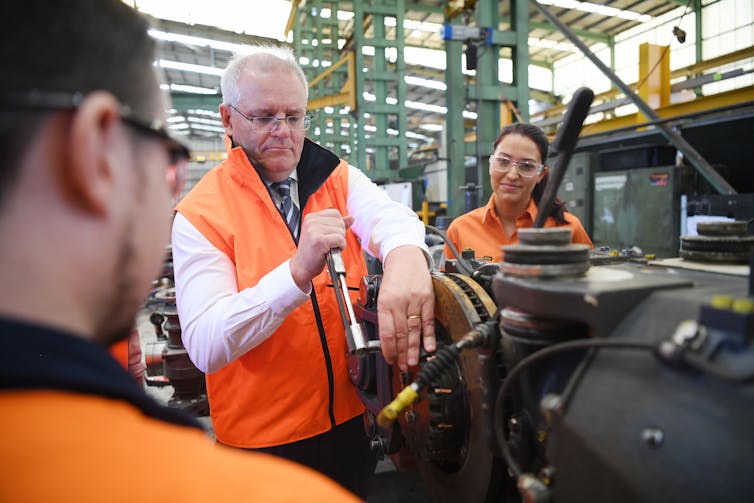
A key to winning elections is performing better than your opponent in the theatre as well as the substance of politics. It’s central to getting voter attention, without which messages about vote-enticing policy offerings won’t be heard.
In recent weeks we have seen a nascent shift in the balance of theatrical advantage between Prime Minister Scott Morrison and Opposition Leader Anthony Albanese. It has been a shift in Albanese’s favour, with potential significance for the 2022 federal election.
As prime minister, Morrison has, until this month, been considered a master of the theatre of politics relative to his Labor rivals. He knows politics is not just about the words you use, but how you use them, what you look like when you use them, the dramatic context of their use and, as a consequence, the emotions they invoke.
He has grabbed attention through preconceived drama and action, spurring emotion in voters that has welded them to the Coalition’s political purpose in sufficient numbers to keep him in power.
At the last election, in May 2019, Morrison’s winning edge over Albanese’s predecessor as opposition leader, Bill Shorten, was one critical factor in the surprise Liberal-National Coalition win.
Morrison relentlessly toured his self-conjured, trucker-capped “daggy dad” persona across Australia during the campaign, generating daily vision of him enthusiastically engaging with voters who radiated enthusiasm back.
This repeated enactment of Morrison’s energetic, mutually positive interaction with voters contrasted favourably to Shorten’s more wooden, lower energy, self-focused performance.
If there is a golden rule in politics, it’s that your pitch has to at least appear to be all about voters, not about you. Morrison achieved this in the 2019 campaign. Shorten did not.
Morrison’s particular strength was being able to do this through pictures more than words – vastly more effective in reaching more voters, more viscerally, and in a shorter time than the alternatives. Annika Smethurst’s new biography, The Accidental Prime Minister[1], provides interesting detail on the roots of this skill: intense family involvement by Morrison’s parents and him in community theatre during his youth.
Assessments of Albanese’s capacity for political thespianism have been relatively negative. His fondness for retelling his origin story[2] since becoming opposition leader has been emblematic. While Albanese is talking about himself, he’s not talking about voters – and voters are interested in themselves, not politicians.
Unlike the Morrison operation, and unfortunately in common with Shorten’s before him, the Albanese operation does not think visually. There’s an over-reliance on words to do a job that evocative pictures, supported by appropriate words, can do so much more powerfully.
Some improvement is evident. A recent interview coinciding with the COP26 climate conference had Albanese at a wind farm, the pictures reinforcing his renewable energy message. That was good. Him squinting at the camera because of sun glare was not.
Now the Albanese operation is starting to think “pictures”, it needs to make sure the candidate looks the best he possibly can in them. No squinting. Labor would be smart to attach a television producer with a good eye to the campaign to make compelling, politically persuasive vision of the alternative prime minister the daily norm, not a hit-and-miss achievement.
This is not least because Morrison’s thespian edge is relative and, recent events suggest, vulnerable.
A subtle deterioration in the optics of Morrison’s performance has been evident since his return from this month’s G20 and COP26 meetings, where he was under pressure on both the policy and character fronts. His announcement of new policy on electric vehicles (EVs) upon return is a case in point.
The Morrison who love-bombed voters so convincingly in the 2019 election campaign had disappeared. In his place was a hectoring politician trying to impose his version of his historical statements on EVs – at odds with the facts – through sheer rhetorical force.
It provided a public glimpse of Morrison’s overbearing private persona described by credible Coalition insiders such as former Liberal MP Julia Banks in her book Power Play[3].
Once glimpsed it may be hard to forget, particularly against the backdrop of sustained public discussion of Morrison’s truthfulness.
Read more: View from The Hill: Scott Morrison caught in catch-22 over the issue of his integrity[4]
Further, the prime minister’s frustration that his assertions, long uncritically accepted, are no longer unquestioned could feed into further deterioration in his voter-friendly persona.
It coincides with Morrison becoming a net liability for the government according to recent opinion polls. The latest Newspoll[5] showed his approval falling to 44 (-2) and his disapproval rising to 52 (+2), for a net approval rating of -8.
This remains marginally better than Albanese’s net -11 approval rating. However, compared to Morrison’s soaring net approval advantage earlier in the year, it’s a significant shift, negating one of the Coalition’s big advantages over Labor.
Read more: How to win an election? Do the substance as well as the theatre of politics[6]
Every election is there for the winning. The theatre of politics is neither a substitute for, nor the antithesis of, good policy: it is what makes winning government, and getting to implement good policy, possible.
If Morrison’s advantage in the theatre of politics cannot be revived, and if Albanese can build on modest recent improvements to further lift his, a change of government at the 2022 election will be more likely.
References
- ^ The Accidental Prime Minister (www.hachette.com.au)
- ^ origin story (www.abc.net.au)
- ^ Power Play (www.hardiegrant.com)
- ^ View from The Hill: Scott Morrison caught in catch-22 over the issue of his integrity (theconversation.com)
- ^ latest Newspoll (theconversation.com)
- ^ How to win an election? Do the substance as well as the theatre of politics (theconversation.com)