With Devotion, Hannah Kent gives us empathically drafted portraits of love in all its forms
- Written by: Jen Webb, Dean, Graduate Research, University of Canberra
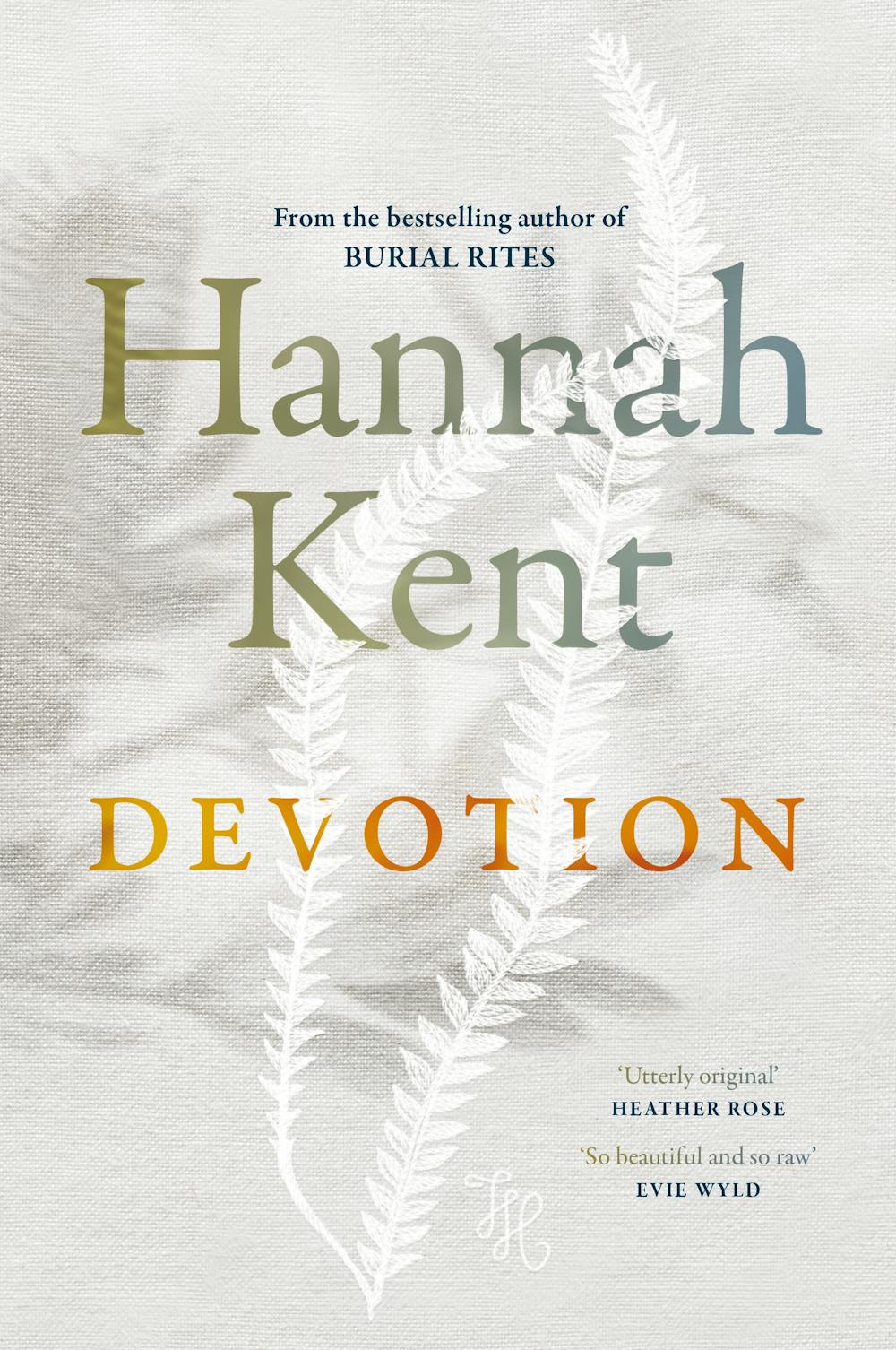
Review: Devotion by Hannah Kent, Picador
I came across Hannah Kent some years ago, hearing from colleagues at another university that she was a particularly impressive student, and I should stay alert for what she might deliver. Not long after, Burial Rites (2013) – a fictional account of the last public execution in Iceland in 1830 – appeared, to popular and critical reception[1].
I couldn’t finish the book; having come to know the main character, Agnes Magnúsdóttir – “know”, that is, in the way readers connect to those who are only squiggles on a page – I just couldn’t watch her die.
Her next book, The Good People (2016), again dealt with an historical legal case[2], this one set in Ireland in 1825. As in her previous book, Kent’s deft portraiture and capacity for empathy meant the whole work sang; the people, the physical and built environments, even the unfamiliar systems of belief were visceral, resonant.
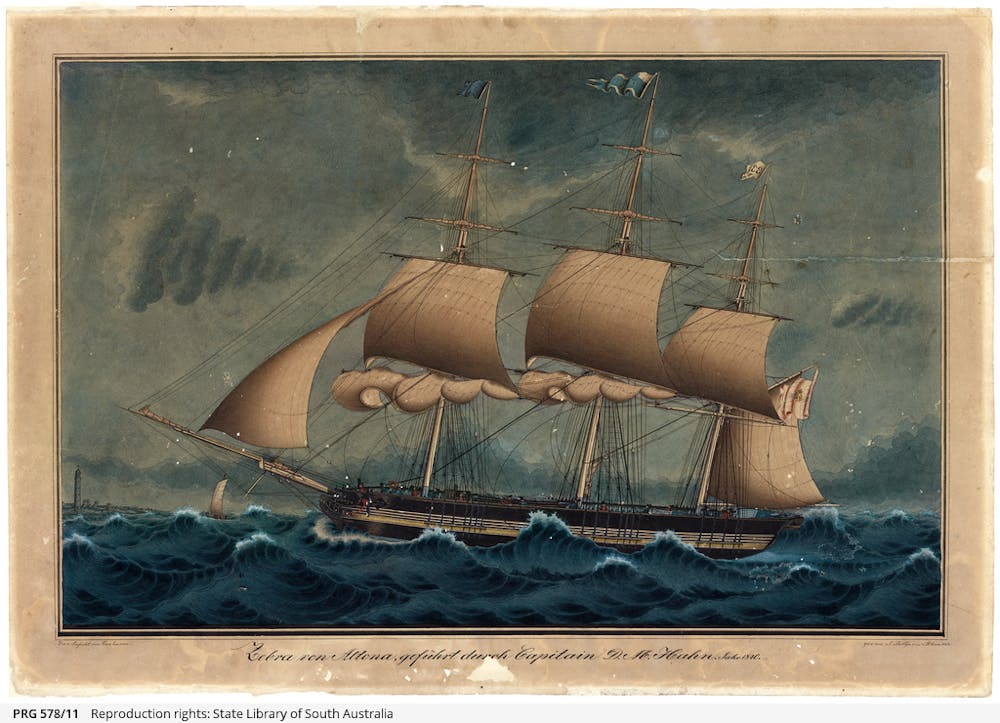 ‘The Zebra’, one of the boats which brought German migrants to the colony of South Australia.
State Library of South Australia
Thea is at the other end of the scale: the child of a woman considered by many to be just too close to witchcraft. But her parents are warm, playful, affectionate and imbue her with confidence in her nature, and in her rights to think, and to perform.
This sets the architecture for a novel filtered through Hanne, while crafting a 3D image of the whole community. All its members are deftly and generously characterised in their struggles to pick a path through life, to balance its inevitable slings and arrows against adherence to their version of the word and will of God.
Hanne and Thea are both mid-teens, and while the trope of the adolescent outsider is a very familiar one, Kent does something fresh and convincing. She lifts her characters beyond the type, and allows them to sustain interest and attention.
‘The Zebra’, one of the boats which brought German migrants to the colony of South Australia.
State Library of South Australia
Thea is at the other end of the scale: the child of a woman considered by many to be just too close to witchcraft. But her parents are warm, playful, affectionate and imbue her with confidence in her nature, and in her rights to think, and to perform.
This sets the architecture for a novel filtered through Hanne, while crafting a 3D image of the whole community. All its members are deftly and generously characterised in their struggles to pick a path through life, to balance its inevitable slings and arrows against adherence to their version of the word and will of God.
Hanne and Thea are both mid-teens, and while the trope of the adolescent outsider is a very familiar one, Kent does something fresh and convincing. She lifts her characters beyond the type, and allows them to sustain interest and attention.
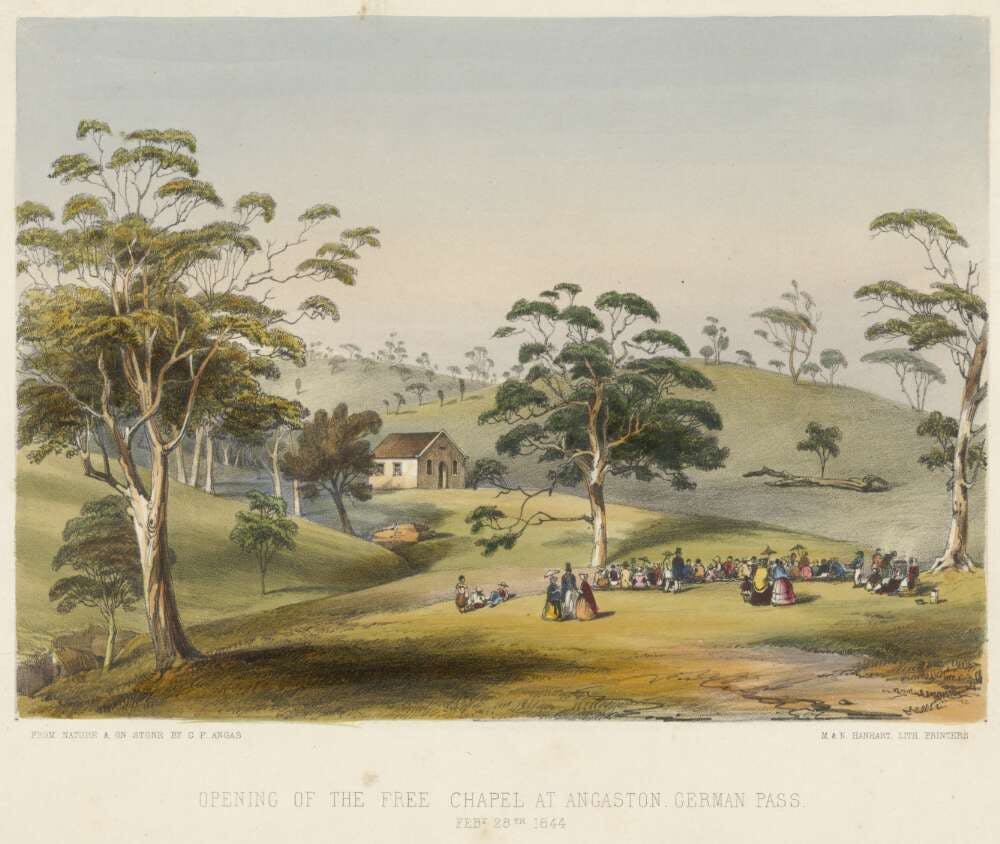 Opening of the Free Chapel at Angaston, German Pass, South Australia in February 1844, illustrated by George French Angas (1822-1886).
National Library of Australia
A good part of this is, I suspect, because of the world we see through Hanne’s eyes. It is shot through with a sort of magic, constant reminders of the co-presence of everything, and evidenced in Hanne’s sympathetic attunement to her surroundings. While this is at odds with her joyless church, it fills Hanne, she says,
with gratitude to God […] I reconciled divinity with the smell of spa, imagined the Lord’s mansion as a wilderness.
She hears trees call her; listens to what the wind has to say; knows the song of the ocean. She knows, too, time is not mere linearity. When she joins her voice to her fellow travellers in a hymn of farewell to Europe, the pure sound she produces will, she avers, continue across history. This is a sort of Einsteinian river of time concept[3]: that the way we understand time is an illusion. This idea is lightly touched on in the first half of the novel and takes on a new weight in the second half (no spoiler alert needed; I shan’t tell you any more of the plot).
Queer love
Hanne’s loneliness and her longing to be seen and cared for combine in the tumultuous love she finds in Thea, and Thea in her. It’s a portrait of that sort of high, innocent, and hungry passion that is a part of adolescence. But it is more than just that; it is also an avowal of possibility, of difference, and of rights to follow all sorts of paths through this life.
Though her community see queer love as utterly sinful, so wrong it cannot even be spoken, Thea and Hanne find ways to be themselves, together and apart. Desire asserts in them its own identity: a shimmering yearning to be close to each other’s bodies, and to share minds committed to unconditional trust.
Opening of the Free Chapel at Angaston, German Pass, South Australia in February 1844, illustrated by George French Angas (1822-1886).
National Library of Australia
A good part of this is, I suspect, because of the world we see through Hanne’s eyes. It is shot through with a sort of magic, constant reminders of the co-presence of everything, and evidenced in Hanne’s sympathetic attunement to her surroundings. While this is at odds with her joyless church, it fills Hanne, she says,
with gratitude to God […] I reconciled divinity with the smell of spa, imagined the Lord’s mansion as a wilderness.
She hears trees call her; listens to what the wind has to say; knows the song of the ocean. She knows, too, time is not mere linearity. When she joins her voice to her fellow travellers in a hymn of farewell to Europe, the pure sound she produces will, she avers, continue across history. This is a sort of Einsteinian river of time concept[3]: that the way we understand time is an illusion. This idea is lightly touched on in the first half of the novel and takes on a new weight in the second half (no spoiler alert needed; I shan’t tell you any more of the plot).
Queer love
Hanne’s loneliness and her longing to be seen and cared for combine in the tumultuous love she finds in Thea, and Thea in her. It’s a portrait of that sort of high, innocent, and hungry passion that is a part of adolescence. But it is more than just that; it is also an avowal of possibility, of difference, and of rights to follow all sorts of paths through this life.
Though her community see queer love as utterly sinful, so wrong it cannot even be spoken, Thea and Hanne find ways to be themselves, together and apart. Desire asserts in them its own identity: a shimmering yearning to be close to each other’s bodies, and to share minds committed to unconditional trust.
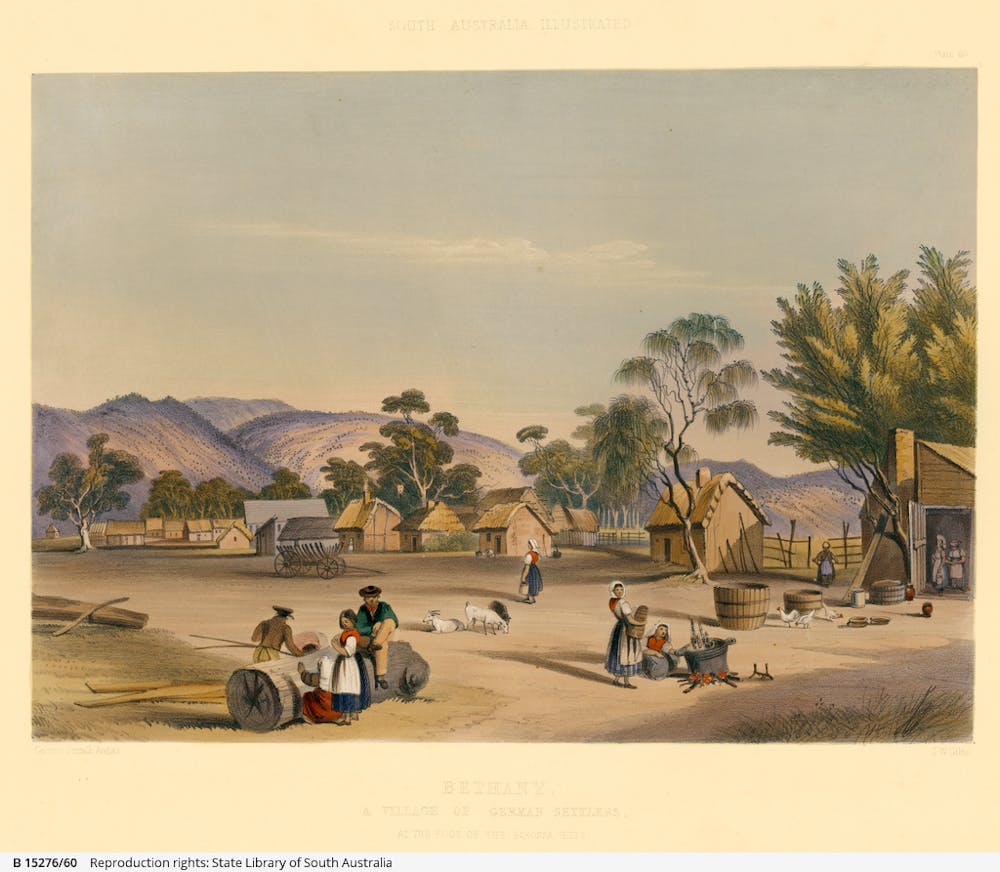 The German settlement of Bethany, at the foot of the Barossa Hills in 1847. illustrated by George French Angas (1822-1886).
State Library of South Australia
The openness they have to each other, and to all around them, allows Kent to subtly but clearly chart the process of settlement: the knowledge and generosity of the Indigenous people whose land they have claimed, and the phenomenological qualities of country – of plant and soil and animal, and of the humans who inhabit the space with them.
Devotion is a rich, often surprising novel, written with the sort of prosody poets like me are always seeking.
References^ popular and critical reception (www.theguardian.com)^ historical legal case (www.theguardian.com)^ Einsteinian river of time concept (www.laphamsquarterly.org)
The German settlement of Bethany, at the foot of the Barossa Hills in 1847. illustrated by George French Angas (1822-1886).
State Library of South Australia
The openness they have to each other, and to all around them, allows Kent to subtly but clearly chart the process of settlement: the knowledge and generosity of the Indigenous people whose land they have claimed, and the phenomenological qualities of country – of plant and soil and animal, and of the humans who inhabit the space with them.
Devotion is a rich, often surprising novel, written with the sort of prosody poets like me are always seeking.
References^ popular and critical reception (www.theguardian.com)^ historical legal case (www.theguardian.com)^ Einsteinian river of time concept (www.laphamsquarterly.org)