20 years after 9/11, the men charged with responsibility are still waiting for trial – here's why
- Written by: Lisa Hajjar, Professor of Sociology, University of California Santa Barbara
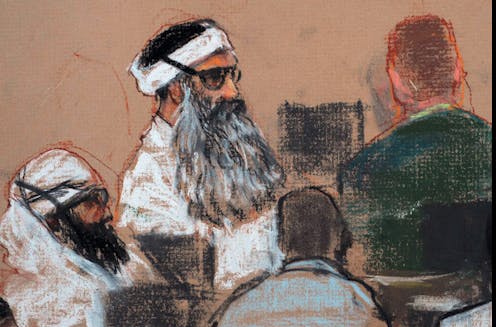
As the 20th anniversary of 9/11[1] passed, the five men accused of responsibility for the attacks were still awaiting trial[2] in the Guantanamo military commission[3].
This case is the largest criminal prosecution in U.S. history in terms of number of victims. The charge sheet lists the names of 2,976 people [4] who were direct casualties of two hijacked commercial airliners that crashed into the World Trade Center and caused the twin towers to collapse, another that crashed into the Pentagon and a fourth, probably aiming for the U.S. Capitol building, that was brought down in a field in western Pennsylvania when several passengers overpowered their hijackers.
Yet two decades after the U.S.‘s worst terrorist attack, the 9/11 case remains mired in the pretrial phase with no start date for the trial. The hearings, which resumed September 7, 2021[5] after a 17-month COVID-19 related suspension, were the first for the case’s new judge – the fourth officer to fill that role.
As someone who has visited Guantanamo on 11 occasions since 2013 to observe legal proceedings in the 9/11 case, I have come to understand that the delays are the inevitable result of an irreconcilable conflict: The U.S. government’s objective is to convict and execute the accused men[6] as a way to provide justice for the thousands of victims. But those goals are stymied by the fact that the defendants are also victims of CIA torture[7].
No martyrdom-by-military commission
The 9/11 case involves five defendants.
Khalid Sheikh Mohammad[8], whom the government refers to as KSM, is accused of being the “mastermind” behind the attacks.
Walid bin Attash[9] is accused of training two of the hijackers how to fight in close quarters using box cutters to take over the planes.
Ramzi bin al-Shibh[10] is accused of recruiting some of the hijackers who formed a cell in Hamburg, Germany, and serving as an intermediary between lead hijacker Mohammed Atta and al-Qaeda leaders.
Ammar al-Baluchi[11], whom the government refers to as Ali Abd al-Aziz Ali, and Mustafa al-Hawsawi[12] are accused of making money transfers to some of the hijackers.
The men were charged in 2007 and arraigned in June 2008. The Bush administration hoped that the trial could be concluded before President George W. Bush left office. But that hope was dashed in December 2008 when Mohammad and the other defendants offered to plead guilty[13] on the condition that they would be executed immediately. This attempt to martyr themselves[14] was not an option – the Military Commission Act does not have a provision for executions without trials.
The Obama administration, after abandoning its plan to try the men in federal court[15] in New York, recharged them in the military commissions on April 4, 2012. In official filings, the abbreviated name for the case is KSM II to denote that this is a second attempt to pull this trial off.
Demands for full disclosure
For most of the 9/11 hearings I have attended, there have been fewer than 10 journalists in the media delegations. Procedural battles over complex and arcane points of law are seemingly not the stuff of headline news.
But as a scholar of law and torture[16], they are fascinating to me. In trying to understand how torture does or should matter to the legal process in a case in which the defendants face the death penalty, I realized that the 9/11 case is caught between conflicting interests that play out in battles between defense teams and prosecutors over the discovery of information[17] about what happened to the defendants during the years they were detained at CIA “black sites” – secret overseas prisons in which U.S. agents interrogated suspects.
The defense lawyers want access to all information the government possesses about their clients’ abusive treatment by the CIA, including granular details about their torture. They insist it is necessary to provide effective legal counsel.
The demand is especially pertinent in a capital case, but information about a defendant’s treatment in pretrial custody is legally relevant in any criminal case.
The prosecution argues that documents containing the full details about the CIA’s now-defunct Rendition, Detention and Interrogation (RDI) program are too sensitive to share, even with lawyers with top-secret security clearances. The CIA’s secrets, as one prosecutor explained[19], are “the most highly classified information that the government has … It’s extremely important that we protect that information.”
Instead of original CIA materials, prosecutors have provided about 21,000 pages of summaries and substitutions that obscure specific dates and locations and mask the identities of agents and contractors.
The CIA, which controls information about its operations and dictates what prosecutors can provide to the defense in discovery, has no institutional interest in due process or fair trials[20], only in maintaining its secrets.
The prosecution, meanwhile, counters defense demands for more information by insisting that this trial is about the defendants’ roles in the crime of 9/11, and what happened to them afterward is unrelated to their involvement in these events.
“The CIA is not on trial,” said prosecutor Jeffrey Groharing[21].
No ‘after torture’
Since September 2019, many of the hearings have been devoted to defense efforts to persuade the judge to exclude evidence the government wants to use at trial, namely statements the defendants gave to FBI agents who interrogated them in 2007, five months after they were transferred from the black sites. The government referred to the agents as “clean teams” because they had no hand in the CIA’s torture program.
The prosecution maintains that because the FBI interrogators used lawful methods rather than coercion when questioning the defendants, these statements should be admissible in court. The defense has called witnesses, including the two architects of the CIA torture program, James Mitchell and Bruce Jessen[22], who testified in January 2020[23]. The Defense teams are making the case that there is no “after torture” for victims, and therefore the FBI statements are tainted by their past torture and should be dismissed – in legal terms – as “fruit of the poisonous tree.”
From my perspective, the pretrial logjam could largely be resolved if the government made a choice: If the priority is to protect the CIA’s secrets, the death penalty should be taken off the table and plea bargain negotiations for life sentences should begin. If the death penalty remains a priority, the defense should be given access to all the information they seek, including, for example, the full Senate Select Committee on Intelligence’s report about the CIA’s rendition program[24].
Although this case garners sporadic media attention, it deserves greater public interest because the stakes are so high. No one can predict when the 9/11 trial will finally begin, let alone how this case will end, but one thing should be clear: an important chapter in the history of the U.S. in the 21st century is being written in the high-security courtroom in Guantanamo.
[Over 110,000 readers rely on The Conversation’s newsletter to understand the world. Sign up today[25].]
References
- ^ 20th anniversary of 9/11 (www.911memorial.org)
- ^ still awaiting trial (www.nytimes.com)
- ^ military commission (www.mc.mil)
- ^ lists the names of 2,976 people (www.mc.mil)
- ^ resumed September 7, 2021 (www.theguardian.com)
- ^ execute the accused men (www.aljazeera.com)
- ^ victims of CIA torture (law.unc.edu)
- ^ Khalid Sheikh Mohammad (www.nbcnews.com)
- ^ Walid bin Attash (www.hrw.org)
- ^ Ramzi bin al-Shibh (www.hrw.org)
- ^ Ammar al-Baluchi (www.dni.gov)
- ^ Mustafa al-Hawsawi (www.hrw.org)
- ^ offered to plead guilty (www.nytimes.com)
- ^ attempt to martyr themselves (www.miamiherald.com)
- ^ abandoning its plan to try the men in federal court (www.nytimes.com)
- ^ scholar of law and torture (soc.ucsb.edu)
- ^ discovery of information (www.americanbar.org)
- ^ Joe Raedle/Getty Images (www.gettyimages.com)
- ^ one prosecutor explained (www.thenation.com)
- ^ no institutional interest in due process or fair trials (www.justsecurity.org)
- ^ prosecutor Jeffrey Groharing (www.nytimes.com)
- ^ James Mitchell and Bruce Jessen (www.npr.org)
- ^ testified in January 2020 (www.nytimes.com)
- ^ Senate Select Committee on Intelligence’s report about the CIA’s rendition program (www.jadaliyya.com)
- ^ Sign up today (theconversation.com)