Local, face-to-face support offers a lifeline for uni students in regional and remote Australia
- Written by: Cathy Stone, Conjoint Associate Professor, School of Humanities & Social Science, University of Newcastle
For university students living out of reach of a campus and studying online, the growing presence of Regional University Centres[1] is proving to be a lifeline in times of COVID-19. An early evaluation shows these centres in regional and remote Australia are highly effective in supporting students who have been historically under-represented at university and are at high risk of not completing courses. As one student said:
“I probably would not have persisted with the course if I had not seen [their centre’s learning skills adviser] to help me.”
Managed locally by indepedent, not-for-profit boards formed from community members, the number of centres has grown to 26 around the country. These centres collaborate with universities to offer face-to-face learning communities for students in regional and remote areas. Within each centre are quiet study spaces, computers, internet, study support and the company of peers.
Read more: We can put city and country people on more equal footing at uni — the pandemic has shown us how[2]
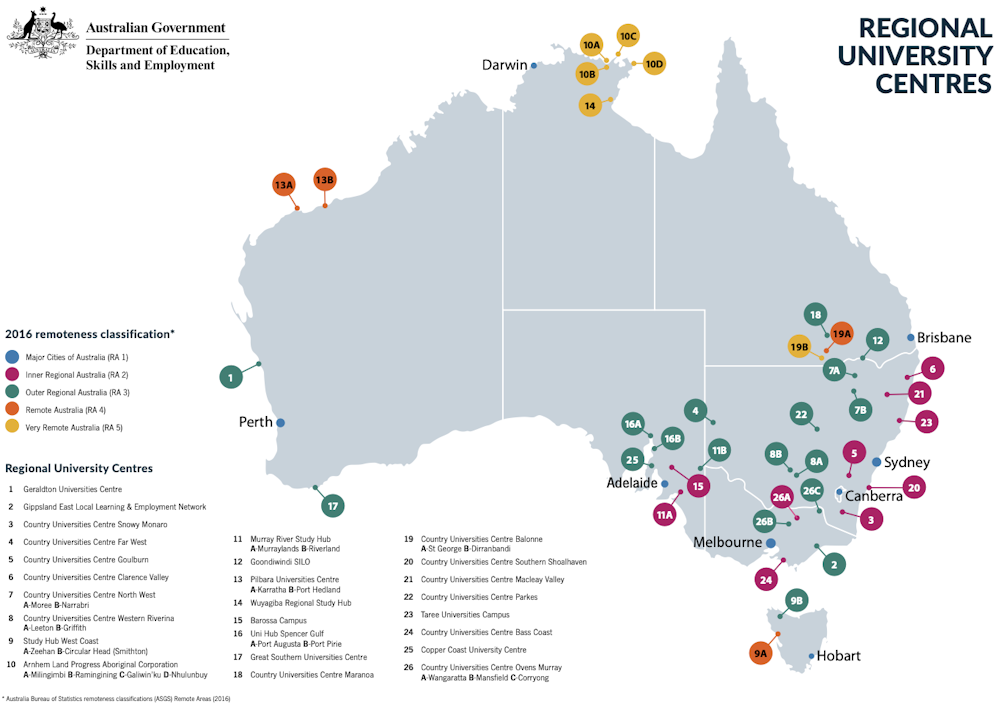 Department of Education, Skills and Employment, CC BY[3][4]
Why are these centres needed?
People in regional and remote Australia are about half as likely[5] as those living in major cities to have a university qualification. This educational divide starts early, with high school students from these areas being about 30% less likely[6] on average to complete year 12 than their city-based peers.
Yet research indicates[7] this is not because these young people don’t want to go to university. Both the cost[8] and the physical and emotional disruption of leaving home[9] are the key barriers[10] for students and their families.
The pandemic has led to a greater appreciation and expansion of online learning[11]. It has given more regional and remote students of all ages[12] the flexibility to stay and study within their local communities. Studying regionally is also more likely to lead to regional work[13], which boosts the local economy.
Read more:
Why regional universities and communities need targeted help to ride out the coronavirus storm[14]
The shift to online learning has thrust the challenges of online study into the spotlight. Until recently only a minority experienced these challenges. Now there is more awareness of the need to improve support for online students, including those outside major cities.
The challenges of online learning include technology and internet connectivity[15] problems, which are more likely in regional and remote Australia. Isolation[16] from teachers and other students can be another barrier.
Regional University Centres are helping students to overcome these challenges.
At each of the centres, they can study, link up with other students, have access to high-speed internet and information technology and get help with their study skills.
Of the 26 centres across Australia, 13 are operating within the Country Universities Centre[17] (CUC) network. A student at one these centres said:
“I have unreliable internet as I live 20km from town. Having access to CUC has helped so much. I am more motivated to continue with my studies because I love going there.”
Department of Education, Skills and Employment, CC BY[3][4]
Why are these centres needed?
People in regional and remote Australia are about half as likely[5] as those living in major cities to have a university qualification. This educational divide starts early, with high school students from these areas being about 30% less likely[6] on average to complete year 12 than their city-based peers.
Yet research indicates[7] this is not because these young people don’t want to go to university. Both the cost[8] and the physical and emotional disruption of leaving home[9] are the key barriers[10] for students and their families.
The pandemic has led to a greater appreciation and expansion of online learning[11]. It has given more regional and remote students of all ages[12] the flexibility to stay and study within their local communities. Studying regionally is also more likely to lead to regional work[13], which boosts the local economy.
Read more:
Why regional universities and communities need targeted help to ride out the coronavirus storm[14]
The shift to online learning has thrust the challenges of online study into the spotlight. Until recently only a minority experienced these challenges. Now there is more awareness of the need to improve support for online students, including those outside major cities.
The challenges of online learning include technology and internet connectivity[15] problems, which are more likely in regional and remote Australia. Isolation[16] from teachers and other students can be another barrier.
Regional University Centres are helping students to overcome these challenges.
At each of the centres, they can study, link up with other students, have access to high-speed internet and information technology and get help with their study skills.
Of the 26 centres across Australia, 13 are operating within the Country Universities Centre[17] (CUC) network. A student at one these centres said:
“I have unreliable internet as I live 20km from town. Having access to CUC has helped so much. I am more motivated to continue with my studies because I love going there.”
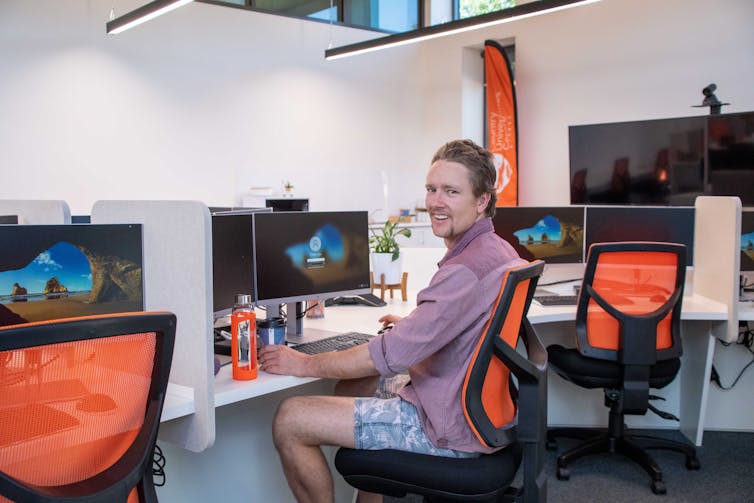 The centres provide students with IT facilities and high-speed internet in areas where connectivity is often poor.
CUC Parkes, Author provided
Read more:
Will Australia's digital divide – fast for the city, slow in the country – ever be bridged?[18]
Early evaluations show centres are effective
The number of Regional University Centres has steadily increased around the country since 2018. This growth has been fuelled by community willpower and funded by a combination of governments and local industry. Early evidence from CUC evaluations is starting to show the positive impact on students.
One example is the Learning Skills Advisor (LSA) program[19] begun in 2020 to provide generic academic skills sessions across the CUC network. The first in-house evaluation provides an interesting snapshot of the students who came to LSA sessions from March 2020 to July 2021, and of the impact of the program in general.
Students from government equity categories were strongly represented. They included students from low socioeconomic status (SES) (72%) and Indigenous (9%) backgrounds. As well, 53% were the first in their families to be at university, 65.5% were aged 25 and over, and 46% were studying part-time.
Other research[20] tells us that part-time, mature-age, low-SES, Indigenous and online students have been historically under-represented at university. If they do manage to get to university, they are more likely to withdraw without qualification.
The recent snapshot tells us the centres are reaching the students most at risk.
The centres provide students with IT facilities and high-speed internet in areas where connectivity is often poor.
CUC Parkes, Author provided
Read more:
Will Australia's digital divide – fast for the city, slow in the country – ever be bridged?[18]
Early evaluations show centres are effective
The number of Regional University Centres has steadily increased around the country since 2018. This growth has been fuelled by community willpower and funded by a combination of governments and local industry. Early evidence from CUC evaluations is starting to show the positive impact on students.
One example is the Learning Skills Advisor (LSA) program[19] begun in 2020 to provide generic academic skills sessions across the CUC network. The first in-house evaluation provides an interesting snapshot of the students who came to LSA sessions from March 2020 to July 2021, and of the impact of the program in general.
Students from government equity categories were strongly represented. They included students from low socioeconomic status (SES) (72%) and Indigenous (9%) backgrounds. As well, 53% were the first in their families to be at university, 65.5% were aged 25 and over, and 46% were studying part-time.
Other research[20] tells us that part-time, mature-age, low-SES, Indigenous and online students have been historically under-represented at university. If they do manage to get to university, they are more likely to withdraw without qualification.
The recent snapshot tells us the centres are reaching the students most at risk.
 Regional University Centres are reaching groups of students who have been under-represented in higher education.
Department of Education, Skills and Employment, CC BY[21][22]
Read more:
Where are the most disadvantaged parts of Australia? New research shows it's not just income that matters[23]
Student feedback is very positive
The positive impacts of the LSA program are clear. The evaluation found:
93% of participating students reported feeling more confident about their studies
96% were more motivated
97.5% achieved higher grades
95% were more likely to continue with their studies.
Students said they found the practical information helpful.
“I learned about different ways to look up information. There were ideas about how to arrange information and structure essays more efficiently.”
“I learned to reference as I go, add the reference to my bibliography as I found the source.”
As students’ confidence improved, so did their grades and their motivation to continue. Their responses make this clear:
“Managed a HD/D average. I attribute this to the support I have received from [LSA].”
“Gave me the edge on exam day.”
“My confidence is up and my marks are following suit.”
They also valued having a space to study, with the facilities they need:
“Perfect study space, away from distractions and everything that is needed right in the one place.”
These preliminary evaluation findings are highly encouraging. They show that the right type of locally available[24] support can encourage and motivate regional and remote students. Building their confidence and skills helps them to persist and succeed.
Read more:
New research shows there is still a long way to go in providing equality in education[25]
A more formal evaluation of the CUC student experience is under way. The results are due to be published in early 2022.
The early results indicate that Regional University Centres are successfully complementing[26] the online education universities are providing. The physical space, technology and face-to-face support the centres offer are making a difference.
This is a win-win, not only for students and universities, but also for the economic, social and educational capital of regional, rural and remote communities.
The author acknowledges the help of Monica Davis, CEO, and Chris Ronan, Equity & Engagement Director, of the Country Universities Centre in the writing of this article.
Regional University Centres are reaching groups of students who have been under-represented in higher education.
Department of Education, Skills and Employment, CC BY[21][22]
Read more:
Where are the most disadvantaged parts of Australia? New research shows it's not just income that matters[23]
Student feedback is very positive
The positive impacts of the LSA program are clear. The evaluation found:
93% of participating students reported feeling more confident about their studies
96% were more motivated
97.5% achieved higher grades
95% were more likely to continue with their studies.
Students said they found the practical information helpful.
“I learned about different ways to look up information. There were ideas about how to arrange information and structure essays more efficiently.”
“I learned to reference as I go, add the reference to my bibliography as I found the source.”
As students’ confidence improved, so did their grades and their motivation to continue. Their responses make this clear:
“Managed a HD/D average. I attribute this to the support I have received from [LSA].”
“Gave me the edge on exam day.”
“My confidence is up and my marks are following suit.”
They also valued having a space to study, with the facilities they need:
“Perfect study space, away from distractions and everything that is needed right in the one place.”
These preliminary evaluation findings are highly encouraging. They show that the right type of locally available[24] support can encourage and motivate regional and remote students. Building their confidence and skills helps them to persist and succeed.
Read more:
New research shows there is still a long way to go in providing equality in education[25]
A more formal evaluation of the CUC student experience is under way. The results are due to be published in early 2022.
The early results indicate that Regional University Centres are successfully complementing[26] the online education universities are providing. The physical space, technology and face-to-face support the centres offer are making a difference.
This is a win-win, not only for students and universities, but also for the economic, social and educational capital of regional, rural and remote communities.
The author acknowledges the help of Monica Davis, CEO, and Chris Ronan, Equity & Engagement Director, of the Country Universities Centre in the writing of this article.
References
- ^ Regional University Centres (www.dese.gov.au)
- ^ We can put city and country people on more equal footing at uni — the pandemic has shown us how (theconversation.com)
- ^ Department of Education, Skills and Employment (www.dese.gov.au)
- ^ CC BY (creativecommons.org)
- ^ about half as likely (apo.org.au)
- ^ 30% less likely (www.dese.gov.au)
- ^ research indicates (journal.spera.asn.au)
- ^ cost (theconversation.com)
- ^ disruption of leaving home (www.sciencedirect.com)
- ^ barriers (www.ncsehe.edu.au)
- ^ appreciation and expansion of online learning (www.ncsehe.edu.au)
- ^ students of all ages (ajet.org.au)
- ^ more likely to lead to regional work (www.dese.gov.au)
- ^ Why regional universities and communities need targeted help to ride out the coronavirus storm (theconversation.com)
- ^ technology and internet connectivity (www.aare.edu.au)
- ^ Isolation (www.tandfonline.com)
- ^ Country Universities Centre (www.cuc.edu.au)
- ^ Will Australia's digital divide – fast for the city, slow in the country – ever be bridged? (theconversation.com)
- ^ Learning Skills Advisor (LSA) program (www.cuc.edu.au)
- ^ research (www.ncsehe.edu.au)
- ^ Department of Education, Skills and Employment (www.dese.gov.au)
- ^ CC BY (creativecommons.org)
- ^ Where are the most disadvantaged parts of Australia? New research shows it's not just income that matters (theconversation.com)
- ^ locally available (studentsuccessjournal.org)
- ^ New research shows there is still a long way to go in providing equality in education (theconversation.com)
- ^ successfully complementing (researchoutput.csu.edu.au)