


CPA Australia Survey: AI adoption by Mainland Chinese businesses escalates
SHANGHAI, CHINA - Media OutReach Newswire - 22 August 2024 - The adoption of Artificial intelligence (AI) among Mainland Chinese companies has increased steadily over the past three years and is expected to surge in the next 12 months.
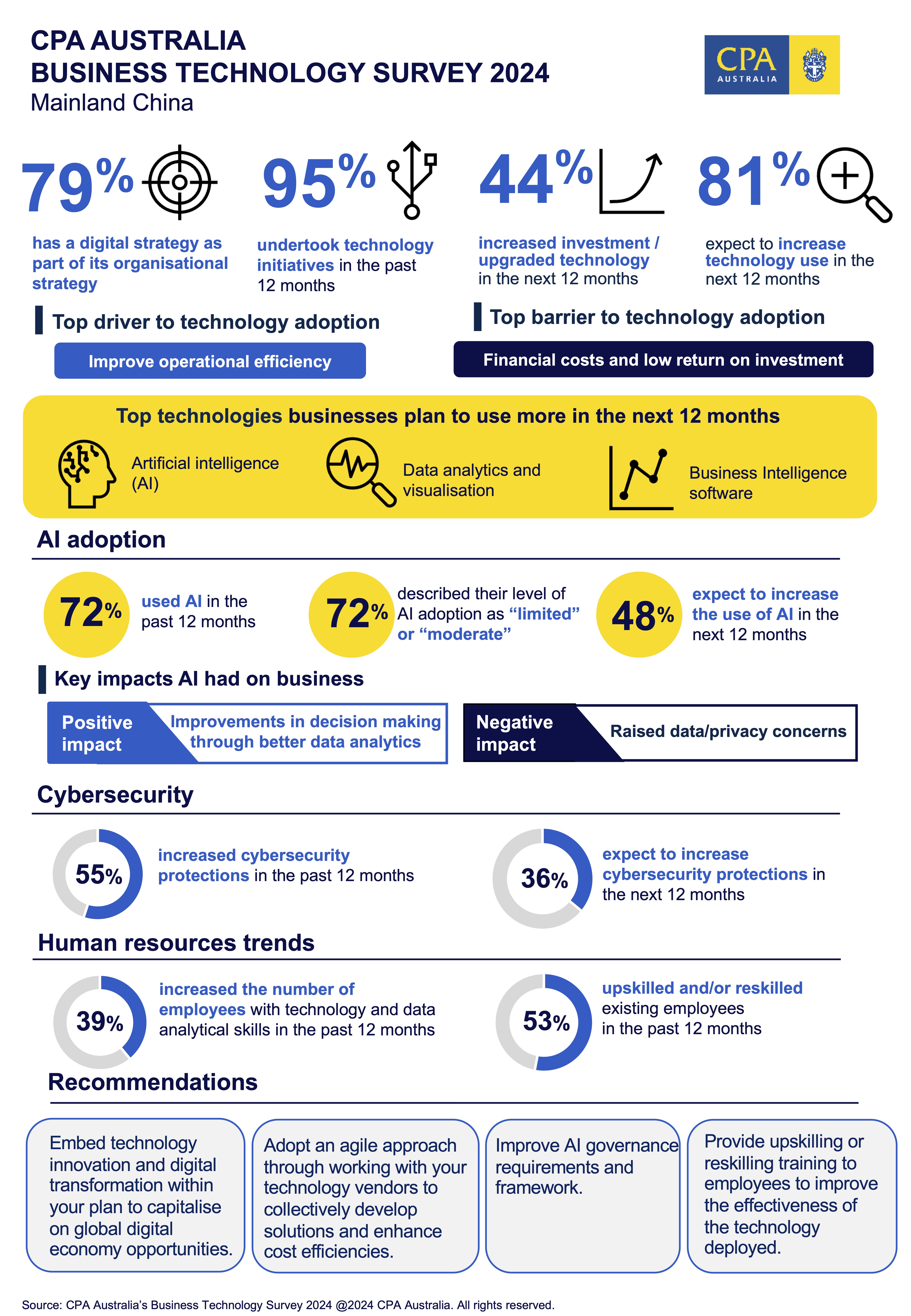
Nearly half of surveyed accounting and finance professionals in Mainland China expect their business will increase the use of AI in the next 12 months, more than double the number from the previous year (48 per cent vs 20 per cent), according to a new survey by one of the world's largest professional accounting organisations, CPA Australia.
CPA Australia's Business Technology Survey 2024 also showed that 44 per cent of respondents in Mainland China said their business increased investment in or upgraded technologies in the past 12 months. When asked about their plans in the next 12 months, 81 per cent expect to increase the use of technology, with increasing the use of AI (48 per cent) the top choice, followed by data analytics and visualisation software (43 per cent) and business intelligence software (37 per cent).
In the past 12 months, 72 per cent of respondents in Mainland China reported their businesses have applied AI, the third consecutive year of growth in AI adoption. In addition, 29 per cent said their businesses used AI all the time, up 10 per cent from last survey.
CPA Australia's East and Central China Committee Deputy President Mr Collin Jin FCPA (Aust.) said: "Government's supportive policies and the rapid maturity of technologies such as generative AI and large language model (LLM), created favorable conditions for Mainland Chinese businesses to embrace AI. By integrating AI, Mainland Chinese businesses are poised to improve their decision-making through better data analytics, streamline operations and improve efficiency by automating routine tasks, and reduce costs. Strategic investments into AI not only fortifies the competitive edge of the businesses but also elevates their contributions within the value chain, paving the way for innovative growth in the digital economy.
"Currently, the adoption of AI is still at a preliminary stage for many Mainland Chinese businesses. According to the survey, 72 per cent of respondents indicated that they adopted AI to a limited or moderate extent in their businesses. In the future, to further promote AI's technology and integrate it with our real economy, companies should keep enhancing their data capabilities, from acquiring to utilizing it in different application scenarios. Only continuous investment in data will advance AI's application, helping companies to transform towards a more intelligent and competitive business model.
Financial costs and low return on investment were identified as the top barrier to adopt technologies in businesses in Mainland China. Most respondents in other Asia-Pacific markets said their business experienced the same challenges.
Jin recommended: "Facing global economic uncertainties, investing into cutting-edge technologies such as generative AI and LLM has become more complex for companies. They should focus on their core business and apply a more comprehensive evaluation mechanism or ROI model to monitor and measure the actual impact of technology applications on operational performance. This will help them to better optimise their technology investments and upgrades.
"In addition, we also recommend the business to embed technology innovation and digital transformation within their globalisation plan to capitalise on global digital economy opportunities."
However, the increasing adoption of digital technologies boosted concerns over security. The survey results show that cybersecurity is the most widely applied technology among Mainland Chinese businesses (91 per cent) in the past 12 months. Three quarters of respondents stated that their businesses used cybersecurity software all the time, and more than half (55 per cent) reported that their businesses increased the cybersecurity protections.
Such investments into cybersecurity brought positive results. In the past 12 months, nearly half (48 per cent) of the Mainland Chinese respondents believe that their businesses' cybersecurity proficiency is above average. Further, 60 per cent of the respondents stated that their businesses did not lose any time or money due to a cybersecurity incident. As a result, 36 per cent of the respondents predict that their businesses will increase the use of cybersecurity software in the next 12 months.
CPA Australia's South China Committee Deputy President Mr Tony Chan FCPA (Aust.) said: "Effective governance is key to harnessing the full potential of these transformative technologies while mitigating risks. As digital threats become more sophisticated, conventional cybersecurity and data security is not enough. It is critical for businesses to regularly review their existing cybersecurity tools and measures to ensure they are updated against threats from new technologies and vicious attacks.
"Nowadays, many regions such as the European Union, have formulated or plan to introduce regulations on AI governance. Those Mainland Chinese businesses planning to expand overseas, should consider taking steps to improve AI governance to meet such requirements. This may include developing clear policies and procedures to guide ethical development, deployment, application, and monitoring AI's adoption across the organisation.
Further, the survey results show 39 per cent of respondents in Mainland China said that their business increased the number of employees with technology and data analytical skills in the past 12 months, 8 percentage points higher than last year. Further, 53 per cent said their business upskilled and/or reskilled existing employees to address the shortage of technology talent.
Chan said: "Building a future-ready workforce, proficient in the foundational logic of machine learning and artificial intelligence, is a key competitive advantage for businesses' sustainable development in the medium to long term. Businesses should maintain their focus on cultivating an innovation-driven culture and providing comprehensive upskilling or reskilling training for employees at all levels."
CPA Australia collected 1,060 responses from accounting and finance professionals in various industries across Asia Pacific including Mainland China, Malaysia, Vietnam, Australia from June to July 2024 for the Business Technology Survey, with 207 respondents from Mainland China. About one-third of Mainland Chinese respondents hold C-suite or other senior level positions.
Read CPA Australia's Business Technology Survey 2024
Hashtag: #CPAAustralia
The issuer is solely responsible for the content of this announcement.
About CPA Australia
CPA Australia is one of the largest professional accounting bodies in the world, with more than 172,000 members in over 100 countries and regions, including more than 22,500 members in Greater China. We have offices in Beijing, Shanghai, Guangzhou and Hong Kong. CPA Australia provides thought leadership on local, national, and international issues affecting the accounting profession and the public interest. We advocate for policies that stimulate sustainable economic growth and have positive business and public outcomes. Find out more at cpaaustralia.com.au










