Hong Kong remains the most costly market in Greater China for the third consecutive year Permanent Hybrid Planning, Experience-Focused Design and Environmental, Social and Governance are Three Key Fit-Out Trends in 2022
- Six Greater China markets figure in top 20 most expensive office fit-out markets in Asia-Pacific
- Permanent Hybrid Planning where costs are still being closely scrutinized
HONG KONG SAR - Media OutReach - 12 April 2022 - The COVID-19 pandemic over the last two years has greatly impacted the workplace. As markets continue to tackle the ongoing impacts and the rise of the Omicron variant, corporate occupiers are increasingly adopting more flexible working practices.
"We have seen a shift in how corporates are envisioning their space requirements, which in turn impacts fit-out decision-making, all within an environment where costs are still being closely scrutinized. Besides the application of thoughtful design and fit-out standards, there is the need for corporate occupiers to provide employees with seamlessly integrated technology solutions for both onsite and offsite working. There is also a greater emphasis on providing a workplace that is not only environmentally friendly but also has the employees' well-being at heart." said Tom Gibson, Head of Project & Development Services, Asia Pacific.
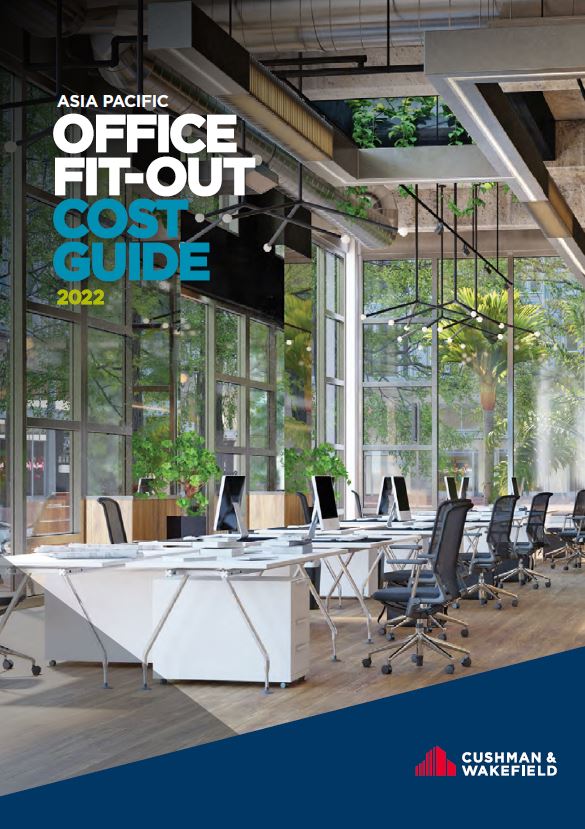
According to Cushman & Wakefield's 2022 Asia Pacific Office Fit-out Cost Guide, the three key office fit-out trends for 2022 are:
1. Planning for permanent hybrid
With Asia Pacific countries in varying stages of Return to Office, occupiers are incorporating an increasing spectrum of flexible working practices. Fit-out typologies are also changing, providing more collaborative spaces as well as space for focused work. There is growing interest in understanding how to engineer an ideal hybrid ecosystem — how much space is needed, what this space should look like, and how much it will cost to fit it out, as well to meet the ever-growing design demands of the flexible workforce.
2. Designing for experience
Insights from Cushman & Wakefield's bespoke workplace strategy tool, Experience per Square FootTM (XSF), have shown that employees across all markets desire greater workplace flexibility, though to varying degrees. Employers are investigating how to embrace greater flexibility while also maintaining corporate culture and equity of employee experience and are increasingly preferring quality over quantity of space. High quality buildings that provide the highest quality health and wellbeing credentials are mandatory, as is the need for seamlessly integrated technology solutions for both onsite and offsite working. The application of thoughtful design and fit-out standards is crucial in order to reflect the role and purpose of the office, which is all about experience, engagement, collaboration, culture, and wellbeing.
3. Incorporating ESG
We are seeing occupiers and investors placing greater emphasis on Environmental, Social, and Governance (ESG) considerations across all aspects of their real estate footprint as they address challenges related to the war for talent, corporate ESG commitments, and the rise of green capital. Occupiers are increasingly seeking green and wellness certifications for their projects and are engaging consultants early in the design process. Project managers play a pivotal role here by exposing clients to the latest workplace design strategies and assisting the integration of ESG principles into their workplace.
"The 2022 report reveals that six Greater China markets figure in the top 20 most expensive office fit-out markets in Asia-Pacific. Hong Kong remains the most costly market in Greater China for the third consecutive year, followed by Shenzhen, Beijing, Guangzhou, Shanghai and Taipei. Across mainland China, occupiers are increasingly seeking green and wellness certifications for their projects and are engaging consultants early in the early project stage to provide inputs in project programming, budget setting, and design specs." commented David Shi, Head of Project & Development Services, China, Cushman & Wakefield.
"Hong Kong occupiers traditionally prefers basic hybrid mode, while there is an increasing trend and greater need for more collaborative hybrid such as incorporating workspace into the break-out area and pantry space. With the COVID-19 pandemic persisting, IT and AV provisions (such as video conferencing) are in greater demand for enhanced remote communications. On the other hand, corporate relocation is still prevalent, despite many occupiers remaining cautious due to the capital expenditure requirements, as the city's fit-out cost ranking no.5 among APAC cities. In turn, landlords are adopting new measures to incentivize and facilitate occupier movements. Looking ahead, corporate requirements and employees' preference for greener practices will likely further push for greater ESG adoption, such as green building certifications and incorporating sustainability elements into their offices." added Bryant Cheung, Head of Project & Development Services, Hong Kong, Cushman & Wakefield.
Cushman & Wakefield's report revealed the average office fit-out costs for 31 cities in Asia Pacific. The top 20 cities in Asia Pacific with the highest office fit-out costs are:
| ASIA PACIFIC RANKING | CITY | AVERAGE COST (USD PSF) |
| 1 | Tokyo | 166 |
| 2 | Osaka | 161 |
| 3 | Nagoya | 157 |
| 4 | Auckland | 139 |
| 5 | Hong Kong | 138 |
| 6 | Sydney | 135 |
| 7 | Singapore | 134 |
| 8 | Melbourne | 132 |
| 9 | Brisbane | 129 |
| 10= | Adelaide | 124 |
| 10= | Perth | 124 |
| 12 | Seoul | 121 |
| 13 | Shenzhen | 119 |
| 14 | Beijing | 117 |
| 15 | Busan | 116 |
| 16 | Guangzhou | 115 |
| 17 | Shanghai | 114 |
| 18 | Taipei | 92 |
| 19 | Manila | 87 |
| 20 | Bangkok | 85 |
Click here to download the 2022 Asia Pacific Office Fit-out Cost Guide.
About Cushman & Wakefield
Cushman & Wakefield (NYSE: CWK) is a leading global real estate services firm that delivers exceptional value for real estate occupiers and owners. Cushman & Wakefield is among the largest real estate services firms in the world, with approximately 50,000 employees in over 400 offices and 60 countries. In Greater China, a network of 22 offices serves local markets across the region, earning recognition and winning multiple awards for industry-leading performance. In 2021, the firm had revenue of $9.4 billion across core services including valuation, consulting, project & development services, capital markets, project & occupier services, industrial & logistics, retail and others. To learn more, visit www.cushmanwakefield.com or follow @CushWake on Twitter.
#Cushman&Wakefield
The issuer is solely responsible for the content of this announcement.