



Forget JobKeeper — what the government and the country need now is a JabMaker plan
- Written by: Mark Kenny, Professor, Australian Studies Institute, Australian National University
Forget last week’s healthy 5.6% unemployment rate[1].
It might be “comfortably below” the Coalition’s 6% threshold for commencing “fiscal repair” (another term for unpopular spending cuts), but the government is under unforeseen political pressure and is anything but relaxed and comfortable.
In any event, this 5.6% figure was from March, which is an important detail because it predated the wind-up of the JobKeeper wage subsidy.
Who knows what that means.
It could mean nothing much or we might see an uptick in jobs lost — employees shed from debt-addled “zombie” firms, which survived the crisis only to perish in the recovery.
At $90-plus billion, the JobKeeper wage subsidy scheme was the biggest single program in Australian history. And by any metric, it was a shining success. Any metric that is, if you exclude the country’s fourth biggest pre-pandemic export sector, education.
Higher education’s ‘long COVID’
Universities suffered a triple COVID hit — denied access to the JobKeeper program due to the way they were structured, denied overseas students from whom (admittedly too much) revenue was relied upon and denied any certainty about their return due to a snail-paced vaccine rollout.
Read more: The government keeps shelving plans to bring international students back to Australia. It owes them an explanation[2]
As a result, a country that led the world through the 2020 pandemic trails it in 2021 through a bungled recovery program, while perhaps permanently hobbling one of its most lucrative and reliable exports.
Ever innovative, Australia may have found a way to give its university sector and therefore its own future growth the economic version of long COVID.
A terrible start to 2021
Politically, Prime Minister Scott Morrison’s options at the start of 2021 looked pretty inviting. Flush with that 2020 success — a combination of good judgement, good luck, and state government front-footedness — Morrison was riding high in public opinion. Inevitably, talk turned to a possible spring election to capitalise.
Labor’s end of the see-saw was weighed down. Doubts were aired about leader Anthony Albanese’s cut-through[3], his chances in an early poll, the pros and cons of a challenge.
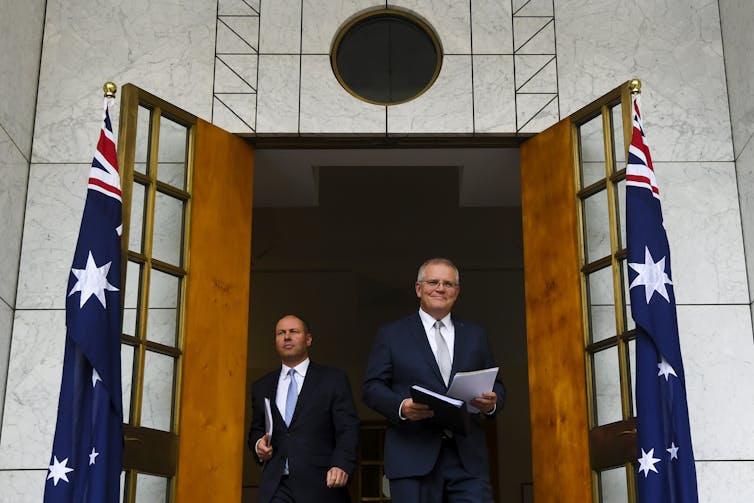 Talk of an early election in 2021 has melted away.
Lukas Coch/AAP
Talk of an early election in 2021 has melted away.
Lukas Coch/AAP
But events since have changed everything. Two months of attempting to politically nuance a series of negative stories and allegations regarding the treatment of women in politics have damaged the government, consumed its oxygen, and pricked the prime minister’s inflated reputation as the supreme pragmatist.
His unwillingness to get in front of the problem has instead evinced a strange defensiveness. His grudging late-stage efforts at political rescue have been less effective for their pointless delay and for the tightly qualified nature of the language used.
The Christine Holgate saga[4] is merely the latest iteration.
It was clear weeks ago[5] that Holgate had been prejudicially forced from her job at Australia Post. The most senior political leverage in the land had been summarily and publicly applied. A prime ministerial apology[6] was the obvious solution, not just for her but for him also.
The vaccine ‘eekout’
Twice-weekly national cabinet meetings began again on Monday[7], in a sign the prime minister understands the seriousness of Australia’s vaccine bungles. But his reluctant acknowledgement of multiple problems in the rollout to date reinforces his instinctive stubbornness.
The abject helplessness of Australia at the vaccine stage is also all the more jarring for its contrast with the 2020 suppression of the virus and the glowing vaccination expectations the government itself created.
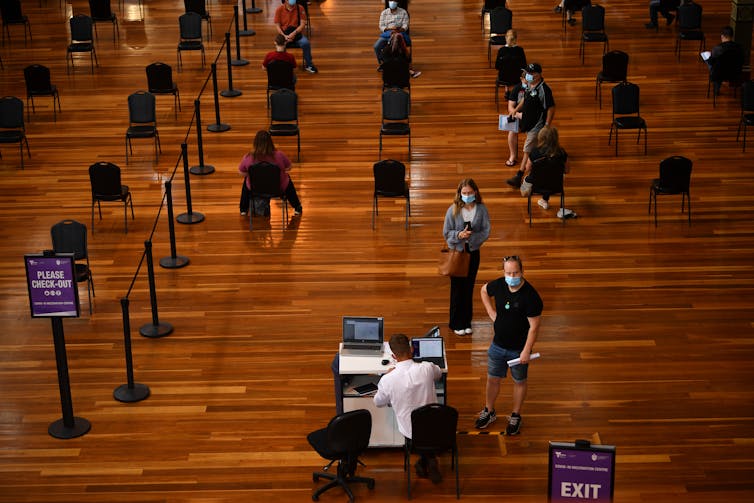 Australia’s vaccination rollout has been plagued by supply issues and health concerns.
James Ross/AAP
Australia’s vaccination rollout has been plagued by supply issues and health concerns.
James Ross/AAP
On these grounds alone, the prime minister’s political judgement is questionable. Australians were promised a world-class vaccine program in which we would be at the front of the queue. What it would lack in immediacy (a luxury of zero community infection, we were assured) would be more than made up for in logistical precision.
In fact, it has failed to materialise. Opaque and piecemeal, the rollout feels more like an eekout.
What will decide the next election?
Now, the Coalition looks to the May 11 Budget for political salvation.
Even with a jobless number of just 5.6%, it has limited political capital to spend and must use the balance sheet to repair its political stocks rather than the nation’s books.
JobKeeper, JobSeeker, and even JobMaker, have either gone or will not make enough difference to matter at the ballot box next year.
What the government really needs is what the country needs — JabMaker.
Read more: To abandon vaccination targets is to abandon the mantle of leadership[8]
After all, it’s the jabless rate rather than the jobless rate that could decide the next election. It currently sits “comfortably” around 95%[9], with no certainty that the population will be vaccinated this calendar year.
The end of October target has been junked, replaced with … nothing.
Compare that to calamitous America where they expect to reach the full adult population by the end of July.
Last week, the US inoculated roughly[10] the entire population of Australia. On one of those days alone, 4.6 million people[11] received jabs of either Pfizer or others such as Moderna, and Johnson & Johnson.
Australia is well and truly “jab-ready”.
Its government, not so much.
References
- ^ 5.6% unemployment rate (www.abc.net.au)
- ^ The government keeps shelving plans to bring international students back to Australia. It owes them an explanation (theconversation.com)
- ^ cut-through (theconversation.com)
- ^ Christine Holgate saga (theconversation.com)
- ^ weeks ago (www.abc.net.au)
- ^ prime ministerial apology (theconversation.com)
- ^ began again on Monday (www.theguardian.com)
- ^ To abandon vaccination targets is to abandon the mantle of leadership (theconversation.com)
- ^ around 95% (www.wsj.com)
- ^ inoculated roughly (www.cnbc.com)
- ^ 4.6 million people (thewest.com.au)










