
As protests roil France, Macron faces a wicked problem — and it could lead to his downfall
- Written by: The Conversation
Two years ago, the streets of France were filled with the gilets jaunes[1] (yellow vests), a grassroots protest movement sparked by a proposed tax hike on petrol.
Though they have shed their yellow safety jackets, many of these disaffected people have joined a new wave of protests[2] that has roiled France for weeks, presenting a major challenge for the government of President Emmanuel Macron.
The protests erupted in late October[3] after the horrific murder of the schoolteacher Samuel Paty, who had used caricatures of the Prophet Muhammad during a lesson. Thousands marched in tribute to Paty[4], but also in support of freedom of speech.
In the past month, protesters have also taken aim at a proposed new security law[5] intended to combat what the government describes as “Islamic radicalism”. Nearly 150 people were arrested[6] last weekend after protests became violent.
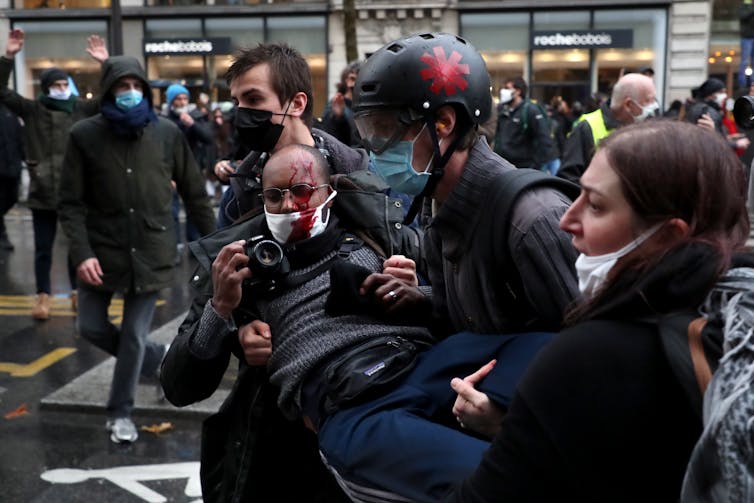 Rights groups and journalists’ unions have denounced what they call ‘arbitrary arrests’ at the latest protests.
CHRISTOPHE PETIT TESSON/EPA
Rights groups and journalists’ unions have denounced what they call ‘arbitrary arrests’ at the latest protests.
CHRISTOPHE PETIT TESSON/EPA
The roots of Macron’s current challenge
An explanation of the tensions connecting these protests takes us deep into the history of France, as well as to contemporary crises. It also suggests that there is no simple solution.
In 1789, French revolutionaries sought to capture their twin aspirations of religious tolerance and freedom of speech in articles 10 and 11[7] of the Declaration of the Rights of Man and the Citizen.
Read more: For French Muslims, every terror attack brings questions about their loyalty to the republic[8]
“No man may be harassed for his opinions, even religious ones”, they insisted, while asserting that “the free communication of thoughts and opinions is one of the most precious rights of man”.
Should these natural rights be curtailed in any way? Yes, of course: as article 4 stipulates, they would be limited to “ensure the enjoyment of the same rights for other members of society”. As to how this would be achieved, “only the law may determine these limits”.
Therein lay the problem. Since “the law” would be made by national legislatures, these limits would always be instrumental — that is, made by elected politicians working within a social and political context. That is Macron’s wicked problem today.
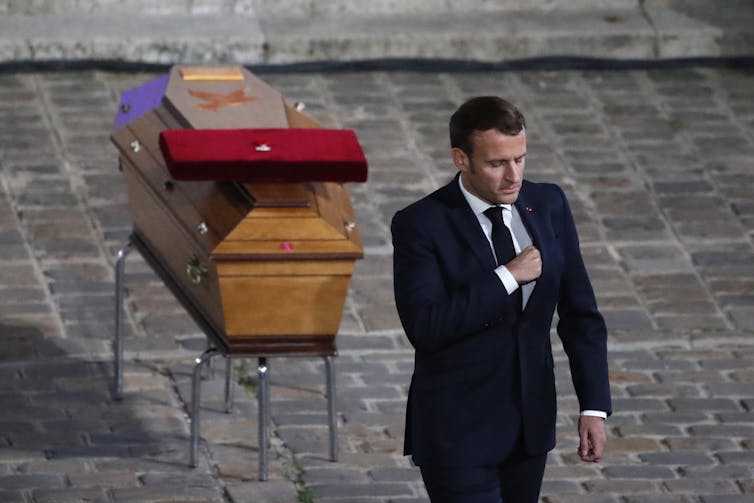 Macron called Paty a ‘quiet hero’ at a memorial service and said he was ‘killed because Islamists want our future’.
Francois Mori/AP
Macron called Paty a ‘quiet hero’ at a memorial service and said he was ‘killed because Islamists want our future’.
Francois Mori/AP
The continuing debate over laïcité
Conflict over limits to freedom arose immediately between revolutionaries and their opponents after 1789. There were ribald, even pornographic, attacks[9] on Marie-Antoinette and the Catholic Church, reflecting a deadly schism between secular, republican France and the church.
For republicans, a central legacy of the revolution has been the principle of laïcité[10], that is, of a secular public space.
Freedom of religion has been guaranteed in France so long as it does not disturb public order. Religion is seen as a private matter and its observance strictly separated from public life.
This is a deeply held conviction in France. It explains the 2010 law that bans the wearing of full-face coverings in public[11], including but not limited to burqas and niqābs.
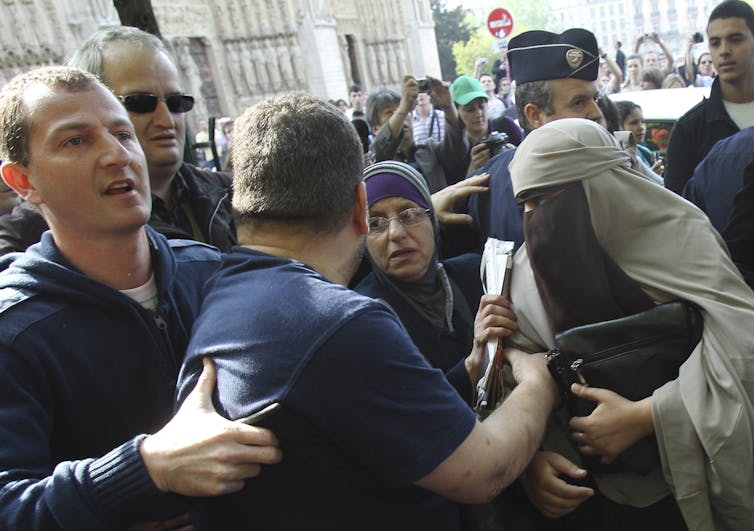 An unidentified veiled woman is led away by police after the law banning face coverings came into effect.
Michel Euler/AP
An unidentified veiled woman is led away by police after the law banning face coverings came into effect.
Michel Euler/AP
French supporters of laïcité would find it perplexing, if not offensive, to see one Australian prime minister, Kevin Rudd, holding Sunday press conferences outside his church, or another, Scott Morrison, welcoming the media inside his church and describing secular events (such as an election victory) as a “miracle”. In France, this might end political careers.
Australian and US commentators have been too ready to criticise France for not being as accepting of difference as their own societies, ignoring France’s different history and present.
Read more: France's laïcité: why the rest of the world struggles to understand it[12]
From 1789, Jews, Protestants, Muslims — as well as Catholics — were guaranteed the freedom to worship, but the fine line between religious freedoms and secular public space has always been blurred, sometimes with tragic consequences.
Take Captain Alfred Dreyfus’s false conviction for treason in 1894[13], followed by his imprisonment and eventual exoneration in 1906. This was profoundly polarising because it embodied the violent divisions in France about the place of Jews in public life at a time of acute anti-semitism.
Dreyfus’s anti-semitic and anti-republican accusers included many clergy — one of the reasons behind the formal separation of church and state in 1905[14].
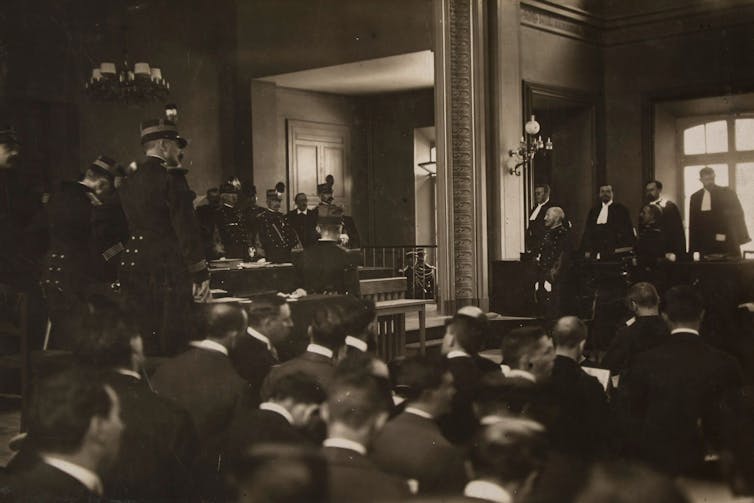 The start of Alfred Dreyfus’s trial in Rennes in 1899.
Wikimedia Commons
The start of Alfred Dreyfus’s trial in Rennes in 1899.
Wikimedia Commons
Deep national tensions over Islam
Similarly, the beheading of Paty and subsequent terror attack in Nice[15] in late October sparked a profound response because they occurred amid deep national tensions over the place of Muslims in France.
These tensions go back to wars of decolonisation in the 1960s, but were heightened by recent attacks[16] at the satirical magazine Charlie Hebdo and the Bataclan theatre in 2015.
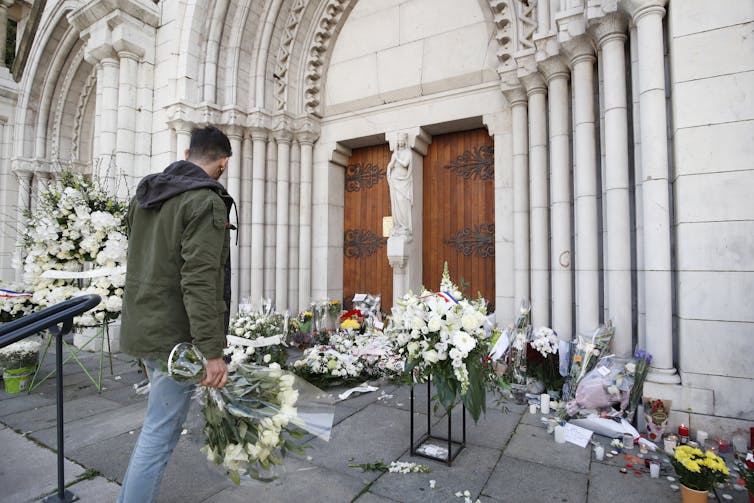 Mourners leave flowers at a memorial to the victims of the knife attack at the Notre Dame Basilica church in Nice.
SEBASTIEN NOGIER/EPA
Mourners leave flowers at a memorial to the victims of the knife attack at the Notre Dame Basilica church in Nice.
SEBASTIEN NOGIER/EPA
While almost all Muslim organisations in France were prompt and unequivocal in repudiating those murders, elsewhere in the Muslim world, some were hostile to the freedoms accorded to media outlets such as Charlie Hebdo to publish caricatures mocking Islam and its prophet.
Leaders in Turkey, Morocco, Pakistan, Egypt and elsewhere condemned the magazine and called for consumer boycotts of French products[17].
Charlie Hebdo’s defence was that it mocks everybody, and it followed with an obscene cartoon[18] of Turkish President Recep Tayyip Erdogan.
Read more: Liberty, equality, fraternity: redefining 'French' values in the wake of Charlie Hebdo[19]
Macron has insisted the respect due to all religions must be balanced by the right to freedom of expression, no matter how offensive some caricatures might be to people of faith.
He has defended the right[20] of Charlie Hebdo to publish the caricatures, even though some might be banned in other countries as deliberately offensive, even racist. While France has anti-hate laws, its highest courts have also been very reluctant to penalise satire.
At the same time, Macron’s minister of national education, Jean-Michel Blanquer, has targeted “Islamo-gauchisme”[21], the supposed undermining of French republican values by left-wing academics and intellectuals infected by feelings of guilt for France’s colonial past.
Can Macron find a solution?
These tensions have now spilled onto the streets in unanticipated ways, as they have become embroiled with deep anxieties and divisions about decolonisation, policing and the limits to secularism. All of this comes at a time of economic despair and strident criticism of the government’s mishandling of the pandemic.
In this context, violent police raids and a sweeping national security law[22], which would make a criminal offence to publish photos or film identifying police officers and expand police surveillance powers, have sparked widespread discontent.
In early December, the Macron government announced a revision of the security bill. This alone will not staunch a profound crisis of confidence in the foundational values of the republic: secularism, freedom of speech and respect for religious plurality.
In such a situation, the siren calls of cultural stereotyping may become louder, and Macron may need a “miracle” of his own[23] to keep France out of the hands of Marine Le Pen and her Rassemblement National (National Rally), formerly known as the Front National, at the presidential elections of April 2022[24].
References
- ^ gilets jaunes (www.theguardian.com)
- ^ new wave of protests (www.bbc.com)
- ^ protests erupted in late October (www.9news.com.au)
- ^ marched in tribute to Paty (www.abc.net.au)
- ^ taken aim at a proposed new security law (www.nytimes.com)
- ^ Nearly 150 people were arrested (www.dw.com)
- ^ articles 10 and 11 (www.jstor.org)
- ^ For French Muslims, every terror attack brings questions about their loyalty to the republic (theconversation.com)
- ^ ribald, even pornographic, attacks (yalebooks.yale.edu)
- ^ laïcité (theconversation.com)
- ^ bans the wearing of full-face coverings in public (www.nytimes.com)
- ^ France's laïcité: why the rest of the world struggles to understand it (theconversation.com)
- ^ Captain Alfred Dreyfus’s false conviction for treason in 1894 (www.history.com)
- ^ formal separation of church and state in 1905 (theconversation.com)
- ^ terror attack in Nice (www.bbc.com)
- ^ recent attacks (www.dw.com)
- ^ consumer boycotts of French products (www.aljazeera.com)
- ^ obscene cartoon (www.bbc.com)
- ^ Liberty, equality, fraternity: redefining 'French' values in the wake of Charlie Hebdo (theconversation.com)
- ^ defended the right (www.reuters.com)
- ^ has targeted “Islamo-gauchisme” (www.lemonde.fr)
- ^ national security law (www.theguardian.com)
- ^ Macron may need a “miracle” of his own (www.aljazeera.com)
- ^ presidential elections of April 2022 (www.bloomberg.com)