
Who is a real man? Most Australians believe outdated ideals of masculinity are holding men back
- Written by: The Conversation
Most Australians recognise that traditional gender stereotypes are limiting and harmful for boys and men, a new national survey has found. And perhaps contrary to popular belief, many Australians are receptive to messages about alternative, healthy versions of masculinity.
The survey of 1,619 respondents, commissioned by the Victorian Health Promotion Foundation, sought to gauge people’s attitudes towards men and masculinity[1]. The sample was representative of the Australian population by age, state and gender.
Most people agreed on a few basic principles:
traditional gender stereotypes are limiting and harmful for boys and men
there is pressure on men to live up to traditional masculine stereotypes
masculine expectations or outdated ideas of masculinity prevent men from living full lives
boys need both women and men as role models, rather than only men.
Masculinity is enforced more by men than women
The survey revealed a consistent gender gap in attitudes toward men’s roles in society and perceptions of masculinity.
Perhaps not surprisingly, the survey showed that compared to women, men are less supportive of gender equality, less likely to see sexism as extensive and systematic, and more likely to endorse men’s dominance in relationships and families.
Ironically, the male respondents in the survey were also less aware than the female respondents of the pressure society places on men to conform to a certain ideal of masculinity.
Read more: Inside the 'man box': how rigid ideas of 'manning up' harm young men and those around them[2]
One of the most interesting findings was the attitudes of younger men. Young men (aged 16-17) generally had more progressive attitudes than older men on traditional gender roles and how they are limiting, outdated and contribute to poor health. Yet, they also had the highest levels of endorsement of men’s use of violence, homophobia, breadwinner roles and men’s patriarchal power and control in relationships.
Such regressive attitudes may reflect the intensified pressure they feel among male peers[3] to prove themselves as men, sexist online culture or other factors.
Conversely, young women’s attitudes were the most progressive of all respondents, creating a large gap between them and their male peers.
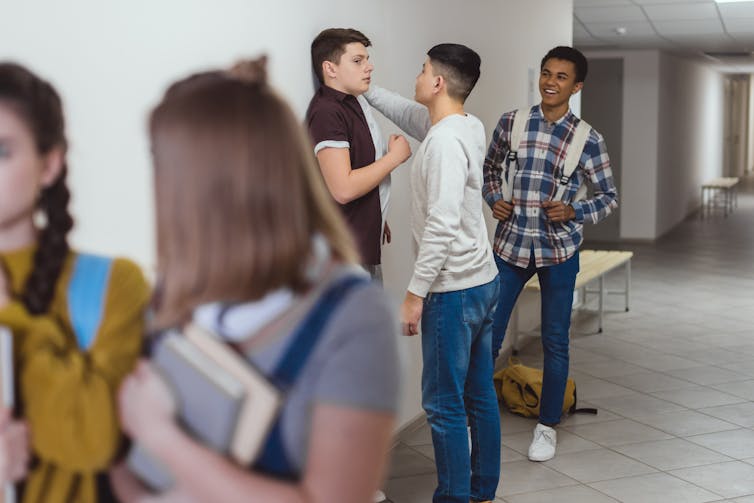 Teenage boys may feel peer pressure to adhere to some traditional views of manhood.
Shutterstock
Teenage boys may feel peer pressure to adhere to some traditional views of manhood.
Shutterstock
Who is a real man?
There was little support overall in the survey for traditional definitions of masculinity based on homophobia. About one-quarter of young men and one-fifth of adult men agreed with the statement, “a gay guy isn’t a real man”. (Even fewer women agreed with this statement.)
There was also little support for the idea men should dominate and control women in relationships, although large minorities of men and particularly young men do support this.
Asked whether “a man should always have the final say about decisions in his relationship or marriage,” 30% of young men and 19% of adult men agreed, compared to just 13% of young women and 9% of adult women.
Read more: Women aren't better multitaskers than men – they're just doing more work[4]
Among our respondents, there was broad recognition that gender is socially constructed[5] – in other words, that boys’ and men’s lives and relations are shaped by social forces as much as they are by biology.
At the same time, many respondents also believed there were “natural” differences between men and women, especially when phrased in these terms.
We also saw widespread recognition of the need to open up gender roles for men, especially because they constrain men’s own health and wellbeing.
There was strong agreement, for instance, that men and boys should be free to explore who they are without the pressures of gender stereotypes. Most people also agreed progress towards gender equality and breaking free of gender stereotypes would be good for men[6].
And though domestic and sexual violence continues to be a major concern, especially during the pandemic[7], it was encouraging to see almost universal agreement among people in Australia that men can play a role[8] in preventing violence against women.
Gender norms are improving
The VicHealth survey complements a growing body of Australian research on people’s attitudes toward men, masculinity and gender.
This includes a national survey[9] of young Australian men’s conformity to the “Man Box” (stereotypical masculine attitudes), a national survey[10] of Australians’ attitudes to gender equality issues and a rolling national survey[11] of awareness and attitudes regarding violence against women.
Other data tell us gender norms in Australia are changing, largely for the better.
Attitudes improved in the 1980s and 1990s, and although progress stalled[12] after this, there have been steady improvements in the past decade[13].
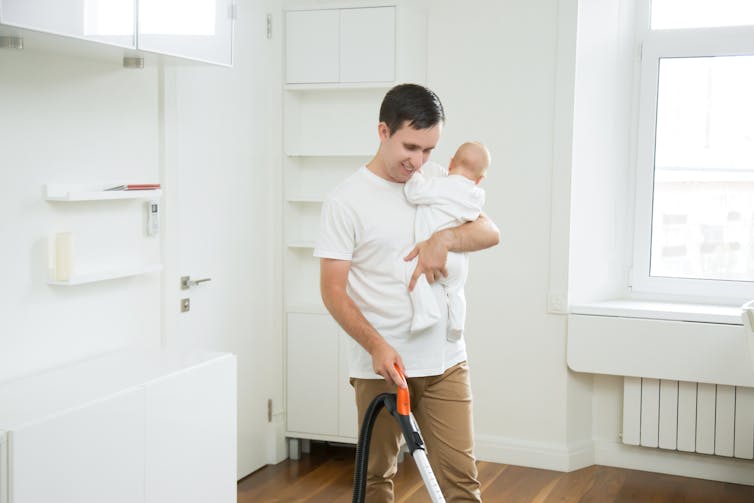 There is a growing awareness in Australia that traditional gender stereotypes are limiting and harmful for men.
Shutterstock
There is a growing awareness in Australia that traditional gender stereotypes are limiting and harmful for men.
Shutterstock
Messages for healthier views on masculinity
One of the key findings of our survey is that framing matters. How messages about gender are phrased affects whether people agree with them — that is, what messages they will support.
For example, when people are presented with messages that men are currently “under attack”, substantial proportions of the population will endorse them — particularly those with pre-existing conservative views.
On the other hand, when statements on gender are framed in progressive or feminist terms — for example, men and boys are restricted by masculine stereotypes and should be freed from them — those with conservative views have similar levels of agreement to middle-of-the-road people.
Read more: Gillette has it right: advertisers can't just celebrate masculinity and ignore the #metoo movement[14]
VicHealth’s research also tested various messages[15] for promoting healthy masculinity to identify those[16] most likely to inspire positive change.
Among the key recommendations for community and health providers to better engage with men:
focus on progressive ideas that will appeal to the vast majority of people, rather than pandering to men with traditionally masculine language or focusing on myth-busting
emphasise the need to free men from outdated masculine stereotypes
focus less on the problem, and more on the solution.
There is a wealth of evidence[17] that conformity to traditional masculine stereotypes is limiting for men and boys and harmful to those around them.
Most Australians agree. It is time to foster positive alternatives, to improve health and wellbeing for everyone.
References
- ^ people’s attitudes towards men and masculinity (www.vichealth.vic.gov.au)
- ^ Inside the 'man box': how rigid ideas of 'manning up' harm young men and those around them (theconversation.com)
- ^ intensified pressure they feel among male peers (www.vichealth.vic.gov.au)
- ^ Women aren't better multitaskers than men – they're just doing more work (theconversation.com)
- ^ socially constructed (www.wiley.com)
- ^ good for men (www.academia.edu)
- ^ especially during the pandemic (theconversation.com)
- ^ men can play a role (journals.sagepub.com)
- ^ national survey (theconversation.com)
- ^ national survey (www.broadagenda.com.au)
- ^ national survey (www.anrows.org.au)
- ^ progress stalled (link.springer.com)
- ^ the past decade (www.anrows.org.au)
- ^ Gillette has it right: advertisers can't just celebrate masculinity and ignore the #metoo movement (theconversation.com)
- ^ tested various messages (www.vichealth.vic.gov.au)
- ^ identify those (www.vichealth.vic.gov.au)
- ^ wealth of evidence (promundoglobal.org)