
Who is Antony Blinken, Biden's pick for secretary of state?
- Written by: The Conversation

US Secretary of State-designate Antony Blinken promises both awkwardness and opportunity for Australia’s Morrison government.
Blinken could hardly represent a more striking contrast with his soon-to-be predecessor Mike Pompeo in his views on the need for America to reinvigorate alliances and address pressing global issues such as climate change.
He will bring to the job a lifetime of experience[1] as a staff member of the Senate Foreign Relations Committee, foreign policy aide to President-elect Joe Biden over many years, and deputy secretary of state in the Obama administration.
The Blinken worldview could be summed up as “America together”, not “America first”. It was given expression in useful detail at a July 9 Hudson Institute dialogue on American Foreign Policy. This document[2] should be compulsory reading for Coalition foreign policy advisers.
Pressure on climate change
First, let us consider the awkwardness for Australia of a Biden administration in which Blinken will play a central role.
After loitering in the shadows of a virtually non-existent US climate policy, the Australian government will now have little choice but to engage more constructively[3] in global efforts to address global warming.
Morrison and his ministers will find it increasingly awkward[4] to avoid a commitment to net zero global greenhouse emissions by 2050, in line with the policies of a new US administration.
Read more: What would a Biden presidency mean for Australia?[5]
Biden has foreshadowed such a commitment as a cornerstone of US foreign policy.
Likewise, Australia’s fudge of making use of leftover Kyoto carbon credits[6] to enable it to meet its climate targets under the Paris Agreement[7] will be difficult to sustain in a new more climate-activist era.
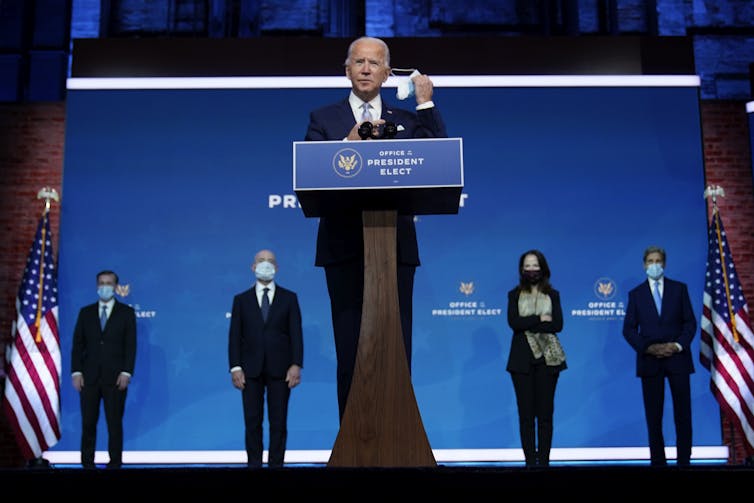 President-elect Joe Biden has signalled he will move to net zero carbon emissions by 2050. Australia has yet to make such a commitment. AAP/AP/Carolyn Kaster
This state of affairs will have implications for Australian domestic politics, in which counterproductive climate politicking has left the country without a sustainable energy policy for more than a decade.
This reflects poorly on successive governments.
Biden’s commitment to rejoin the Paris Agreement from “day one”[8] and the centrality of climate policy in his administration was amplified by Blinken at the Hudson event[9]. He said:
Quite simply, [climate change] is arguably the one truly existential issue that we face. It has to be, and under a Biden administration would be, a number-one priority.
Blinken said that among early priorities of a Biden administration would be the convening of a summit of the world’s major carbon emitters to:
…rally countries not just on sticking with Paris, but to actually raise their ambitions and try to push progress further and faster.
He gave notice the US would work to insist that China:
…stop subsidising coal exports and outsourcing pollution to other countries by financing billions of dollars’ worth of dirty fossil fuel energy projects through the Belt and Road Initiative.
These initiatives will inevitably have implications for Australian coal exporters.
Read more: Hopes of an improvement in Australia-China relations dashed as Beijing ups the ante[10]
Blinken also talked about “locking in enforceable commitments to reduce emissions in global shipping and aviation”.
These are ambitious goals by any standards, and will inevitably feed into Australian policy debate. The Morrison government’s choice is either to get with the program or allow itself to be regarded as an outlier, along with Brazil and Saudi Arabia[11], of countries resistant to coordinated global efforts to bring down carbon emissions.
A chance to thaw the frost with China
On China, where Australian government policy has been all at sea, the incoming administration presents Australia with a chance to reset its relationship with its most important economic partner.
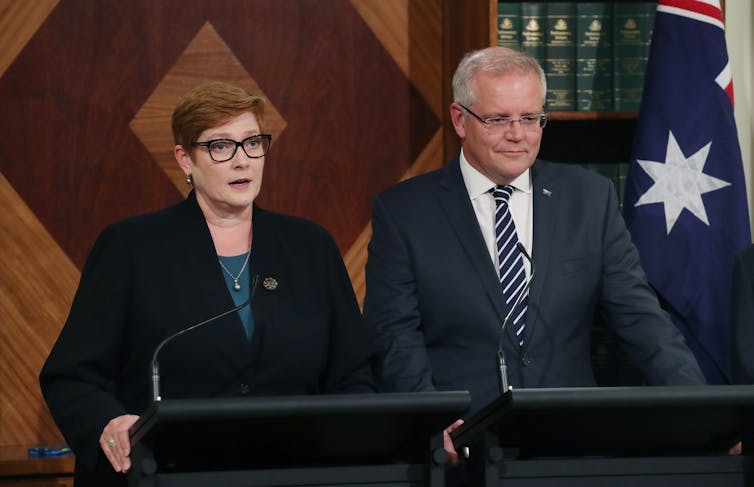 The incoming US administration should offer the Australian government, among other things, a chance to again re-set its testy relationship with China.
Those attempts at such a reset surfaced in a speech this week[12] by Morrison to the UK Policy Exchange, a London-based conservative think tank. Here, the prime minister put aside some of the bluster that has characterised recent exchanges, in which Australia promised not to succumb to Chinese bullying.
In light of real harm being rendered to Australian businesses by Chinese boycotts, Morrison sounded more conciliatory:
Australia is not and has never been in the economic containment camp on China […] Australia desires an open, transparent and mutually beneficial relationship with China as our largest trading partner.
These words are unexceptional in themselves. But they clearly amount to an attempt by Morrison to take advantage of the potential for a fresh start offered by a new administration in Washington.
Blinken’s remarks on China to the Hudson Institute should be given close attention in Canberra. He points to the need for America to restore confidence in its own democracy first, so as to be in a sounder position to counter China’s rise.
Beijing had been able to take advantage of America’s inward-looking domestic turmoil over the past four years to advance its own global reach.
In turn, the US needed to revitalise its alliances to deal with China’s rise. Once that is done, a Biden administration would be able to:
…engage China and work with China, in areas where our interests clearly overlap, whether it is again contending with climate change, dealing with global health and pandemics, [or] dealing with the spread of dangerous weapons. We’re much better off, though, finding ways to cooperate when we’re acting from a position of strength than from a position of weakness.
These sentiments should be welcomed in Canberra, where a ragged China policy in recent years has tended to be consumed by security concerns. Restoring balance to that policy in coordination with an American push to bolster alliances of Western democracies would be desirable.
At his Hudson Institute event, Blinken addressed a range of contentious foreign policy issues. These included the vexed question of what to do about Iran’s nuclear ambitions. Biden has indicated he would like to revive America’s participation in the Iran nuclear deal abandoned by Donald Trump[13]. However, this will be easier said than done, given the progress Tehran has made towards acquiring a breakout nuclear capability.
On the Middle East more generally, Blinken said:
I think we would be doing less not more in the Middle East.
This view no doubt reflects frustrations Blinken himself has experienced over many years in seeking to bridge seemingly intractable conflicts, such as the Palestinian issue, at the expense of other priorities.
Former Secretary of State John Kerry’s designation as America’s climate envoy[14] attests to a Biden administration’s commitments on the global warming front. Kerry was one of the architects of the Paris Agreement.
Blinken’s nomination as secretary of state should be regarded as a positive development from Australia’s perspective, given his significant foreign policy experience and his proclaimed willingness, indeed determination, to work with friends and allies.
The Australian government, marinaded in a security mindset, would be advised to buy into what promises to be a much more expansive American foreign policy with climate as its centrepiece.
References
- ^ lifetime of experience (www.nytimes.com)
- ^ document (www.hudson.org)
- ^ little choice but to engage more constructively (theconversation.com)
- ^ increasingly awkward (www.abc.net.au)
- ^ What would a Biden presidency mean for Australia? (theconversation.com)
- ^ leftover Kyoto carbon credits (reneweconomy.com.au)
- ^ Paris Agreement (unfccc.int)
- ^ rejoin the Paris Agreement from “day one” (www.nytimes.com)
- ^ the Hudson event (www.hudson.org)
- ^ Hopes of an improvement in Australia-China relations dashed as Beijing ups the ante (theconversation.com)
- ^ Brazil and Saudi Arabia (www.carbonbrief.org)
- ^ speech this week (www.pm.gov.au)
- ^ Iran nuclear deal abandoned by Donald Trump (theconversation.com)
- ^ John Kerry’s designation as America’s climate envoy (www.nytimes.com)