as Angela Merkel departs, she leaves a great legacy of leadership
- Written by: Gabriele Suder, Professor. Dean, New Business Acceleration, Federation University Australia
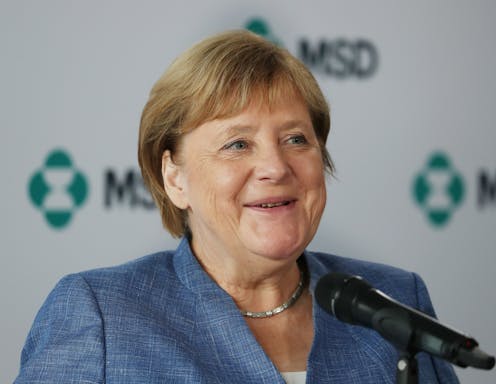
With Chancellor Angela Merkel departing as one of the most significant politicians in a generation, the German elections of September 26 will be very closely watched. This is the first time since 2005 that national elections will take place without her.
This first female German chancellor has served a record four terms in government. While she has her critics, she has overall been a source of stability, coherence and consultation. She has also become a role model of how to deal with controversy and crisis.
Standing down on her own terms
Merkel is now dedicated to making space for the future generation as Germany, the EU and the world face accelerating challenges. These range from the pandemic and climate change, relations with the US, Russia, China, and beyond. The geo-political and geo-strategic landscape is shifting. Merkel played a crucial role in pursuing EU-style multilateralism as a vector of peace and stability.
Some believe Merkel missed some important opportunities that can now be picked up or reinforced. Among those are bringing other European Union nations, such as France, even closer to taking on more EU leadership, an ambition strengthened when French President Emmanuel Macron was elected. Macron, the fourth French president elected during Merkel’s time as chancellor, was seen as liberal, pro-European and reformist. But his ideas on financial integration and a multi-speed model for Europe did not meet the expected enthusiasm, including in Germany, while he was struggling with reforms internally.
In her 16 years as leader, Merkel has seen many international counterparts come and go. She has worked with eight Japanese prime ministers, seven Italian prime ministers, five UK prime ministers, and four US presidents – not to mention six changes of prime minister in Australia.
Many leaders dramatically underestimated her, judging wrongly from her early nickname of “das Mädchen” (the girl) that she might be a political neophyte. She soon proved to be a role model for reliability and responsibility, and the impact of female leadership.
Read more: Auf Wiedersehen, 'Mutti': How Angela Merkel’s centrist politics shaped Germany and Europe[1]
Merkel’s place in history
Merkel is the first German chancellor to stand down on her own terms and timeline without the political pressures known by her predecessors. Importantly, she also does not have an obvious successor. This makes this election less than predictable. Neither the centre-right’s (CDU) Armin Laschet – Merkel’s party colleague – nor the centre-left’s (SPD) Olaf Scholz (currently finance minister), nor the Green Party’s Annalena Baerbock are seen as charismatic or convincing.
This leads to the question where the “Merkel voters” will head with their votes. During her tenure, women voters, economic centrists and ethnic minority voters in particular voted for her party in support of her, rather than for the CDU’s policies.
This also raises the question of what legacy she will leave.
Some have called[2] Merkel one of the most influential world leaders of the modern era. Others recognise her[3] as extraordinary in various ways, at times with critique.
Merkel has modernised Germany and, to some extent, liberalised a very conservative system, always with Germany’s economic interests at its centre. She became known to leverage Germany’s strong post-second world war values-driven perspective (very much embedded in the promise that history should never repeat itself). In doing so, she advanced and modernised the values of democracy, human rights, equality, diversity and the value of partner-level engagement to solve challenges and find solutions, together.
Merkel’s place in history is also symbolic. Raised in East Germany during the period it was split from the West and aligned to the Soviet regime, she entered politics during the era of reunification. Untarnished by the East’s past, she is a highly educated, humble woman with a doctorate in quantum chemistry who made it through a career marked by a range of roles. As she has also revealed[4] she has not been thwarted by misogyny in politics or life in general.
She became chancellor at a time when Germany struggled to find cohesion between the former east and west. She brought same sex marriage, and radical policy shifts such as on nuclear policy after the Fukushima disaster. She has advanced a very environmentally conscious society to move toward a carbon-neutral economy, with Germany aiming to be carbon neutral by 2045 (the EU target is 2050). Her welcoming “we can do this” attitude to refugees and asylum seekers[5] was noted around the world.
Under Merkel, Germany wielded the strongest political influence in the EU, though it took this role rather reluctantly, becoming its leading integrating force and its leading economy.
Symmetry and strength
Merkel’s leadership has not been without its hiccups, such as when saving the Euro currency during the Euro-crisis and Global Financial Crisis. Merkel brokered deals[6] during endless discussion to keep Greece in the EU and maintain European solidarity.
She also played a key role in negotiating a stable transition through Brexit. There were times when she pushed through ideas that contradicted the general consensus on an issue within Germany and among her voters, such as in her moderate stance on China[7].
But one of the ways she will be remembered is for standing tall when her values were challenged. The most notable example of this is her decision to keep open Germany’s borders to refugees, after much consideration. This depth of thought brought the term merkeln into the German language, expressing long reflective periods in decision-making. It also brought her the nickname “Mutti” (mother) to reflect her caring, empathetic and decisive approach.
Read more: How Angela Merkel has become – and remains – one of the world's most successful political leaders[8]
She has often been criticised in Germany for leading without communicating a larger vision. But her ability to learn and thrive during challenges while maintaining integrity, stability and responsible engagement shapes her legacy in Germany and beyond.
Merkel has been much praised, especially internationally, for her broader crisis management and her outstanding ability to maintain engagement. It is this legacy, combined with the ongoing importance of European and international collaboration, that remains front of mind for German voters as they elect their next leader.
References
- ^ Auf Wiedersehen, 'Mutti': How Angela Merkel’s centrist politics shaped Germany and Europe (theconversation.com)
- ^ have called (www.forbes.com)
- ^ recognise her (www.independent.co.uk)
- ^ also revealed (www.focus.de)
- ^ attitude to refugees and asylum seekers (www.dw.com)
- ^ brokered deals (www.euractiv.com)
- ^ moderate stance on China (www.dw.com)
- ^ How Angela Merkel has become – and remains – one of the world's most successful political leaders (theconversation.com)