why is Australia such a tough market for the cruise ship industry?
- Written by: Freya Higgins-Desbiolles, Adjunct Senior Lecturer in Tourism Management/ Adjunct Associate Professor, University of South Australia
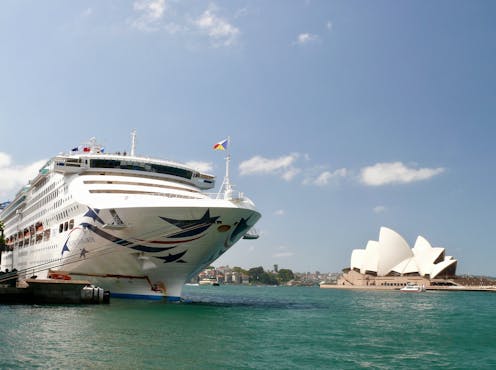
Miami-based cruise operator Carnival Corporation has announced[1] it will retire its P&O Cruises Australia brand in March 2025.
The decision marks the end of the line for an iconic cruise brand in Australia and the Pacific, after nearly a century[2] of operations.
Parent company Carnival has been on a campaign of international growth through acquisitions and mergers since at least 1989. P&O Cruises Australia was bought by the company in 2003.
Many Australians might remember the brand’s iconic television advertisements from the 1980s and ‘90s that encouraged them to escape the rat race.
P&O’s memorable advertisements from the 1980s and 1990s encouraged Australians to escape the rat race.But the reality of cruising’s international consolidation leaves little room for such nostalgia and national brand attachment.
Still, cruising is a big part of Australia’s tourism sector, and cruises are a large source of inbound visitors. The Australian Cruise Association estimates the industry’s total economic contribution[3] is as high as A$5.63 billion.
Australians are hungry for cruise ship experiences. They make up the fourth largest[4] source market for passengers, at 1.25 million last year.
Australia is a tough place to make a profit
A recent report[5] by Cruise Lines International Association painted a picture of a thriving industry. New, bigger ships are being rolled out to meet a growing market of both new and loyal cruise enthusiasts.
So why are operators struggling here? P&O hasn’t been the only brand facing difficulties down under.
P&O’s sister line Cunard recently announced it will stop basing itself[7] in Australia from 2026, and Virgin Voyages’ Resilient Lady has cancelled plans[8] for a second sailing season here next summer.
Carnival said[9] its decision on P&O Australia came down to the region’s “significantly higher operating and regulatory costs” and small population. The company said it had been forced to change its operating approach to achieve “efficiencies”.
The cruise sector was hit hard by the pandemic. In early 2020, Carnival reported a staggering single quarter net loss of US$4.4 billion[10]. The company also suffered reputational damage following a high-profile COVID outbreak[11] on its Ruby Princess cruise ship.
The international cruise market is heavily concentrated. Almost 80%[12] of the passenger market is shared by three big companies: Carnival, Royal Caribbean International and Norwegian cruise lines.
Australia’s high operating costs and relatively small market make it tough for big cruise companies to achieve the profitability they expect. Carnival’s Cunard Line attributed its decision to move out[13] of Melbourne to a 15% hike in port fees.
As these companies have sought to strengthen their competitive advantage, acquiring smaller players has been a popular strategy.
This mass tourism model can deliver relatively cheap holidays for passengers. But it often also sacrifices well-loved smaller cruise operations that are more connected to local histories and cultures.
There is also the tyranny of distance for Australia, and increasing geopolitical risks affecting cruising.
The Australasian region faces stiff competition as a cruise destination from alternatives such as the Caribbean and the Mediterranean, which are close to large markets. Virgin Voyages said its cancellation of the 2024–25 sailing schedule was due to major safety concerns in the Red Sea.
What does its future hold?
Reassuringly, customers with P&O bookings for the remainder of 2024 will not be affected. Next year, the brand’s Pacific Encounter and Pacific Adventure ships will continue to sail, but under new branding for Carnival Cruise Line. Pacific Explorer will be retired from service.
In Australia, the mass tourism model of the big cruise operators is no doubt here to stay. But there could be further cuts to the range of destination ports offered as the industry prioritises profits.
In the longer term, however, a crucial question concerns the future of ports around Australia that have been enticed into engaging with the cruise industry. Many government tourism authorities have been keen to expand the sector.
As a result, access to some smaller ports has been negotiated and there has been a push to build new facilities in New South Wales, the biggest market.
This has received pushback[16] from some parts of the community who argue the economic benefits don’t outweigh the cultural and ecological cost.
In the future, there could be a more sustainable solution for Australian cruising in smaller expedition-like formats. These have been particularly successful in locations such as the Kimberley in Western Australia.
Local communities at small-ship destinations may find this model of cruising more acceptable, given its lower passenger numbers and smaller environmental impact.
References
- ^ announced (www.carnivalaustralia.com)
- ^ nearly a century (www.pocruises.com.au)
- ^ total economic contribution (www.australiancruiseassociation.com)
- ^ fourth largest (www.cruising.org.au)
- ^ recent report (cruising.org)
- ^ Sunflowerey/Shutterstock (shutterstock.com)
- ^ stop basing itself (www.cruisehive.com)
- ^ cancelled plans (www.smh.com.au)
- ^ said (www.carnivalaustralia.com)
- ^ US$4.4 billion (www.reuters.com)
- ^ high-profile COVID outbreak (www.bbc.com)
- ^ 80% (cruisemarketwatch.com)
- ^ move out (www.canberratimes.com.au)
- ^ Paulharding00/Shutterstock (www.shutterstock.com)
- ^ Rachel Claire/Pexels (www.pexels.com)
- ^ pushback (www.nsw.gov.au)
Authors: Freya Higgins-Desbiolles, Adjunct Senior Lecturer in Tourism Management/ Adjunct Associate Professor, University of South Australia