Daylight saving is about to start. But why do the days get longer?
- Written by: Laura Nicole Driessen, Postdoctoral researcher in radio astronomy, University of Sydney

The days are getting longer and in Australia, the switch to daylight saving time is almost upon us (for about 70% of the population, anyway).
But why do we have longer days in summer and shorter days in winter?
It’s all about the tilt
Earth goes around the Sun in an almost circular orbit. But not everything is lined up perfectly. Earth’s axis is tilted by 23.44 degrees relative to its orbit around the Sun.
Imagine Earth’s orbit as a flat frisbee with the Sun in the middle and Earth as a ball on a stick going around the edge.
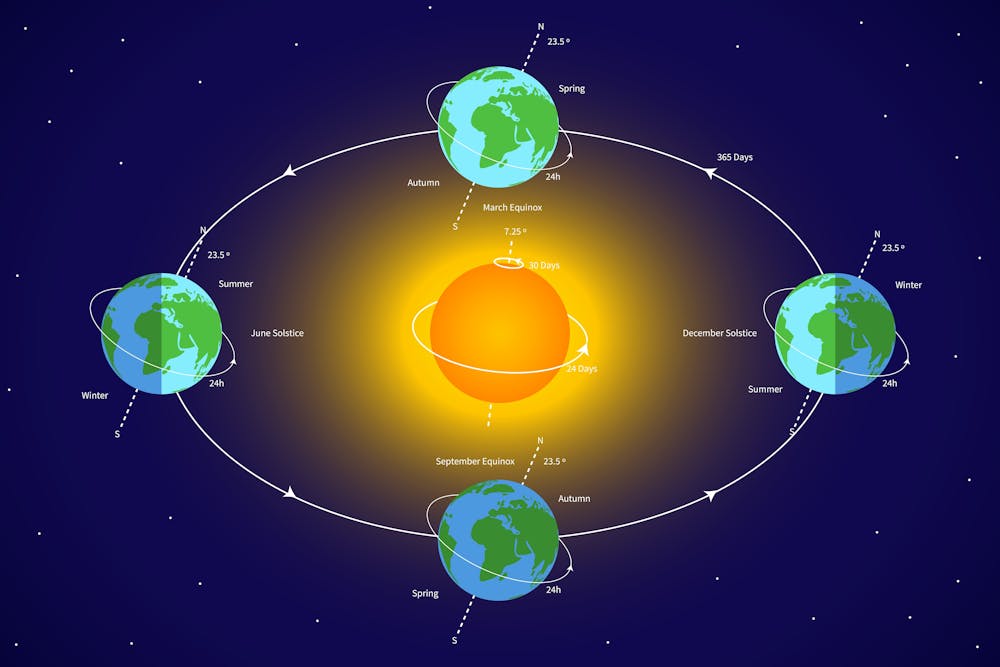
If Earth’s axis wasn’t tilted (if its tilt was zero degrees) the stick would be exactly perpendicular to the frisbee. If you grab that perpendicular stick and tip it 23.44 degrees sideways, that’s what Earth’s tilt looks like now.
As Earth orbits the Sun, the tilt of the stick does not rotate relative to the Sun. If you were in outer space looking at the Sun and you watched from the exact same position for a whole year, you would see Earth go around the Sun while the stick stayed tilted the same direction.
In other words, if the top of the stick was pointing to the right when you started watching Earth go around the Sun, it would stay pointing to the right the whole way around.
This tilt gives us longer days in summer and shorter days in winter. Let’s set up the scenario so the Northern Hemisphere is the top of the planet and the Southern Hemisphere is the bottom of the planet.
When Earth is on one side of the Sun, the top of the stick is pointed towards the Sun. This is summer in the Northern Hemisphere and winter in the Southern Hemisphere. Six months later, when Earth is on the other side of the Sun, the bottom of the stick is pointed towards the Sun – and the seasons are reversed.
Solstices and equinoxes
Those two points, when the top of the stick is pointing directly towards the Sun or directly away from the Sun, are the solstices. They are the longest and shortest days of the year, depending on your hemisphere.
The shortest day of 2024 in Australia was June 21. Looking forward to sunnier times, the longest day of the year in 2024 will be December 21.
In between the summer and winter solstice, we have the equinoxes – when days and nights are almost exactly the same length. Those are the days when the stick through Earth is “side-on” to the Sun. The equinox is also the day when the Sun passes directly over Earth’s equator. In 2024 this happened on March 20 at 2:06pm AEDT and September 22 at 10:43pm AEST.
That means that since September 22, days have been getting longer than nights in the Southern Hemisphere.
What does daylight saving do?
Earth’s tilt means the Sun both rises earlier and sets later as we head towards summer. When the clocks (in some states) switch to daylight saving time, people in these states all get one hour less of sleep. However, the total length of the day doesn’t change just because we changed our clocks.
For me, daylight saving means I need an extra cup of coffee in the morning for about a week before I adjust to the daylight saving-lag (like jet lag, but without the fun of travel).
What it really gives us is more daylight in the evening, instead of more daylight in the morning. If you’re already a morning person, this isn’t the way to go. But if you prefer to have a long dinner in the summer sun it’s ideal.
Has it always been this way?
Earth’s axis hasn’t always been tilted at 23.44 degrees. It cycles from a minimum 22.1 degree tilt to a maximum 24.5 degree tilt and back again once every approximately 41,000 years.
Earth’s axis also “precesses”, where the stick through it draws a circle once every approximately 26,000 years. You can see this in the animation below.
 Demonstration of the precession of Earth’s axis. NASA/JPL-Caltech[2]
The length of a day on Earth hasn’t always been the same, either.
At the moment, the length of a day is nearly exactly 24 hours. But it’s shifting all the time by tiny amounts. This is tracked very closely by a system of telescopes and satellites. These systems measure “Earth orientation parameters[3]” that describe Earth’s exact orientation compared to the position of stars in the sky.
These are important to astronomers because the exact location of our telescopes is important for creating accurate maps of the sky. On top of all of this, the gravitational drag from the Moon causes days to become longer by around 2.3 milliseconds every 100 years. A few billion years ago, Earth’s day was a lot shorter – only 19 hours long[4].
Even though some of us are losing an hour of sleep this weekend, at least we get to enjoy 2.3 milliseconds longer every day than our great – and great-great – grandparents did.
References
- ^ Angela Cini/Shutterstock (www.shutterstock.com)
- ^ NASA/JPL-Caltech (science.nasa.gov)
- ^ Earth orientation parameters (ggos.org)
- ^ only 19 hours long (www.earthscope.org)
Read more https://theconversation.com/daylight-saving-is-about-to-start-but-why-do-the-days-get-longer-240221