Crime won't stop because of COVID. So how should we protect crime scene investigators?
- Written by: Paola Magni, Senior Lecturer in Forensic Science, Murdoch University
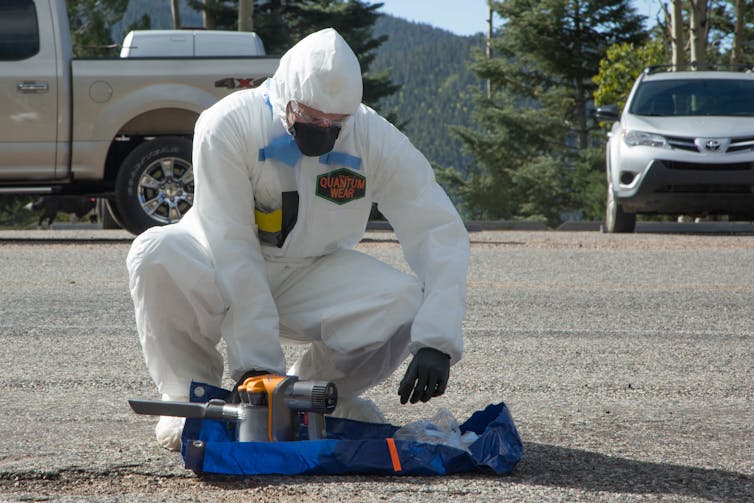
COVID may have curtailed travel, hospitality, education and entertainment, but crime scene investigation never stops.
As a forensic scientist, researcher and lecturer, I know first-hand the risks and challenges crime scene investigation (CSI) teams have faced over the past two years as we’ve grappled with the realities of operating amid the threat of COVID.
CSI units present a unique challenge, as investigators often work at close quarters for prolonged periods. Yet surprisingly, until now, there has been very little adjustment to existing crime scene procedures.
When COVID first appeared, guidelines were quickly introduced[1] in a range of countries[2] for forensic autopsies of COVID-positive cases and the handling of infected biological samples, but not for CSI protocols more generally.
How should CSI teams be protected?
One possibility is CSI teams could adopt the existing protective measures[3] used for chemical, biological, radiological or nuclear incidents.
Those measures were largely developed in the wake of the 9/11 terror attacks, and in response to broader concerns about terrorism that began to emerge in the 1990s.
But these safety precautions are burdensome, time-consuming and expensive, particularly for local and regional law enforcement agencies, and are not necessarily useful when dealing with a virus.
Officers dealing with identifying a potential toxic warfare agent, for example, would need much more bulky equipment than the standard PPE used to prevent COVID infections.
And let’s not forget the role of our law enforcement agencies also includes many other tasks, such as crime prevention and public order, not just identifying, securing and providing evidence in a criminal court. In an ideal world, each police department would have its own specialist forensic agents. But the reality, especially in small cities and remote areas, is that officers are trained for every task, including collecting forensic evidence.
All over the world during the 2020 lockdowns, minor offences such as burglaries and car thefts declined[5]. But there was no drop in serious crimes, such as homicide and domestic violence.
In fact, COVID has arguably created new types of incidents to investigate, such as suspicious deaths in hotel quarantine[6].
Read more: Some crimes have seen drastic decreases during coronavirus — but not homicides in the US[7]
COVID looks set to be with us for some time yet. So what is the best way to protect our CSI teams in an affordable and practical way?
COVID-safe crime scenes
One place to look for ideas is Italy, which has so far recorded[8] 5.6 million COVID cases and almost 140,000 deaths.
Together with Enrico Di Luise of the Italian Military Police Laboratory of Forensic Biology in Messina, I have published[9] a world-first set of recommendations to make forensic operations possible across the different phases of crime scene management, from evidence collection in the field to analysis in the lab.
Briefly, our recommendations include:
-
CSI call policy. To ensure maximum preparedness, operations call centre staff should be trained to ask for information about the health conditions of the victim(s) and other people involved in the case, including their travel history and contact history.
-
Equipment preparation and sanitation. Any object, if contaminated at the scene of a crime, can potentially spread infection to the rest of the CSI team. To guard against this, team members should each be given their own individual set of equipment, such as briefcases, evidence boxes, chemical reagent sets, and ultraviolet flashlights. Disposable materials or tools should be treated as medical waste and placed in a designated area of the crime scene. Reusable items should be disinfected at the crime scene with sanitiser or bleach, and back at headquarters should be sanitised a second time by mechanical or chemical disinfection, or thermal sterilisation in an oven called an autoclave. This should be done in a dedicated room by staff wearing appropriate PPE.
-
Working groups. CSI team should be able to maintain independent forensic capacity, including experts in at least the areas of forensic biology, fingerprint analysis and photography, plus the ability for one team member to also take on the task of team leader. This is the only feasible way to maintain teams with full operational ability. Officers should be organised into small, non-interchangeable teams, so if one or more members of a particular team falls ill, another team can step in without risk of exposure.
-
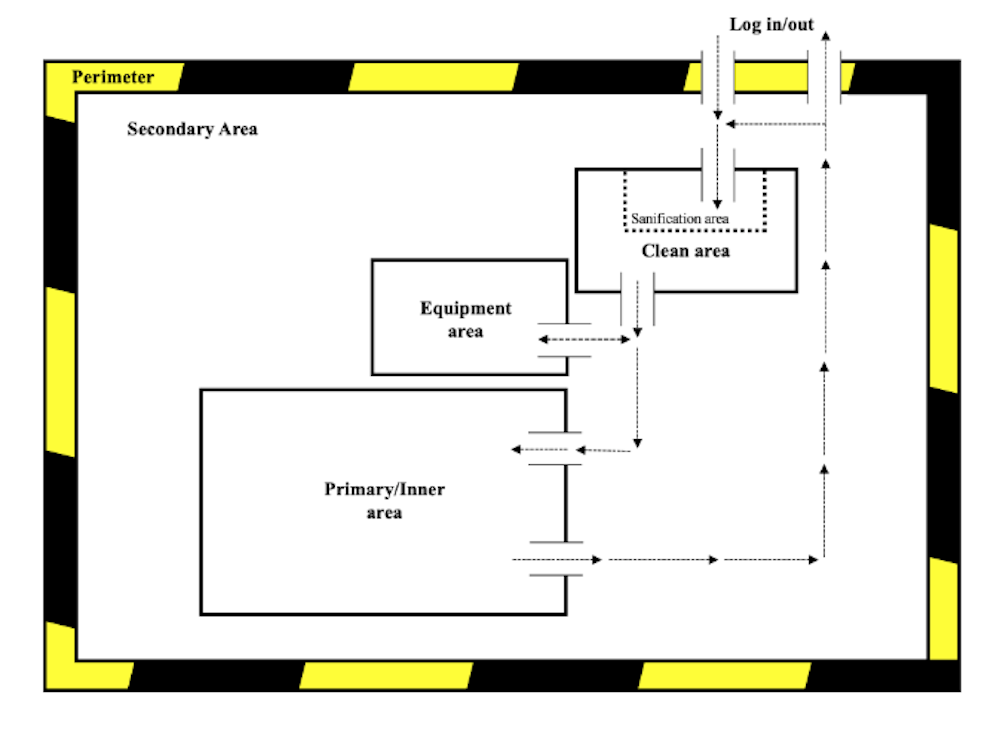
Procedure at the scene. Regardless of the scenario, CSI operators must consider every crime scene as a “hot zone”. Limiting the number of operators present in a room or small space at any given time is crucial. We have proposed a new general layout by which crime scenes can be divided into different areas, including one-way paths in and out, and a dedicated “clean area”.
- Chain of custody. A correct chain of custody for evidence is crucial to any forensic case. But different types of evidence have different infection potential, and often have to be treated in different labs, by different staff or on different time frames. Until now, details such as time and exact location have rarely been included in routine traceability recordings, but should now be included. These details could be vital in tracing the movement of potentially contaminated items.
Read more: COVID has changed policing — but now policing needs to change to respond better to COVID[10]
References
- ^ introduced (pubmed.ncbi.nlm.nih.gov)
- ^ range of countries (www.cdc.gov)
- ^ existing protective measures (www.researchgate.net)
- ^ Katelyn Strange/US Army/Wikimedia Commons (commons.wikimedia.org)
- ^ declined (theconversation.com)
- ^ suspicious deaths in hotel quarantine (7news.com.au)
- ^ Some crimes have seen drastic decreases during coronavirus — but not homicides in the US (theconversation.com)
- ^ recorded (www.statista.com)
- ^ published (www.ncbi.nlm.nih.gov)
- ^ COVID has changed policing — but now policing needs to change to respond better to COVID (theconversation.com)