School sports houses help shape our understanding of belonging and identity. Does who they’re named after matter?
- Written by: Kate Kirby, PhD Candidate in History, University of the Sunshine Coast
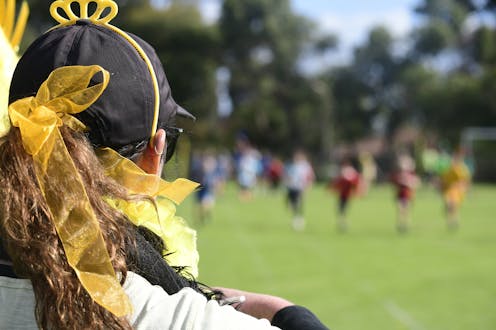
Sport plays an important role in the conception of Australian national identity. With the 2024 Paris Olympic and Paralympic Games currently in swing and Queensland preparing to host the games in 2032, international success in the green and gold remains a focus of the Australian media.
But away from international performances, banal experiences in everyday settings also contribute to perceptions of national identity. Experiences in local and school sport – away from the bright lights of sporting mega-events – are crucial to understanding how and why sport connects strongly to Australian identity.
What can you remember about your own school sports days? Many people still remember their allocated school sports house name and colour – even decades after childhood.
Our new research[1] looked at the historical and contemporary naming of school sports houses in Queensland to understand how our broader societal ideas about role models and other positively regarded places, animals and things might have changed over time.
Sports houses are typically named for people or things school leadership and the community believe hold admirable qualities they hope to encourage in students. As Australian society evolves and opinions change, so too should the namesakes deemed appropriate for school sports houses.
The making of school houses
Limited initially to private schools in Britain[2] from the 1850s, the practice of implementing school sports houses[3] spread to Australian private schools by the 1900s and expanded into British and Australian public schools throughout the first half of the 20th century.
Tied to the origins of physical education[4] and its ambition for all male children to be fit to defend empire and nation, sports houses continue to be seen as a way to encourage a sense of team loyalty and to foster healthy competition. The names, mascots, colours and “war cries” of these sports houses play an important part in fostering a sense of belonging.

While many private secondary schools opened in Queensland in the first half of the 20th century, it was not until the postwar period that large numbers of public high schools were founded, with the initial wave ending by 1969.
In our research we compared the names of houses for both public and private schools in Queensland in 1969 and 2023, to understand how school sports house culture has changed since.
At least 66% of Queensland high schools had adopted sports houses by 1969. By 2023, this had risen to 95%.
Who gets to be a namesake?
Sports houses are often named for people, places or things perceived as having positive qualities schools believe children should respect or emulate.
In 1969, private Queensland high schools predominantly named sports houses after people from the fields of education and religion, with some houses named after significant school community leaders.
By 2023, little had changed with private high school naming traditions, with religion remaining the most common category of sports house names.
 Students competing in tunnel ball in Brisbane in 1947.
State Library of Queensland[6]
Students competing in tunnel ball in Brisbane in 1947.
State Library of Queensland[6]
Queensland’s public high schools initially turned to colonial namesakes, such as Cook House (for Captain James Cook), Kennedy House (for the colonial explorer Edmund Kennedy[7]) and Leichhardt House (for the colonial explorer and naturalist Ludwig Leichhardt[8]).
Like private schools, public schools have tended to retain their sports house names over time, with one notable exception: some public high schools renamed their sports houses to non-colonial namesakes over the past few decades, sometimes choosing local First Nations language terms or places as replacements.
Despite this, in 2023, 40 Queensland public high schools had colonial namesakes for their sports houses.
The rise of the woman sport star
The most remarkable change evident in the data is houses named after sportspeople had risen dramatically in popularity, from 10 houses in 1969 to 115 in 2023, all identified at public schools.
The diversity of sportspeople represented also increased. Bradman House (for Sir Donald Bradman) remains the most popular in this category, but he is now followed by Fraser House (for Dawn Fraser) and Freeman House (for Cathy Freeman).
 The Cavell House team, winners of the senior relay race at the St. Aidan’s School, 1936. Edith Louisa Cavell was a British nurse who worked during the First World War.
Trove[9]
The Cavell House team, winners of the senior relay race at the St. Aidan’s School, 1936. Edith Louisa Cavell was a British nurse who worked during the First World War.
Trove[9]
The rise in women athletes as house namesakes in the 2023 data indicates a desire to provide schoolchildren with a greater diversity of role models. In 1969, 11% of all high school sports houses with people namesakes were named after women, increasing to 22.6% by 2023.
But there are dramatic differences when considering types of schools. In 2023, of the houses at public co-ed schools named after people, 16.3% were women namesakes. At private girls high schools, the figure jumps to 67.3%.
In comparison, at Queensland’s private boys high schools, over 90% of such house names were after men.
Colours and mascots
While the “best” house colour is a conversation for another day, we can confirm the four most popular house colours in use in 2023 were blue (20.97%), red (20.81%), green (19.81%) and yellow/gold (18.54%).
We expected maroon to be more popular, given its status representing Queensland in the State of Origin, but only 27 sports houses had this colour in 2023.
 20% of the school houses in 2023 were green.
ChameleonsEye/Shutterstock[10]
20% of the school houses in 2023 were green.
ChameleonsEye/Shutterstock[10]
Animal mascots were also interesting: the most popular in 2023 were aggressive predator types such as eagles, sharks, lions and crocodiles. Cuddlier Australian natives like koalas, possums and wombats were rare inclusions, though the “fighting kangaroo” was the eighth most common animal mascot.
In addition to being a shared experience of growing up in Australia, school sports houses are potent examples of banal nationalism, whereby elements of Australianness are reinforced through the tradition of school athletics and swimming carnivals.
In addition to providing organisation and belonging within a school setting, sports houses exist as primers for local, state and national identities.
The choices made by school administrators about house names, colours and mascots point not only to a school’s history and traditions but also the social environments in which such decisions are made and remade.
References
- ^ Our new research (www.tandfonline.com)
- ^ private schools in Britain (www.jstor.org)
- ^ school sports houses (en.wikipedia.org)
- ^ physical education (ses.library.usyd.edu.au)
- ^ State Library of Queensland (collections.slq.qld.gov.au)
- ^ State Library of Queensland (collections.slq.qld.gov.au)
- ^ Edmund Kennedy (en.wikipedia.org)
- ^ Ludwig Leichhardt (en.wikipedia.org)
- ^ Trove (nla.gov.au)
- ^ ChameleonsEye/Shutterstock (www.shutterstock.com)