Albanese appoints Tony Burke to neutralise immigration issues and sends Clare O'Neil to grapple with housing crisis
- Written by: Michelle Grattan, Professorial Fellow, University of Canberra
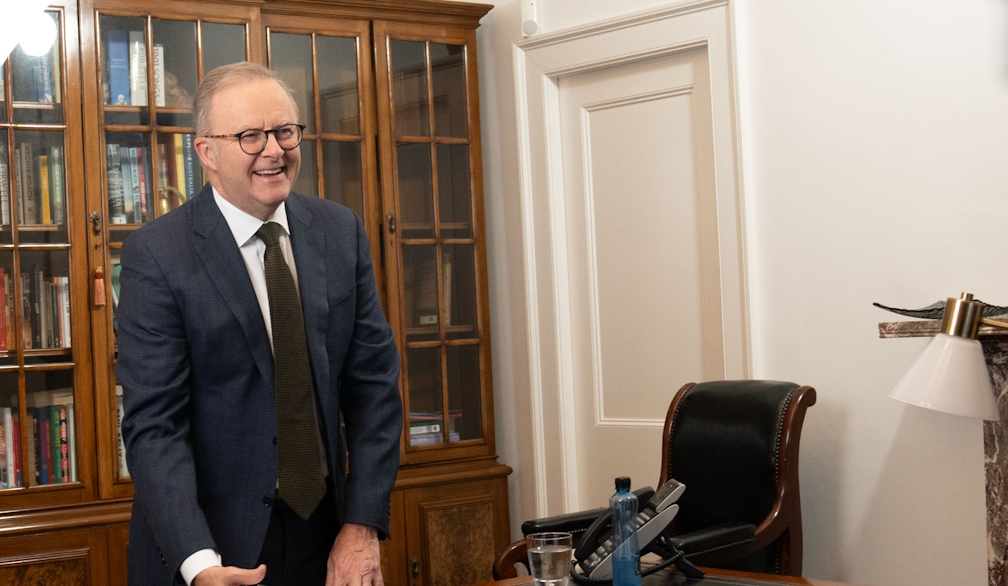
Anthony Albanese is seeking to neutralise the difficult issues in immigration and former detainees by appointing Tony Burke, a strong political performer, into the challenging Home Affairs portfolio.
Burke, 54, minister for employment and workplace relations, from the right, becomes minister for home affairs, immigration and multicultural affairs, and cyber security. He stays minister for the arts and leader of the House.
He replaces Clare O'Neil, also from the right, who moves to housing and homelessness.
Immigration Minister Andrew Giles, from the left, who has struggled in his job, is shifted to skills and training, vacated by Brendan O'Connor, who is leaving parliament at the election.
There will now be no separate minister for immigration. Instead, everything will come under Burke, who will have two assistant ministers (the name given to parliamentary secretaries). Matt Thistlethwaite will assist on immigration, and Julian Hill will assist on citizenship and multicultural affairs.
The Australian Security Intelligence Organisation (ASIO), which is a statutory body, will be moved from under the home affairs umbrella to under that of Attorney-General Mark Dreyfus.
In other changes, Assistant Minister Senator Malarndirri McCarthy moves, as anticipated, up into cabinet to become minister for Indigenous Australians, replacing Linda Burney, who is retiring at the election.
Murray Watt becomes minister for employment and workplace relations. His agriculture portfolio is taken by Julie Collins, currently the housing minister. But Watt’s emergency management responsibilities go to Jenny McAllister, who is elevated from an assistant minister into the outer ministry and also becomes minister for cities.
Pat Conroy, who is minister for defence industry and capability delivery and minister for international development and the pacific, is promoted from the outer ministry to the cabinet. Albanese said: “I’ve made the decision that this area [of defence] is such an important area of delivery that it is worthy of two cabinet ministers.” (Deputy Prime Minister Richard Marles is defence minister.)
There are various changes in the ranks of assistant minister. Carol Brown, a Tasmania senator, has stepped down as an assistant minister for health reasons. Backbenchers Kate Thwaites (Victoria), Josh Wilson (Western Australia) and Julian Hill (Victoria) become assistant ministers.
Notably, Albanese has formally acknowledged in his changes what he has previously indicated – that he won’t run a referendum for a republic. There is no assistant minister for the republic in his new line up.
Burke, who as briefly immigration minister in 2013, is a savvy choice to deal with the fraught areas of migration, the former immigration detainees and border protection – although he will be carrying an extremely heavy load. He will have carriage of the suite of parliamentary questions in the area. There will be no junior minister for the opposition to grill, and the two assistant ministers are not able to be quizzed at question time.
Dreyfus has achieved his long-term wish for ASIO to be hived off from the home affairs area. It joins the Australian Federal Police in answering to parliament through the attorney-general. But Albanese has not heeded the many calls for the Home Affairs department to be split, with immigration becoming a separate, economically-oriented department with its own separate cabinet minister.
Burke departs workplace relations having delivered handsomely to the unions. The record includes facilitating multi-employer bargaining, new protections for workers, minimum standards for gig workers, and family and domestic violence leave. The government has backed wage rises for the low paid.
He bequeaths to Watt the follow-through on the media revelations about the criminality and other nefarious conduct within the CFMEU. The Fair Work Commission is to apply to put an administrator into the union – this has yet to be done.
O'Neil finds herself moving from one problem-laden area to another. Albanese said she was a good communicator, but the housing shortfall will require a lot more than communication. The government has little prospect of meeting its housing target, and a great deal of arm-twisting needs to be done with the states. Housing is one of the government’s major vulnerabilities at the election.
McCarthy was always the logical successor to Burney. She will be with Albanese when he goes to the Garma Festival later this week. The big question for her is whether she can craft a credible way forward in Indigenous affairs to fill the policy void the government has been suffering post-referendum. A closing the gap report to be released this week will underline the extent of the problems.
McCarthy doesn’t have an assistant minister for Indigenous Australians, the position she has held. Assistant minister Ged Kearney takes on Indigenous health in addition to her previous responsibilities of health and aged care. More back up is surely needed for a minister making the leap McCarthy is undertaking.
Giles will find life a lot more congenial in skills and training, but putting him there means this area is now outside cabinet, just when Australia’s skill shortage is a burning issue.
Albanese’s reshuffle which, barring the unforeseen, is set to be the last before the election, should strengthen the team. The PM has identified a number of weak spots and moved to address them.
He could have done more, but he puts a high price on stability – and not creating the enemies that boldness often brings.
Moreover, the tight factional system imposes an unfortunate corset when it comes to replacements and promotions.
To take an egregious example: Andrew Leigh, a well-qualified economic talent, continues to languish as an assistant minister when he should be in the ministry. He pays the price of not being in a faction, something rare as hens’ teeth in the modern Labor caucus.
Albanese has also appointed three “special envoys”. Asked the difference between these and assistant ministers, he said: “An assistant minister is someone who’s making decisions, I mean, they’re in the executive. What I’ve done with the envoy positions is put in place people who can give thought to things that mightn’t lead to an immediate policy decision or they’re certainly not funding any programs”.
They are all worthy recipients. But it looks like giving a job to someone when you don’t have a job to give them.